
米那普明用于青少年纤维肌痛患者的初步经验:来自一项临床试验项目的经验教训
Preliminary experience using milnacipran in patients with juvenile fibromyalgia: lessons from a clinical trial program.
作者信息
Arnold Lesley M, Bateman Lucinda, Palmer Robert H, Lin Yuhua
机构信息
Women's Health Research Program, University of Cincinnati College of Medicine, 260 Stetson Street, Suite 3200, Cincinnati, OH, 45219, USA.
Fatigue Consultation Clinic, 1002 E. South Temple Street, Suite 408, Salt Lake City, UT, 84102, USA.
出版信息
Pediatr Rheumatol Online J. 2015 Jun 26;13:27. doi: 10.1186/s12969-015-0025-9.
BACKGROUND
There are no approved medications for juvenile fibromyalgia (JFM), a disorder that is often under-diagnosed. The effects of milnacipran, a drug approved for the management of fibromyalgia (FM) in adults, was assessed in a clinical trial program for JFM.
METHODS
Patients, ages 13-17 years who met the Yunus and Masi criteria for JFM and/or 1990 American College of Rheumatology criteria for FM, were enrolled in a responder-enriched, randomized withdrawal trial. After receiving open-label milnacipran (8 weeks), patients with ≥50 % improvement in pain underwent double-blind randomization (1:2) to either placebo or continuing treatment with milnacipran (8 weeks). All patients, including those who did not meet the randomization criteria for double-blind withdrawal, were allowed to enter an extension study with open-label milnacipran (up to 52 weeks). The primary endpoint was loss of therapeutic response (LTR) during the double-blind period. Additional outcome measures included the Patient Global Impression of Severity (PGIS), Pediatric Quality of Life Inventory (PedsQL: Generic Core Scales, Multidimensional Fatigue Scale), and Multidimensional Anxiety Scale for Children (MASC). Safety assessments included adverse events (AEs), vital signs, electrocardiograms, and laboratory tests.
RESULTS
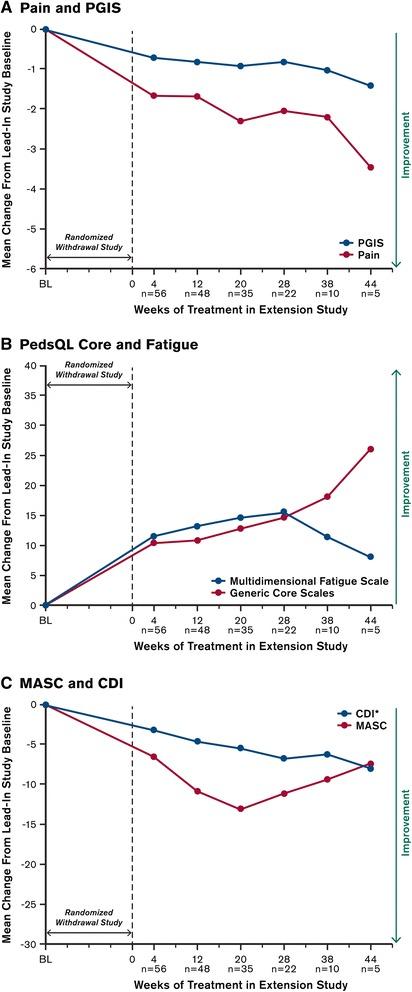
The milnacipran program was terminated early due to low enrollment. Because only 20 patients were randomized into the double-blind withdrawal period, statistical analyses were not conducted for the LTR endpoint. However, 116 patients entered the open-label period of the initial study and 57 participated in the open-label extension study. Their experience provides preliminary information about the use of milnacipran in JFM patients. During both open-label periods, there were mean improvements in pain severity, PGIC, PedsQL, and MASC scores. No unexpected safety issues were detected. The most commonly reported treatment-emergent AEs were nausea, headache, vomiting, and dizziness. Mean increases in heart rate and blood pressure were observed, and were consistent with the AE profile in adults with FM.
CONCLUSIONS
The open-label findings provide preliminary evidence that milnacipran may improve symptoms of JFM, with a safety and tolerability profile that is consistent with the experience in adult FM patients. Future trial designs for JFM should consider the relatively low recognition of this condition compared to adult FM and the difficulties with enrollment.
TRIAL REGISTRATION
NCT01328002 ; NCT01331109.
背景
青少年纤维肌痛(JFM)尚无获批药物,该疾病常被漏诊。米那普明是一种已获批用于治疗成人纤维肌痛(FM)的药物,在一项针对JFM的临床试验项目中对其效果进行了评估。
方法
年龄在13 - 17岁、符合尤努斯和马西JFM标准及/或1990年美国风湿病学会FM标准的患者,被纳入一项富集反应者、随机撤药试验。在接受开放标签的米那普明治疗(8周)后,疼痛改善≥50%的患者进行双盲随机分组(1:2),分为安慰剂组或继续使用米那普明治疗(8周)。所有患者,包括那些不符合双盲撤药随机化标准的患者,都被允许进入开放标签的米那普明扩展研究(最长52周)。主要终点是双盲期内治疗反应丧失(LTR)。其他结局指标包括患者总体严重程度印象(PGIS)、儿童生活质量量表(PedsQL:通用核心量表、多维疲劳量表)以及儿童多维焦虑量表(MASC)。安全性评估包括不良事件(AE)、生命体征、心电图和实验室检查。
结果
由于入组率低,米那普明项目提前终止。因为只有20名患者被随机分配到双盲撤药期,所以未对LTR终点进行统计分析。然而,116名患者进入了初始研究的开放标签期,57名患者参与了开放标签扩展研究。他们的经验提供了关于米那普明在JFM患者中使用的初步信息。在两个开放标签期,疼痛严重程度、PGIC、PedsQL和MASC评分均有平均改善。未发现意外的安全问题。最常报告的治疗中出现的AE是恶心、头痛、呕吐和头晕。观察到心率和血压平均升高,且与成人FM患者的AE情况一致。
结论
开放标签研究结果提供了初步证据,表明米那普明可能改善JFM症状,其安全性和耐受性与成人FM患者的经验一致。未来JFM的试验设计应考虑到与成人FM相比,该疾病的认知度相对较低以及入组困难的问题。
试验注册
NCT01328002;NCT01331109。

 Zotero 插件