
由石墨烯量子点增强的高响应性二硫化钼光电探测器。
Highly responsive MoS2 photodetectors enhanced by graphene quantum dots.
作者信息
Chen Caiyun, Qiao Hong, Lin Shenghuang, Man Luk Chi, Liu Yan, Xu Zaiquan, Song Jingchao, Xue Yunzhou, Li Delong, Yuan Jian, Yu Wenzhi, Pan Chunxu, Ping Lau Shu, Bao Qiaoliang
机构信息
Institute of Functional Nano and Soft Materials (FUNSOM), Jiangsu Key Laboratory for Carbon-Based Functional Materials and Devices, and Collaborative Innovation Center of Suzhou Nano Science and Technology, Soochow University, Suzhou 215123, P. R. China.
1] Institute of Functional Nano and Soft Materials (FUNSOM), Jiangsu Key Laboratory for Carbon-Based Functional Materials and Devices, and Collaborative Innovation Center of Suzhou Nano Science and Technology, Soochow University, Suzhou 215123, P. R. China [2] Department of Applied Physics, The Hong Kong Polytechnic University, Hung Hom, Hong Kong SAR, China.
出版信息
Sci Rep. 2015 Jul 3;5:11830. doi: 10.1038/srep11830.
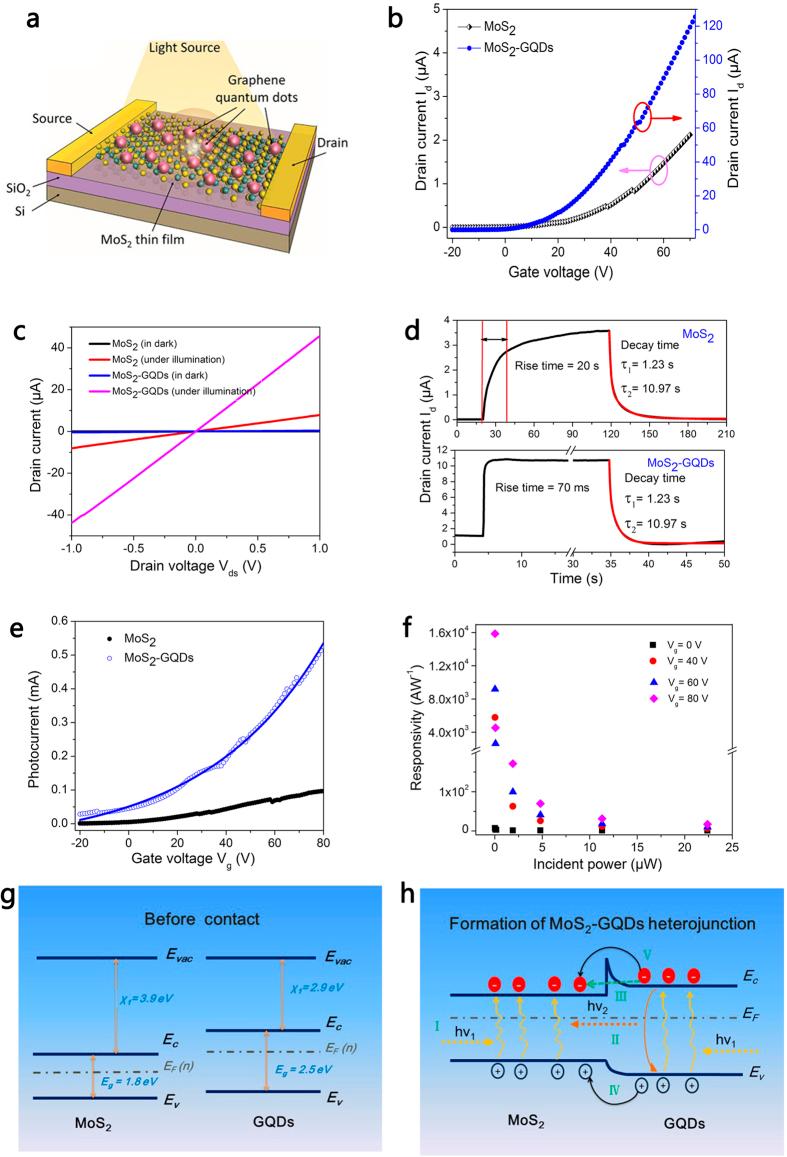
Molybdenum disulphide (MoS2), which is a typical semiconductor from the family of layered transition metal dichalcogenides (TMDs), is an attractive material for optoelectronic and photodetection applications because of its tunable bandgap and high quantum luminescence efficiency. Although a high photoresponsivity of 880-2000 AW(-1) and photogain up to 5000 have been demonstrated in MoS2-based photodetectors, the light absorption and gain mechanisms are two fundamental issues preventing these materials from further improvement. In addition, it is still debated whether monolayer or multilayer MoS2 could deliver better performance. Here, we demonstrate a photoresponsivity of approximately 10(4) AW(-1) and a photogain of approximately 10(7) electrons per photon in an n-n heterostructure photodetector that consists of a multilayer MoS2 thin film covered with a thin layer of graphene quantum dots (GQDs). The enhanced light-matter interaction results from effective charge transfer and the re-absorption of photons, leading to enhanced light absorption and the creation of electron-hole pairs. It is feasible to scale up the device and obtain a fast response, thus making it one step closer to practical applications.
二硫化钼(MoS₂)是层状过渡金属二硫属化物(TMDs)家族中的典型半导体,因其可调节的带隙和高量子发光效率,是一种用于光电子和光探测应用的有吸引力的材料。尽管基于二硫化钼的光电探测器已展示出880 - 2000 AW⁻¹的高光响应度和高达5000的光增益,但光吸收和增益机制是阻碍这些材料进一步改进的两个基本问题。此外,单层还是多层二硫化钼能实现更好的性能仍存在争议。在此,我们展示了一种由覆盖有一层石墨烯量子点(GQDs)的多层二硫化钼薄膜组成的n - n异质结构光电探测器,其光响应度约为10⁴ AW⁻¹,光增益约为每光子10⁷个电子。增强的光与物质相互作用源于有效的电荷转移和光子的再吸收,导致光吸收增强和电子 - 空穴对的产生。扩大器件规模并获得快速响应是可行的,从而使其向实际应用迈进了一步。

 Zotero 插件