
胆管癌中的基因异质性:靶向治疗的一大挑战。
Genetic heterogeneity in cholangiocarcinoma: a major challenge for targeted therapies.
作者信息
Brandi Giovanni, Farioli Andrea, Astolfi Annalisa, Biasco Guido, Tavolari Simona
机构信息
Department of Experimental, Diagnostic and Specialty Medicine, S. Orsola-Malpighi University Hospital, Bologna, Italy.
"G. Prodi" Interdepartmental Center for Cancer Research (C.I.R.C.), University of Bologna, Bologna, Italy.
出版信息
Oncotarget. 2015 Jun 20;6(17):14744-53. doi: 10.18632/oncotarget.4539.
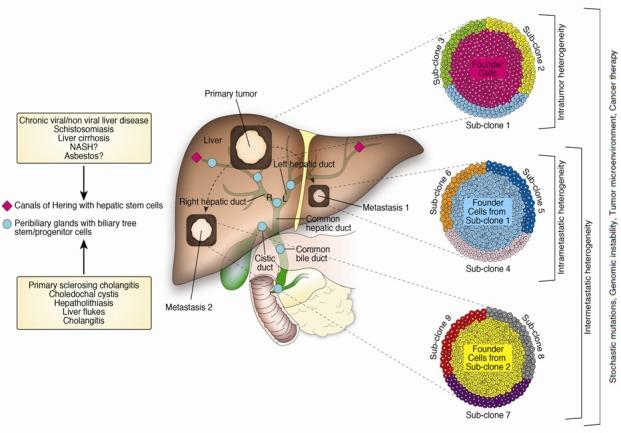
Cholangiocarcinoma (CC) encompasses a group of related but distinct malignancies whose lack of a stereotyped genetic signature makes challenging the identification of genomic landscape and the development of effective targeted therapies. Accumulated evidences strongly suggest that the remarkable genetic heterogeneity of CC may be the result of a complex interplay among different causative factors, some shared by most human cancers while others typical of this malignancy. Currently, considerable efforts are ongoing worldwide for the genetic characterization of CC, also using advanced technologies such as next-generation sequencing (NGS). Undoubtedly this technology could offer an unique opportunity to broaden our understanding on CC molecular pathogenesis. Despite this great potential, however, the high complexity in terms of factors potentially contributing to genetic variability in CC calls for a more cautionary application of NGS to this malignancy, in order to avoid possible biases and criticisms in the identification of candidate actionable targets. This approach is further justified by the urgent need to develop effective targeted therapies in this disease. A multidisciplinary approach integrating genomic, functional and clinical studies is therefore mandatory to translate the results obtained by NGS into effective targeted therapies for this orphan disease.
胆管癌(CC)包含一组相关但不同的恶性肿瘤,其缺乏固定的基因特征使得确定基因组格局以及开发有效的靶向治疗方法具有挑战性。越来越多的证据有力地表明,CC显著的基因异质性可能是不同致病因素之间复杂相互作用的结果,其中一些因素为大多数人类癌症所共有,而另一些则是这种恶性肿瘤所特有的。目前,全球正在投入大量精力对CC进行基因特征分析,也在使用下一代测序(NGS)等先进技术。毫无疑问,这项技术可以为拓宽我们对CC分子发病机制的理解提供独特的机会。然而,尽管有这种巨大潜力,但由于可能导致CC基因变异的因素非常复杂,因此在将NGS应用于这种恶性肿瘤时需要更加谨慎,以避免在确定候选可操作靶点时可能出现的偏差和批评。这种方法因迫切需要在这种疾病中开发有效的靶向治疗而更具合理性。因此,必须采用一种整合基因组、功能和临床研究的多学科方法,将通过NGS获得的结果转化为针对这种罕见病的有效靶向治疗方法。
 Zotero 插件