
健康肥胖与客观身体活动。
Healthy obesity and objective physical activity.
作者信息
Bell Joshua A, Hamer Mark, van Hees Vincent T, Singh-Manoux Archana, Kivimäki Mika, Sabia Séverine
机构信息
Department of Epidemiology & Public Health, University College London, London, United Kingdom;
Department of Epidemiology & Public Health, University College London, London, United Kingdom; National Centre for Sport & Exercise Medicine, Loughborough University, Leicestershire, United Kingdom;
出版信息
Am J Clin Nutr. 2015 Aug;102(2):268-75. doi: 10.3945/ajcn.115.110924. Epub 2015 Jul 8.
BACKGROUND
Disease risk is lower in metabolically healthy obese adults than in their unhealthy obese counterparts. Studies considering physical activity as a modifiable determinant of healthy obesity have relied on self-reported measures, which are prone to inaccuracies and do not capture all movements that contribute to health.
OBJECTIVE
We aimed to examine differences in total and moderate-to-vigorous physical activity between healthy and unhealthy obese groups by using both self-report and wrist-worn accelerometer assessments.
DESIGN
Cross-sectional analyses were based on 3457 adults aged 60-82 y (77% male) participating in the British Whitehall II cohort study in 2012-2013. Normal-weight, overweight, and obese adults were considered "healthy" if they had <2 of the following risk factors: low HDL cholesterol, hypertension, high blood glucose, high triacylglycerol, and insulin resistance. Differences across groups in total physical activity, based on questionnaire and wrist-worn triaxial accelerometer assessments (GENEActiv), were examined by using linear regression. The likelihood of meeting 2010 World Health Organization recommendations for moderate-to-vigorous activity (≥2.5 h/wk) was compared by using prevalence ratios.
RESULTS
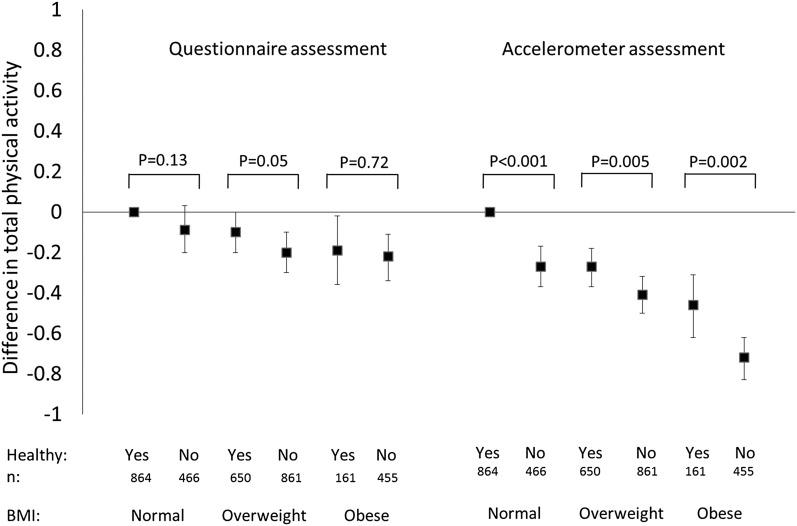
Of 3457 adults, 616 were obese [body mass index (in kg/m²) ≥30]; 161 (26%) of those were healthy obese. Obese adults were less physically active than were normal-weight adults, regardless of metabolic health status or method of physical activity assessment. Healthy obese adults had higher total physical activity than did unhealthy obese adults only when assessed by accelerometer (P = 0.002). Healthy obese adults were less likely to meet recommendations for moderate-to-vigorous physical activity than were healthy normal-weight adults based on accelerometer assessment (prevalence ratio: 0.59; 95% CI: 0.43, 0.79) but were not more likely to meet these recommendations than were unhealthy obese adults (prevalence ratio: 1.26; 95% CI: 0.89, 1.80).
CONCLUSIONS
Higher total physical activity in healthy than in unhealthy obese adults is evident only when measured objectively, which suggests that physical activity has a greater role in promoting health among obese populations than previously thought.
背景
代谢健康的肥胖成年人的疾病风险低于代谢不健康的肥胖成年人。将体力活动视为健康肥胖的一个可改变决定因素的研究依赖于自我报告的测量方法,这种方法容易出现不准确的情况,并且无法捕捉到所有对健康有贡献的运动。
目的
我们旨在通过自我报告和佩戴在手腕上的加速度计评估,研究健康肥胖组和不健康肥胖组在总体力活动以及中度至剧烈体力活动方面的差异。
设计
横断面分析基于2012 - 2013年参与英国白厅II队列研究的3457名60 - 82岁的成年人(77%为男性)。体重正常、超重和肥胖的成年人如果具有以下风险因素少于2项,则被视为“健康”:低高密度脂蛋白胆固醇、高血压、高血糖、高三酰甘油和胰岛素抵抗。基于问卷调查和佩戴在手腕上的三轴加速度计评估(GENEActiv),通过线性回归分析各群体在总体力活动方面的差异。使用患病率比来比较达到2010年世界卫生组织中度至剧烈活动建议(≥2.5小时/周)的可能性。
结果
在3457名成年人中,616人肥胖[体重指数(kg/m²)≥30];其中161人(26%)为健康肥胖。无论代谢健康状况或体力活动评估方法如何,肥胖成年人的体力活动都少于体重正常的成年人。仅通过加速度计评估时,健康肥胖成年人的总体力活动高于不健康肥胖成年人(P = 0.002)。基于加速度计评估,健康肥胖成年人达到中度至剧烈体力活动建议的可能性低于健康体重正常的成年人(患病率比:0.59;95%置信区间:0.43,0.79),但并不高于不健康肥胖成年人(患病率比:1.26;95%置信区间:0.89,1.80)。
结论
只有在客观测量时,健康肥胖成年人的总体力活动才明显高于不健康肥胖成年人,这表明体力活动在促进肥胖人群健康方面的作用比以前认为的更大。

 Zotero 插件