
奥拉帕尼抑制PARP或基因敲除通过调节CD4(+) T细胞功能来阻断小鼠的哮喘样表现。
PARP inhibition by olaparib or gene knockout blocks asthma-like manifestation in mice by modulating CD4(+) T cell function.
作者信息
Ghonim Mohamed A, Pyakurel Kusma, Ibba Salome V, Al-Khami Amir A, Wang Jeffrey, Rodriguez Paulo, Rady Hamada F, El-Bahrawy Ali H, Lammi Matthew R, Mansy Moselhy S, Al-Ghareeb Kamel, Ramsay Alistair, Ochoa Augusto, Naura Amarjit S, Boulares A Hamid
机构信息
The Stanley Scott Cancer Center, School of Medicine, Louisiana State University Health Sciences Center, 1700 Tulane Ave, New Orleans, LA, 70112, USA.
Microbiology and Immunology Department, Faculty of Pharmacy, Al-Azhar University, Cairo, Egypt.
出版信息
J Transl Med. 2015 Jul 14;13:225. doi: 10.1186/s12967-015-0583-0.
BACKGROUND
An important portion of asthmatics do not respond to current therapies. Thus, the need for new therapeutic drugs is urgent. We have demonstrated a critical role for PARP in experimental asthma. Olaparib, a PARP inhibitor, was recently introduced in clinical trials against cancer. The objective of the present study was to examine the efficacy of olaparib in blocking established allergic airway inflammation and hyperresponsiveness similar to those observed in human asthma in animal models of the disease.
METHODS
We used ovalbumin (OVA)-based mouse models of asthma and primary CD4(+) T cells. C57BL/6J WT or PARP-1(-/-) mice were subjected to OVA sensitization followed by a single or multiple challenges to aerosolized OVA or left unchallenged. WT mice were administered, i.p., 1 mg/kg, 5 or 10 mg/kg of olaparib or saline 30 min after each OVA challenge.
RESULTS
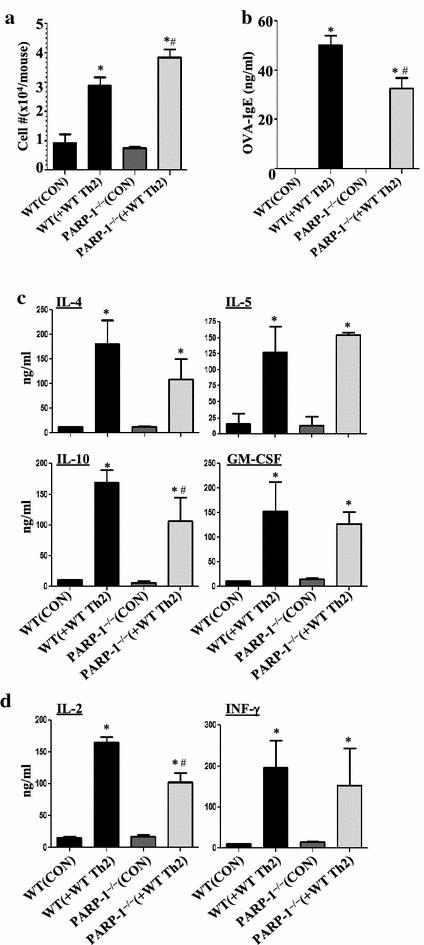
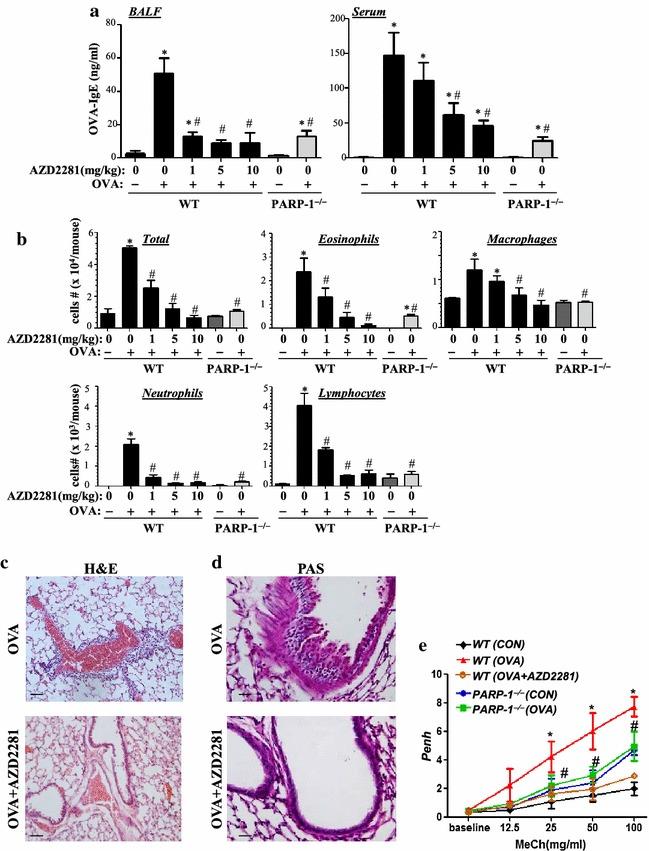
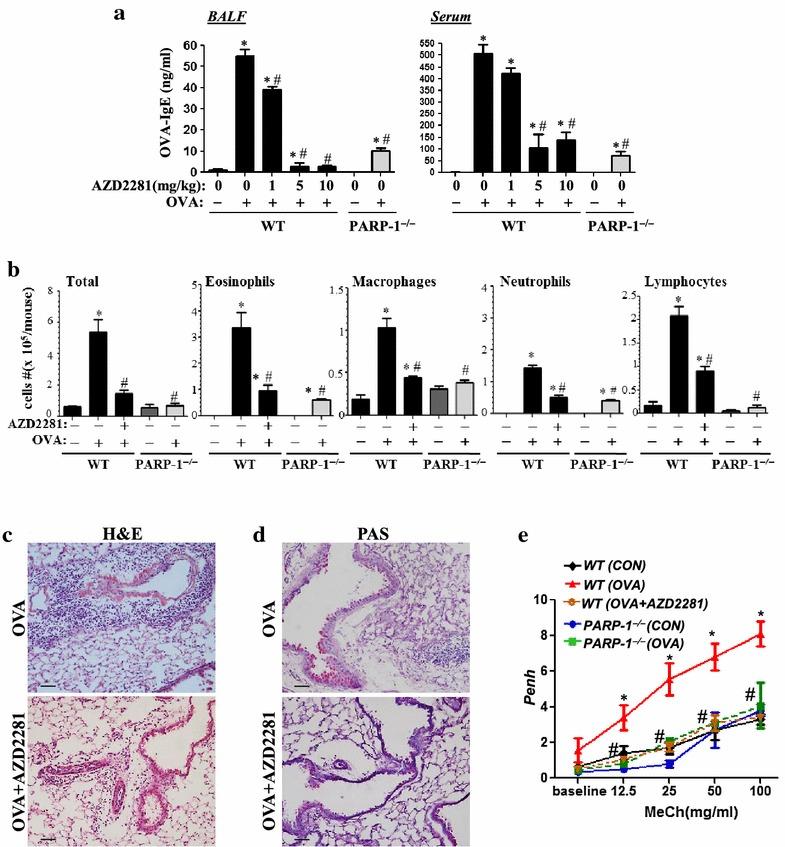
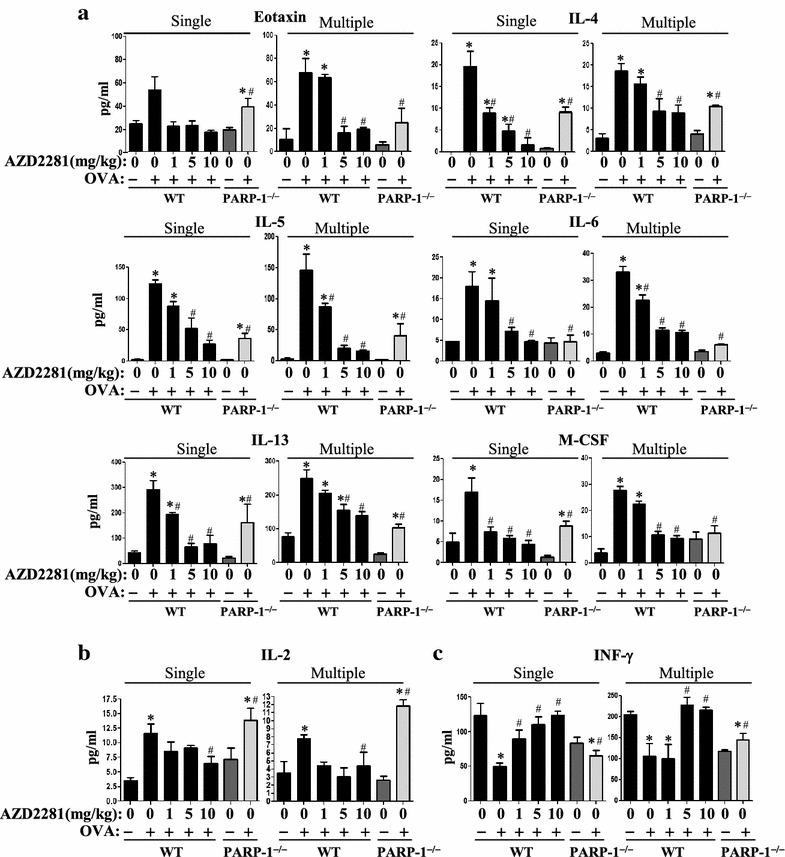
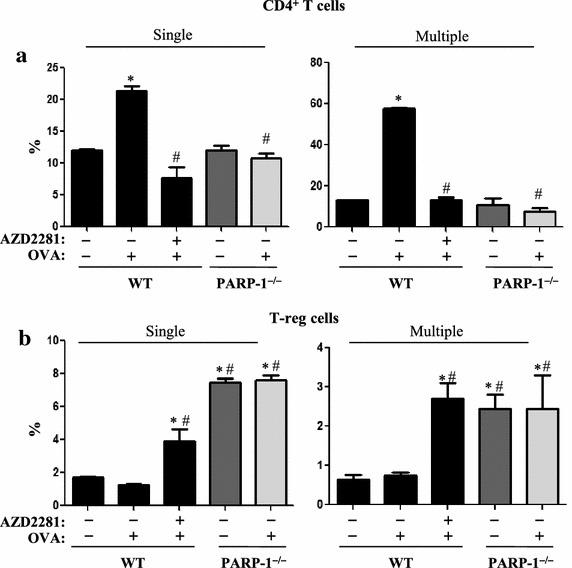
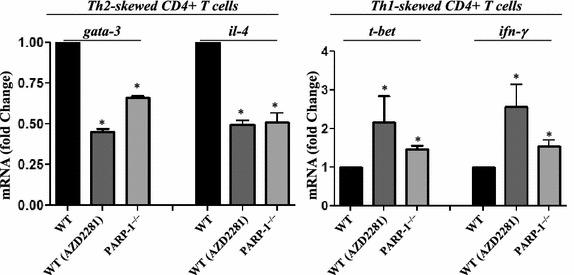
Administration of olaparib in mice 30 min post-challenge promoted a robust reduction in airway eosinophilia, mucus production and hyperresponsiveness even after repeated challenges with ovalbumin. The protective effects of olaparib were linked to a suppression of Th2 cytokines eotaxin, IL-4, IL-5, IL-6, IL-13, and M-CSF, and ovalbumin-specific IgE with an increase in the Th1 cytokine IFN-γ. These traits were associated with a decrease in splenic CD4(+) T cells and concomitant increase in T-regulatory cells. The aforementioned traits conferred by olaparib administration were consistent with those observed in OVA-challenged PARP-1(-/-) mice. Adoptive transfer of Th2-skewed OT-II-WT CD4(+) T cells reversed the Th2 cytokines IL-4, IL-5, and IL-10, the chemokine GM-CSF, the Th1 cytokines IL-2 and IFN-γ, and ovalbumin-specific IgE production in ovalbumin-challenged PARP-1(-/-)mice suggesting a role for PARP-1 in CD4(+) T but not B cells. In ex vivo studies, PARP inhibition by olaparib or PARP-1 gene knockout markedly reduced CD3/CD28-stimulated gata-3 and il4 expression in Th2-skewed CD4(+) T cells while causing a moderate elevation in t-bet and ifn-γ expression in Th1-skewed CD4(+) T cells.
CONCLUSIONS
Our findings show the potential of PARP inhibition as a viable therapeutic strategy and olaparib as a likely candidate to be tested in human asthma clinical trials.
背景
相当一部分哮喘患者对当前的治疗方法没有反应。因此,迫切需要新的治疗药物。我们已经证明了PARP在实验性哮喘中起关键作用。奥拉帕尼是一种PARP抑制剂,最近已被引入抗癌临床试验。本研究的目的是在该疾病的动物模型中检验奥拉帕尼阻断已建立的过敏性气道炎症和高反应性的疗效,这些炎症和高反应性类似于在人类哮喘中观察到的情况。
方法
我们使用基于卵清蛋白(OVA)的哮喘小鼠模型和原代CD4(+) T细胞。C57BL/6J野生型(WT)或PARP-1基因敲除(-/-)小鼠先进行OVA致敏,然后对雾化OVA进行单次或多次激发,或不进行激发。在每次OVA激发后30分钟,给WT小鼠腹腔注射1 mg/kg、5或10 mg/kg的奥拉帕尼或生理盐水。
结果
在激发后30分钟给小鼠施用奥拉帕尼,即使在反复用卵清蛋白激发后,也能显著降低气道嗜酸性粒细胞增多、黏液分泌和高反应性。奥拉帕尼的保护作用与抑制Th2细胞因子嗜酸性粒细胞趋化因子、IL-4、IL-5、IL-6、IL-13和M-CSF以及卵清蛋白特异性IgE有关,同时Th1细胞因子IFN-γ增加。这些特征与脾脏CD4(+) T细胞减少以及调节性T细胞相应增加有关。奥拉帕尼给药所赋予的上述特征与在OVA激发的PARP-1(-/-)小鼠中观察到的特征一致。过继转移Th2偏向的OT-II-WT CD4(+) T细胞可逆转OVA激发的PARP-1(-/-)小鼠中Th2细胞因子IL-4、IL-5和IL-10、趋化因子GM-CSF、Th1细胞因子IL-2和IFN-γ以及卵清蛋白特异性IgE的产生,这表明PARP-1在CD4(+) T细胞而非B细胞中起作用。在体外研究中,奥拉帕尼抑制PARP或PARP-1基因敲除显著降低了Th2偏向的CD4(+) T细胞中CD3/CD28刺激的gata-3和il4表达,同时使Th1偏向的CD4(+) T细胞中t-bet和ifn-γ表达适度升高。
结论
我们的研究结果表明PARP抑制作为一种可行的治疗策略具有潜力,奥拉帕尼作为一种可能的候选药物有待在人类哮喘临床试验中进行测试。
 Zotero 插件