
每搏量变异度指导液体治疗:是否适用于高危手术患者?一项已终止的随机对照试验。
Stroke volume variation to guide fluid therapy: is it suitable for high-risk surgical patients? A terminated randomized controlled trial.
机构信息
Department of Clinical Medicine, University of Bergen, 5020 Bergen, Norway ; Department of Anaesthesia and Intensive Care, Haukeland University Hospital, 5021 Bergen, Norway.
Department of Anesthesiology and Intensive Care, Oulu University Hospital, PL 21, 90029 Oulu, Finland.
出版信息
Perioper Med (Lond). 2015 Jul 22;4:6. doi: 10.1186/s13741-015-0016-x. eCollection 2015.
BACKGROUND
Perioperative goal-directed fluid therapy (GDFT) may improve outcome after high-risk surgery. Minimal invasive measurement of stroke volume variation (SVV) has been recommended to guide fluid therapy. We intended to study how perioperative GDFT with arterial-based continuous SVV monitoring influences postoperative complications in a high-risk surgical population.
METHODS
From February 1st 2012, all ASA 3 and 4 patients undergoing abdominal surgery in two university hospitals were assessed for randomization into a control group or GDFT group. An arterial-line cardiac output monitor was used to measure SVV, and fluid was given after an algorithm in the intervention group. Restrictions of the method excluded patients undergoing laparoscopic surgery, patients with atrial fibrillation and patients with severe mitral/aortal stenosis. To detect a decrease in number of complication from 40 % in the control group to 20 % in the GDFT group, n = 164 patients were needed (power 80 %, alpha 0.05, two-sided test). To include the needed amount of patients, the study was estimated to last for 2 years.
RESULTS
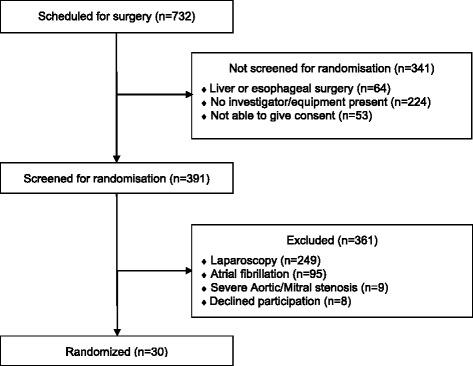
After 1 year, 30 patients were included and the study was halted due to slow inclusion rate. Of 732 high-risk patients scheduled for abdominal surgery, 391 were screened for randomization. Of those, n = 249 (64 %) were excluded because a laparoscopic technique was preferred and n = 95 (24 %) due to atrial fibrillation.
CONCLUSIONS
Our study was stopped due to a slow inclusion rate. Methodological restrictions of the arterial-line cardiac output monitor excluded the majority of patients. This leaves the question if this method is appropriate to guide fluid therapy in high-risk surgical patients.
TRIAL REGISTRATION
ClinicalTrials.gov: NCT01473446.
背景
围手术期目标导向液体治疗(GDFT)可能改善高危手术患者的预后。微创测量每搏量变异(SVV)已被推荐用于指导液体治疗。我们旨在研究基于动脉的连续 SVV 监测的围手术期 GDFT 如何影响高危手术人群的术后并发症。
方法
从 2012 年 2 月 1 日起,对在两所大学医院接受腹部手术的所有 ASA 3 和 4 级患者进行随机分组,进入对照组或 GDFT 组。使用动脉线心输出量监测器测量 SVV,并在干预组的算法后给予液体。该方法的限制排除了接受腹腔镜手术、心房颤动和严重二尖瓣/主动脉瓣狭窄的患者。为了检测并发症数量从对照组的 40%下降到 GDFT 组的 20%,需要 n=164 名患者(功率 80%,α=0.05,双侧检验)。为了包括所需数量的患者,该研究估计持续 2 年。
结果
1 年后,纳入 30 名患者,由于纳入率较慢,研究停止。在计划接受腹部手术的 732 名高危患者中,有 391 名接受了随机分组的筛查。其中,n=249(64%)因首选腹腔镜技术而被排除,n=95(24%)因心房颤动而被排除。
结论
由于纳入率较慢,我们的研究停止了。动脉线心输出量监测器的方法学限制排除了大多数患者。这就提出了一个问题,即这种方法是否适合指导高危手术患者的液体治疗。
试验注册
ClinicalTrials.gov:NCT01473446。
 Zotero 插件