
利妥昔单抗治疗系统性红斑狼疮和干燥综合征难治性血小板减少症的疗效与安全性:一项21例回顾性研究
Efficacy and Safety of Rituximab in Systemic Lupus Erythematosus and Sjögren Syndrome Patients With Refractory Thrombocytopenia: A Retrospective Study of 21 Cases.
作者信息
Jiang Bin, Li Ting, Guo Li, Shen Hao, Ye Shuang, Chen Sheng
机构信息
From the *Shanghai Institute of Immunology and †Department of Rheumatology, Renji Hospital, Shanghai Jiao Tong University School of Medicine, Shanghai, China; ‡Department of Microbiology, Perelman School of Medicine, University of Pennsylvania, Philadelphia, PA.
出版信息
J Clin Rheumatol. 2015 Aug;21(5):244-50. doi: 10.1097/RHU.0000000000000273.
OBJECTIVE
Recent studies suggested a potential of rituximab (RTX) in treating autoimmune thrombocytopenia (AITP) secondary to autoimmune diseases. In this study, we retrospectively evaluated the efficacy and safety of RTX therapy in patients with refractory AITP secondary to systemic lupus erythematosus (SLE) and Sjögren syndrome (SS).
METHODS
Twenty-one SLE and/or SS patients with treatment-resistant AITP were treated once or repeatedly with RTX at the Rheumatology Clinic Renji Hospital, during the period March 2012 to June 2014. Clinical and laboratory variables recorded at every follow-up visit were analyzed.
RESULTS
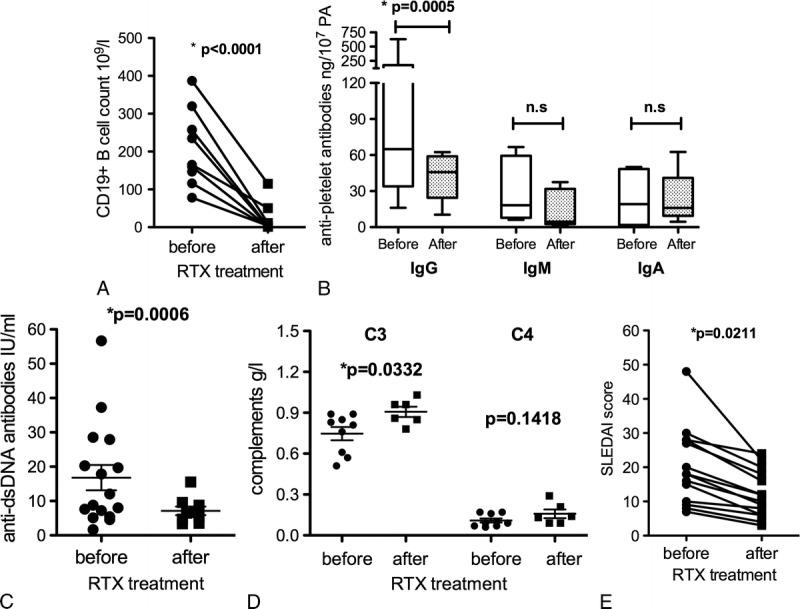
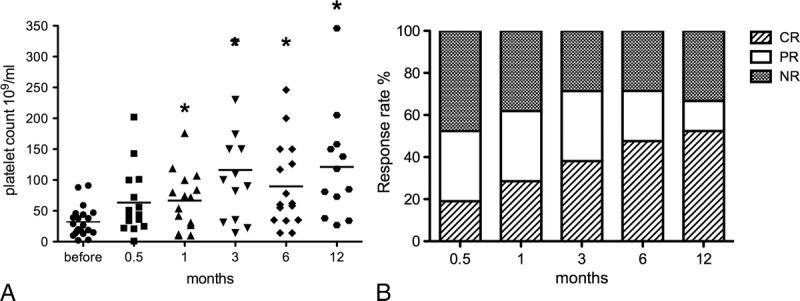
The median age of all patients was 37.05 ± 3.15 years (range, 13-67 years; 20 female and 1 male). The median AITP duration before RTX treatment was 5.46 years. Previous treatments of 21 patients included immunosuppressive agents such as corticosteroids (n = 19), cyclosporine (n = 9), mycophenolate mofetil (n = 2), methotrexate (n = 3), cyclophosphamide (n = 2), vincristine (n = 3), and hydroxychloroquine (n = 15), and 7 patients received concomitantly intravenous immunoglobulin therapy. Two patients had undergone splenectomy without improvement. Seventeen patients (80.95%) were treated repeatedly with RTX during the follow-up period. The overall response rate to RTX treatment (including complete response, 52.38%; partial response, 28.57%) was 80.95%. A significant increase (P < 0.05) of platelet counts was seen after 1 month (median, 32.24 × 10/mL vs 66.53 × 10/mL). Relapses occurred mostly during the first 9 months, and maintaining duration of response was 10.27 months (range, 2-17 months) on average after the first RTX infusion. Antiplatelet antibodies, especially IgG isotype, decreased significantly (P < 0.05) after RTX treatment. No adverse effects were observed among 15 patients (71.4%); however, 2 cases died of severe pneumonia, and another developed lymphoma.
CONCLUSIONS
Rituximab is an additional potent therapeutic treatment option for SLE and SS patients with AITP refractory to conventional immunosuppressive treatments. For most patients, RTX was safe and well tolerated.
目的
近期研究提示利妥昔单抗(RTX)在治疗继发于自身免疫性疾病的自身免疫性血小板减少症(AITP)方面具有潜力。在本研究中,我们回顾性评估了RTX治疗系统性红斑狼疮(SLE)和干燥综合征(SS)继发的难治性AITP患者的疗效和安全性。
方法
2012年3月至2014年6月期间,21例SLE和/或SS合并治疗抵抗性AITP患者在上海交通大学医学院附属仁济医院风湿科门诊接受了一次或多次RTX治疗。分析每次随访记录的临床和实验室变量。
结果
所有患者的中位年龄为37.05±3.15岁(范围13 - 67岁;20例女性,1例男性)。RTX治疗前AITP的中位病程为5.46年。21例患者之前的治疗包括免疫抑制剂,如皮质类固醇(n = 19)、环孢素(n = 9)、霉酚酸酯(n = 2)、甲氨蝶呤(n = 3)、环磷酰胺(n = 2)、长春新碱(n = 3)和羟氯喹(n = 15),7例患者同时接受了静脉注射免疫球蛋白治疗。2例患者接受脾切除术后病情未改善。17例患者(80.95%)在随访期间接受了多次RTX治疗。RTX治疗的总体缓解率(包括完全缓解,52.38%;部分缓解,28.57%)为80.95%。1个月后血小板计数显著增加(P < 0.05)(中位数,32.24×10⁹/L对66.53×10⁹/L)。复发大多发生在最初9个月内,首次输注RTX后平均缓解持续时间为10.27个月(范围2 - 17个月)。RTX治疗后抗血小板抗体,尤其是IgG亚型,显著降低(P < 0.05)。15例患者(71.4%)未观察到不良反应;然而,2例患者死于重症肺炎,另1例发生淋巴瘤。
结论
对于常规免疫抑制治疗难治的SLE和SS合并AITP患者,利妥昔单抗是一种有效的额外治疗选择。对大多数患者而言,RTX安全且耐受性良好。
 Zotero 插件