
肌肉浸润性尿路上皮癌新辅助铂类化疗反应的蛋白质生物标志物的鉴定与验证
Identification and Validation of Protein Biomarkers of Response to Neoadjuvant Platinum Chemotherapy in Muscle Invasive Urothelial Carcinoma.
作者信息
Baras Alexander S, Gandhi Nilay, Munari Enrico, Faraj Sheila, Shultz Luciana, Marchionni Luigi, Schoenberg Mark, Hahn Noah, Hoque Mohammad Obaidul, Berman David, Bivalacqua Trinity J, Netto George
机构信息
Department of Pathology, Johns Hopkins School of Medicine, Baltimore, Maryland, United States of America; Department of Urology, Johns Hopkins School of Medicine, Baltimore, Maryland, United States of America.
Department of Urology, Johns Hopkins School of Medicine, Baltimore, Maryland, United States of America.
出版信息
PLoS One. 2015 Jul 31;10(7):e0131245. doi: 10.1371/journal.pone.0131245. eCollection 2015.
BACKGROUND
The 5-year cancer specific survival (CSS) for patients with muscle invasive urothelial carcinoma of the bladder (MIBC) treated with cystectomy alone is approximately 50%. Platinum based neoadjuvant chemotherapy (NAC) plus cystectomy results in a marginal 5-10% increase in 5-year CSS in MIBC. Interestingly, responders to NAC (<ypT2) have a 5-year CSS of 90% which is in stark contrast to the 30-40% CSS for those whose MIBC is resistance to NAC. While the implementation of NAC for MIBC is increasing, it is still not widely utilized due to concerns related to delay of cystectomy, potential side-effects, and inability to predict effectiveness. Recently suggested molecular signatures of chemoresponsiveness, which could prove useful in this setting, would be of considerable utility but are yet to be translated into clinical practice.
METHODS
mRNA expression data from a prior report on a NAC-treated MIBC cohort were re-analyzed in conjunction with the antibody database of the Human Protein Atlas (HPA) to identify candidate protein based biomarkers detectable by immunohistochemistry (IHC). These candidate biomarkers were subsequently tested in tissue microarrays derived from an independent cohort of NAC naive MIBC biopsy specimens from whom the patients were treated with neoadjuvant gemcitabine cisplatin NAC and subsequent cystectomy. The clinical parameters that have been previously associated with NAC response were also examined in our cohort.
RESULTS
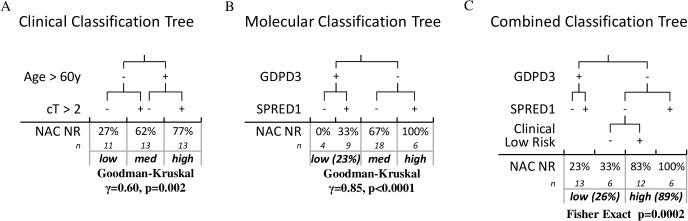
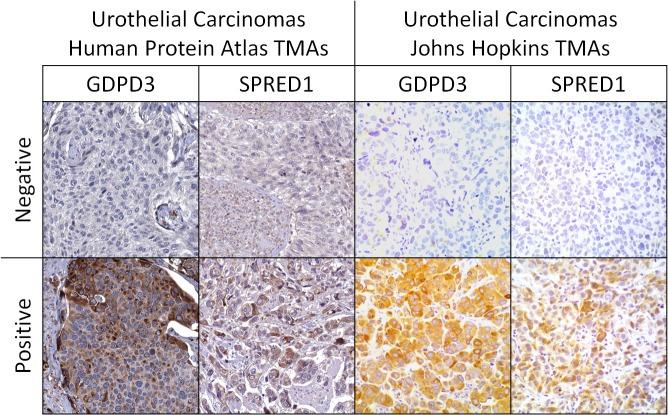
Our analyses of the available mRNA gene expression data in a discovery cohort (n = 33) and the HPA resulted in 8 candidate protein biomarkers. The combination of GDPD3 and SPRED1 resulted in a multivariate classification tree that was significantly associated with NAC response status (Goodman-Kruskal γ = 0.85 p<0.0001) in our independent NAC treated MIBC cohort. This model was independent of the clinical factors of age and clinical tumor stage, which have been previously associated with NAC response by our group. The combination of both these protein biomarkers detected by IHC in biopsy specimens along with the relevant clinical parameters resulted in a prediction model able to significantly stratify the likelihood of NAC resistance in our cohort (n = 37) into two well separated halves: low-26% n = 19 and high-89% n = 18, Fisher's exact p = 0.0002).
CONCLUSION
We illustrate the feasibility of translating a gene expression signature of NAC response from a discovery cohort into immunohistochemical markers readily applicable to MIBC biopsy specimens in our independent cohort. The results from this study are being characterized in additional validation cohorts. Additionally, we anticipate that emerging somatic mutations in MIBC will also be important for NAC response prediction. The relationship of the findings in this study to the current understanding of variant histologic subtypes of MIBC along with the evolving molecular subtypes of MIBC as it relates to NAC response remains to be fully characterized.
背景
单纯膀胱切除术治疗的肌层浸润性膀胱尿路上皮癌(MIBC)患者的5年癌症特异性生存率(CSS)约为50%。铂类新辅助化疗(NAC)联合膀胱切除术使MIBC患者的5年CSS略有提高,幅度为5%-10%。有趣的是,NAC反应者(<ypT2)的5年CSS为90%,这与MIBC对NAC耐药者30%-40%的CSS形成鲜明对比。虽然MIBC的NAC应用正在增加,但由于担心膀胱切除术延迟、潜在副作用以及无法预测疗效,其仍未得到广泛应用。最近提出的化学敏感性分子特征在此情况下可能有用,将具有相当大的实用价值,但尚未转化为临床实践。
方法
结合人类蛋白质图谱(HPA)的抗体数据库,对先前一份关于NAC治疗的MIBC队列的mRNA表达数据进行重新分析,以鉴定可通过免疫组织化学(IHC)检测的基于蛋白质的候选生物标志物。随后,在来自独立队列的NAC初治MIBC活检标本的组织微阵列中测试这些候选生物标志物,该队列患者接受新辅助吉西他滨顺铂NAC及随后的膀胱切除术。我们的队列中还检查了先前与NAC反应相关的临床参数。
结果
我们对发现队列(n = 33)中可用的mRNA基因表达数据和HPA进行分析,得到了8个候选蛋白质生物标志物。在我们独立的NAC治疗的MIBC队列中,GDPD3和SPRED1的组合产生了一个多变量分类树,与NAC反应状态显著相关(古德曼-克鲁斯卡尔γ = 0.85,p<0.0001)。该模型独立于年龄和临床肿瘤分期等临床因素,我们的研究小组先前已将这些因素与NAC反应相关联。通过IHC在活检标本中检测到的这两种蛋白质生物标志物与相关临床参数的组合,产生了一个预测模型,该模型能够在我们的队列(n = 37)中将NAC耐药的可能性显著分层为两个明显分开的部分:低耐药组-26%(n = 19)和高耐药组-89%(n = 18),费舍尔精确检验p = 0.0002)。
结论
我们证明了将发现队列中NAC反应的基因表达特征转化为易于应用于我们独立队列中MIBC活检标本的免疫组织化学标志物的可行性。本研究结果正在其他验证队列中进行表征。此外,我们预计MIBC中出现的体细胞突变对NAC反应预测也将很重要。本研究结果与目前对MIBC不同组织学亚型的理解以及与NAC反应相关的MIBC不断演变的分子亚型之间的关系仍有待充分表征。

 Zotero 插件