
通过16S核糖体核糖核酸的实时聚合酶链反应扩增揭示炎症性肠病患者结肠黏膜微生物群的改变
Alterations of mucosal microbiota in the colon of patients with inflammatory bowel disease revealed by real time polymerase chain reaction amplification of 16S ribosomal ribonucleic acid.
作者信息
Kabeerdoss Jayakanthan, Jayakanthan Prabavathi, Pugazhendhi Srinivasan, Ramakrishna Balakrishnan S
机构信息
Wellcome Trust Research Laboratory, Christian Medical College, Vellore, India.
出版信息
Indian J Med Res. 2015 Jul;142(1):23-32. doi: 10.4103/0971-5916.162091.
BACKGROUND & OBJECTIVES: Alterations in microbial communities closely associated with the intestinal mucosa are likely to be important in the pathogenesis of inflammatory bowel disease (IBD). We examined the abundance of specific microbial populations in colonic mucosa of patients with ulcerative colitis (UC), Crohn's disease (CD) and controls using reverse transcription quantitative polymerase chain reaction (RT-qPCR) amplification of 16S ribosomal ribonucleic acid (16S rRNA).
METHODS
RNA was extracted from colonic mucosal biopsies of patients with UC (32), CD (28) and patients undergoing screening colonoscopy (controls), and subjected to RT-qPCR using primers targeted at 16S rRNA sequences specific to selected microbial populations.
RESULTS
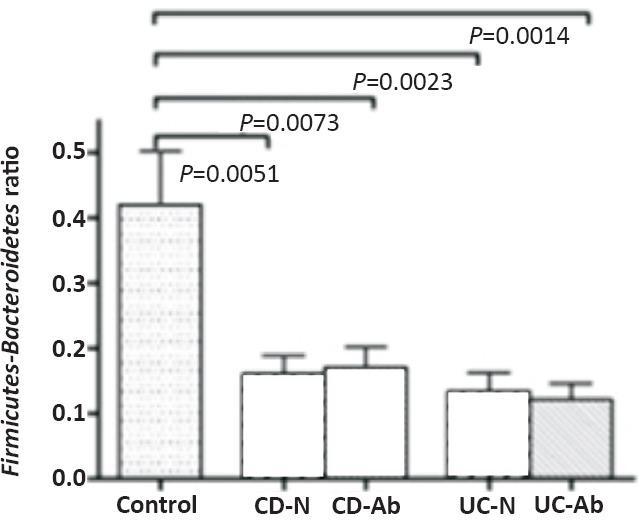
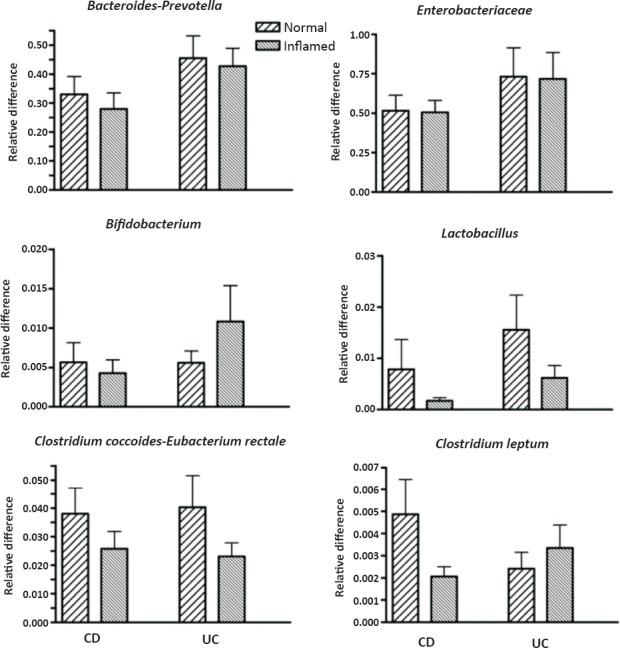
Bacteroides-Prevotella-Porphyromonas group and Enterobacteriaceae were the most abundant mucosal microbiota. Bacteroides and Lactobacillus abundance was greater in UC patients compared with controls or CD. Escherichia coli abundance was increased in UC compared with controls. Clostridium coccoides group and C. leptum group abundances were reduced in CD compared with controls. Microbial population did not differ between diseased and adjacent normal mucosa, or between untreated patients and those already on medical treatment. The Firmicutes to Bacteroidetes ratio was significantly decreased in both UC and CD compared with controls, indicative of a dysbiosis in both conditions.
INTERPRETATION & CONCLUSIONS: Dysbiosis appears to be a primary feature in both CD and UC. Microbiome-directed interventions are likely to be appropriate in therapy of IBD.
背景与目的
与肠道黏膜密切相关的微生物群落改变可能在炎症性肠病(IBD)的发病机制中起重要作用。我们使用逆转录定量聚合酶链反应(RT-qPCR)扩增16S核糖体核糖核酸(16S rRNA),检测了溃疡性结肠炎(UC)、克罗恩病(CD)患者及对照者结肠黏膜中特定微生物种群的丰度。
方法
从UC患者(32例)、CD患者(28例)及接受结肠镜筛查的患者(对照者)的结肠黏膜活检组织中提取RNA,并使用针对选定微生物种群特异性16S rRNA序列的引物进行RT-qPCR。
结果
拟杆菌-普雷沃菌-卟啉单胞菌属组和肠杆菌科是最丰富的黏膜微生物群。与对照者或CD患者相比,UC患者中拟杆菌和乳酸杆菌的丰度更高。与对照者相比,UC患者中大肠杆菌的丰度增加。与对照者相比,CD患者中球形梭菌属组和纤细梭菌属组的丰度降低。患病黏膜与相邻正常黏膜之间,以及未治疗患者与已接受治疗患者之间的微生物种群没有差异。与对照者相比,UC和CD患者的厚壁菌门与拟杆菌门的比例均显著降低,表明两种疾病状态下均存在生态失调。
解读与结论
生态失调似乎是CD和UC的主要特征。针对微生物群的干预措施可能适用于IBD的治疗。


 Zotero 插件