
MTR和MTRR基因多态性与神经管缺陷风险关联的分析。
Analysis of MTR and MTRR Polymorphisms for Neural Tube Defects Risk Association.
作者信息
Wang Yongxin, Liu Yuan, Ji Wenyu, Qin Hu, Wu Hao, Xu Danshu, Tukebai Turtuohut, Wang Zengliang
机构信息
From the Neurosurgical Department, the 1st Affiliated Hospital of Xinjiang Medical University, Urumqi, China.
出版信息
Medicine (Baltimore). 2015 Sep;94(35):e1367. doi: 10.1097/MD.0000000000001367.
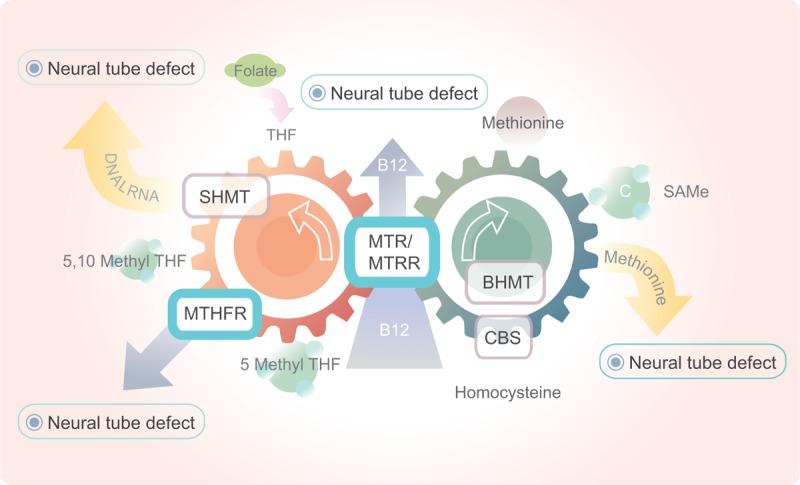
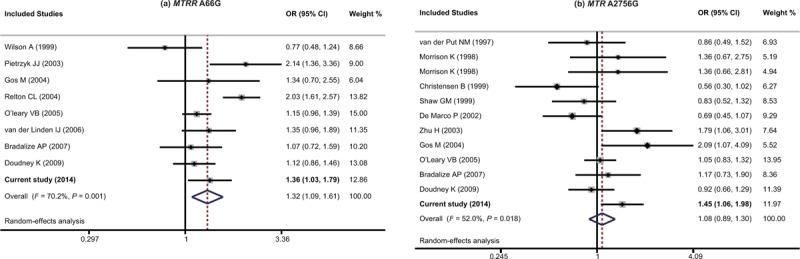
Neural tube defects (NTDs) are the most common congenital defects of the central nervous system among neonates and the folate status during pregnancy was considered as the most important etiopathogenesis of NTDs. Besides, methionine synthase (MTR) gene and methionine synthase reductase (MTRR) gene were folate metabolism involved genes and had been investigated in several previous studies with inconsistent results. Hence, we aimed to explore the association of 4 selected single-nucleotide polymorphisms (SNPs) on MTRR/MTR gene and the susceptibility of NTDs in a Chinese population.Seven SNPs were selected from HapMap databases with Haploview 4.2 software. A polymerase chain reaction-restriction fragment length polymorphism (PCR-RFLP) was performed to genotype the polymorphisms from blood samples of 165 NTDs patients and 280 healthy controls. The correlation between these SNPs and NTDs risk was tested by Student t test and Chi-square test by STATA 11.0 software. Furthermore, we performed a meta-analysis of relevant studies to investigate the association between the SNPs MTRR 66A>G and MTR 2756A>G and the susceptibility of NTDs.An increased risk of NTDs was verified to be significantly associated with MTRR 66A>G (G allele vs. A allele: OR = 1.36 (1.03-1.80), P = 0.028; GG + AG vs. AA: OR = 1.60 (1.05-2.43), P = 0.027) and MTR 2756A>G (G allele vs. A allele: OR = 1.45 (1.06-1.98), P = 0.021; GG + AG vs. AA: OR = 1.51 (1.02-2.23), P = 0.038) in our study. However, the other SNPs in our analysis showed no significant association with NTDs risk (all P > 0.05). Furthermore, the result of the meta-analysis supported the association between MTRR 66A>G and NTDs risk (G allele vs. A allele: OR = 1.32, 95% CI = 1.09-1.61, GG + GA vs. AA: OR = 1.49, 95% CI = 1.06-2.09, GG vs. AA: OR = 1.61, 95% CI = 1.04-2.49).Our study confirmed that the MTRR 66A>G and MTR 2756A>G were significantly associated with the increased NTDs risk in a Chinese population. The further meta-analysis enhance that MTRR 66A>G was connected with the susceptibility of NTDs widely. Further investigations based on more detailed stratification were recommended.
神经管缺陷(NTDs)是新生儿中最常见的中枢神经系统先天性缺陷,孕期叶酸状态被认为是NTDs最重要的发病机制。此外,甲硫氨酸合成酶(MTR)基因和甲硫氨酸合成酶还原酶(MTRR)基因是参与叶酸代谢的基因,之前已有多项研究对其进行了调查,但结果并不一致。因此,我们旨在探讨中国人群中MTRR/MTR基因上4个选定的单核苷酸多态性(SNP)与NTDs易感性之间的关联。
使用Haploview 4.2软件从HapMap数据库中选择了7个SNP。采用聚合酶链反应-限制性片段长度多态性(PCR-RFLP)技术对165例NTDs患者和280例健康对照的血样进行基因分型。通过STATA 11.0软件的Student t检验和卡方检验来检测这些SNP与NTDs风险之间的相关性。此外,我们对相关研究进行了荟萃分析,以研究SNP MTRR 66A>G和MTR 2756A>G与NTDs易感性之间的关联。
在我们的研究中,证实NTDs风险增加与MTRR 66A>G(G等位基因与A等位基因:OR = 1.36(1.03 - 1.80),P = 0.028;GG + AG与AA:OR = 1.60(1.05 - 2.43),P = 0.027)和MTR 2756A>G(G等位基因与A等位基因:OR = 1.45(1.06 - 1.98),P = 0.021;GG + AG与AA:OR = 1.51(1.02 - 2.23),P = 0.038)显著相关。然而,我们分析中的其他SNP与NTDs风险无显著关联(所有P > 0.05)。此外,荟萃分析结果支持MTRR 66A>G与NTDs风险之间的关联(G等位基因与A等位基因:OR = 1.32,95% CI = 1.09 - 1.61,GG + GA与AA:OR = 1.49,95% CI = 1.06 - 2.09,GG与AA:OR = 1.61,95% CI = 1.04 - 2.49)。
我们的研究证实,MTRR 66A>G和MTR 2756A>G与中国人群中NTDs风险增加显著相关。进一步的荟萃分析强化了MTRR 66A>G与NTDs易感性广泛相关的结论。建议基于更详细分层进行进一步研究。

 Zotero 插件