
非肽能C纤维细胞毒性消融后脊髓板层I背角神经元的有限变化。
Limited changes in spinal lamina I dorsal horn neurons following the cytotoxic ablation of non-peptidergic C-fibers.
作者信息
Saeed Abeer W, Pawlowski Sophie A, Ribeiro-da-Silva Alfredo
机构信息
Department of Pharmacology and Therapeutics, McGill University, 3655 Promenade Sir-William-Osler, Montreal, QC, H3G 1Y6, Canada.
Alan Edwards Centre for Research on Pain, McGill University, Montreal, QC, H3A 0G1, Canada.
出版信息
Mol Pain. 2015 Sep 9;11:54. doi: 10.1186/s12990-015-0060-z.
BACKGROUND
Non-peptidergic nociceptive neurons are a sub-population of small diameter primary sensory neurons that comprise approximately 50 % of the C fiber population. Together with the peptidergic sub-population, they transmit nociceptive information from the periphery to the superficial dorsal horn of the spinal cord. Despite the numerous studies investigating the role of the non-peptidergic primary afferents, their role in normal nociception and in pain remains poorly understood. Our lab has previously demonstrated that, in rat models of neuropathic and inflammatory pain, there is a de novo expression of substance P receptors (NK-1r) by lamina I pyramidal projection neurons, a neuronal population that normally does not express these receptors.
RESULTS
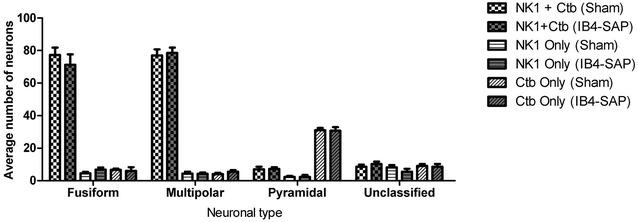
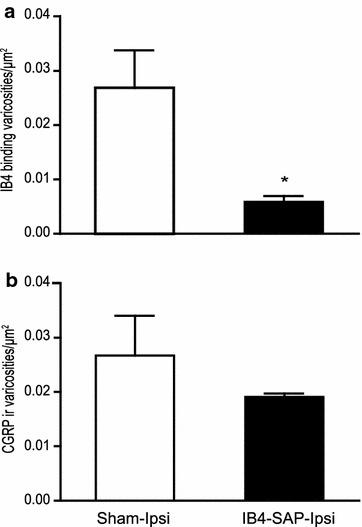
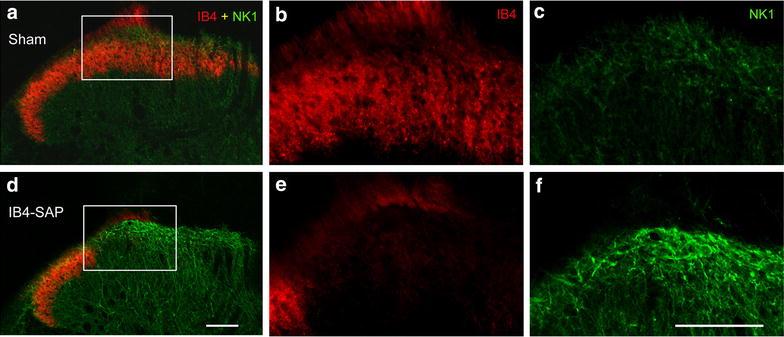
In this study, we used a ribosomal toxin, saporin, conjugated to the lectin IB4 to selectively ablate the non-peptidergic nociceptive C fibers, to investigate if the loss of these fibers was enough to induce a change in NK-1r expression by lamina I projection neurons. IB4-saporin treatment led to the permanent ablation of the IB4-positive afferents but also to a small non-significant reduction in CGRP-positive afferents. An overall increase in immunoreactivity for the NK-1r was observed in lamina I projection neurons, however, the lack of non-peptidergic afferents did not increase the number of lamina I pyramidal projection neurons immunoreactive for the receptor.
CONCLUSIONS
Our results demonstrate that the deletion of the non-peptidergic afferents, at the L4-L5 spinal levels, is not sufficient to trigger the de novo expression of NK-1r by projection pyramidal neurons but increases the expression of NK-1r in fusiform and multipolar projection neurons. Furthermore, our data suggest that a neuropathic component is essential to trigger the expression of NK-1r by pyramidal neurons.
背景
非肽能伤害性神经元是小直径初级感觉神经元的一个亚群,约占C纤维群体的50%。它们与肽能亚群一起,将伤害性信息从外周传递到脊髓浅背角。尽管有大量研究探讨非肽能初级传入纤维的作用,但它们在正常伤害感受和疼痛中的作用仍知之甚少。我们实验室先前已证明,在神经性和炎性疼痛的大鼠模型中,I层锥体投射神经元会从头表达P物质受体(NK-1r),而该神经元群体通常不表达这些受体。
结果
在本研究中,我们使用与凝集素IB4偶联的核糖体毒素皂草素,选择性地消融非肽能伤害性C纤维,以研究这些纤维的缺失是否足以诱导I层投射神经元中NK-1r表达的变化。IB4-皂草素处理导致IB4阳性传入纤维的永久性消融,但也导致CGRP阳性传入纤维略有减少,差异无统计学意义。在I层投射神经元中观察到NK-1r免疫反应性总体增加,然而,缺乏非肽能传入纤维并未增加对该受体免疫反应的I层锥体投射神经元的数量。
结论
我们的结果表明,在L4-L5脊髓水平缺失非肽能传入纤维不足以触发投射锥体神经元从头表达NK-1r,但会增加梭形和多极投射神经元中NK-1r的表达。此外,我们的数据表明,神经病变成分对于触发锥体神经元表达NK-1r至关重要。


 Zotero 插件