
心脏再同步治疗对心脏重塑和收缩功能的影响:来自心脏再同步逆转收缩期左心室功能不全重塑(REVERSE)试验的结果
Effects of Cardiac Resynchronization Therapy on Cardiac Remodeling and Contractile Function: Results From Resynchronization Reverses Remodeling in Systolic Left Ventricular Dysfunction (REVERSE).
作者信息
St John Sutton Martin, Cerkvenik Jeffrey, Borlaug Barry A, Daubert Claude, Gold Michael R, Ghio Stefano, Chirinos Julio A, Linde Cecilia, Ky Bonnie
机构信息
Division of Cardiovascular Medicine, Perelman School of Medicine at the University of Pennsylvania, Philadelphia, PA (M.S.J.S., J.A.C., B.K.).
Medtronic, Inc, Minneapolis, MN (J.C.).
出版信息
J Am Heart Assoc. 2015 Sep 11;4(9):e002054. doi: 10.1161/JAHA.115.002054.
BACKGROUND
Cardiac resynchronization therapy results in improved ejection fraction in patients with heart failure. We sought to determine whether these effects were mediated by changes in contractility, afterload, or volumes.
METHODS AND RESULTS
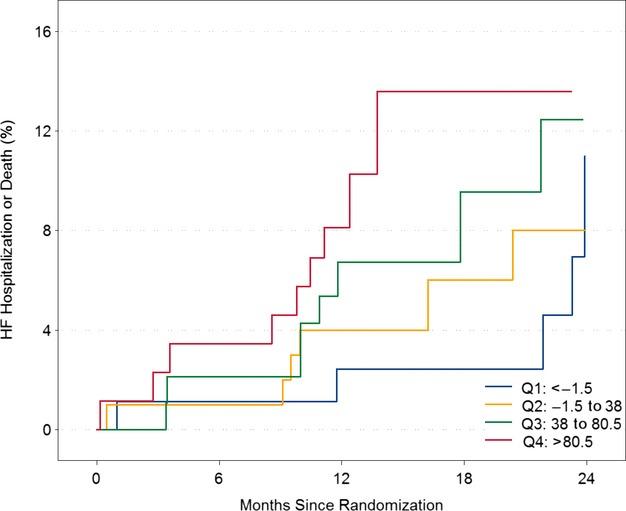
In 610 patients with New York Heart Association class I/II heart failure from the Resynchronization Reverses Remodeling in Systolic Left Ventricular Dysfunction (REVERSE) study, we performed detailed quantitative echocardiography assessment prior to and following cardiac resynchronization therapy. We derived measures of contractility (the slope [end-systolic elastance] and the volume intercept of the end-systolic pressure-volume relationship, stroke work, and preload recruitable stroke work), measures of arterial load and ventricular-arterial coupling, and measures of chamber size (volume intercept, end-systolic and end-diastolic volumes). At 6 and 12 months, cardiac resynchronization therapy was associated with a reduction in the volume intercept and end-systolic and end-diastolic volumes (P<0.01). There were no consistent effects on end-systolic elastance, stroke work, preload recruitable stroke work, or ventricular-arterial coupling. In the active cardiac resynchronization therapy population, baseline measures of arterial load were associated with the clinical composite score (odds ratio 1.30, 95% CI 1.04 to 1.63, P=0.02). The volume intercept was associated with mortality (hazard ratio 1.90, 95% CI 1.01 to 3.59, P=0.047) and more modestly with the combined end point of mortality or heart failure hospitalization (hazard ratio 1.48, 95% CI 0.8 to 2.25, P=0.06). In contrast, end-systolic elastance, stroke work, preload recruitable stroke work, and ventricular-arterial coupling were not associated with any outcomes.
CONCLUSION
In patients with NYHA Class I/II heart failure, cardiac resynchronization therapy exerts favorable changes in left ventricular end-systolic and end-diastolic volumes and the volume intercept. The volume intercept may be useful to gain insight into prognosis in heart failure.
CLINICAL TRIAL REGISTRATION
URL: https://www.clinicaltrials.gov/. Unique identifier: NCT00271154.
背景
心脏再同步治疗可改善心力衰竭患者的射血分数。我们试图确定这些效应是否由收缩性、后负荷或容量的变化介导。
方法和结果
在心脏再同步逆转收缩期左心室功能不全(REVERSE)研究中纳入的610例纽约心脏协会I/II级心力衰竭患者,我们在心脏再同步治疗前后进行了详细的定量超声心动图评估。我们得出了收缩性指标(斜率[收缩末期弹性]和收缩末期压力-容量关系的容量截距、每搏功和可募集前负荷每搏功)、动脉负荷和心室-动脉耦联指标以及腔室大小指标(容量截距、收缩末期和舒张末期容积)。在6个月和12个月时,心脏再同步治疗与容量截距、收缩末期和舒张末期容积的减少相关(P<0.01)。对收缩末期弹性、每搏功、可募集前负荷每搏功或心室-动脉耦联没有一致的影响。在接受积极心脏再同步治疗的人群中,动脉负荷的基线指标与临床综合评分相关(比值比1.30,95%可信区间1.04至1.63,P=0.02)。容量截距与死亡率相关(风险比1.90,95%可信区间1.01至3.59,P=0.047),与死亡率或心力衰竭住院的联合终点相关性较弱(风险比1.48,95%可信区间0.8至2.25,P=0.06)。相比之下,收缩末期弹性、每搏功、可募集前负荷每搏功和心室-动脉耦联与任何结局均不相关。
结论
在纽约心脏协会I/II级心力衰竭患者中,心脏再同步治疗可使左心室收缩末期和舒张末期容积以及容量截距发生有益变化。容量截距可能有助于深入了解心力衰竭的预后。
临床试验注册


 Zotero 插件