
孕期晚期和出生后早期暴露于电子烟尼古丁蒸汽的雄性小鼠的成年行为
Adult Behavior in Male Mice Exposed to E-Cigarette Nicotine Vapors during Late Prenatal and Early Postnatal Life.
作者信息
Smith Dani, Aherrera Angela, Lopez Armando, Neptune Enid, Winickoff Jonathan P, Klein Jonathan D, Chen Gang, Lazarus Philip, Collaco Joseph M, McGrath-Morrow Sharon A
机构信息
Neurogenetics and Behavior Center, Department of Psychological and Brain Sciences, Johns Hopkins University, Baltimore, Maryland, United States of America.
Eudowood Division of Pediatric Respiratory Sciences, Johns Hopkins University School of Medicine, Baltimore, Maryland, United States of America.
出版信息
PLoS One. 2015 Sep 15;10(9):e0137953. doi: 10.1371/journal.pone.0137953. eCollection 2015.
METHODS
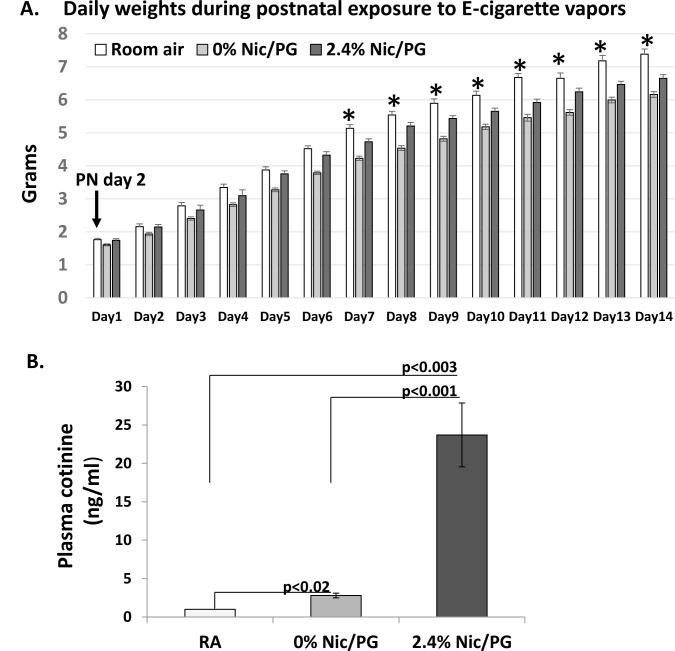
Timed-pregnant C57BL/6J mice were exposed to 2.4% nicotine in propylene glycol (PG) or 0% nicotine /PG once a day from gestational day 15 until delivery. After delivery, offspring and mothers were exposed to E-cigarette vapors for an additional 14 days from postnatal day 2 through 16. Following their last exposure serum cotinine levels were measured in female juvenile mice. Male mice underwent behavioral testing at 14 weeks of age to assess sensorimotor, affective, and cognitive functional domains.
RESULTS
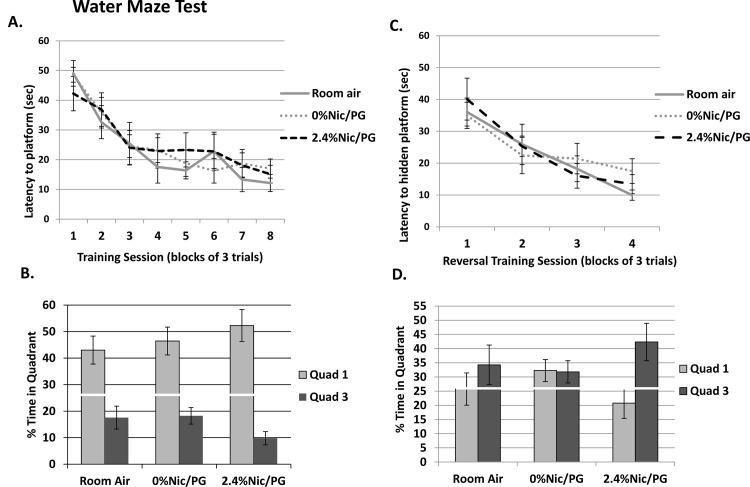
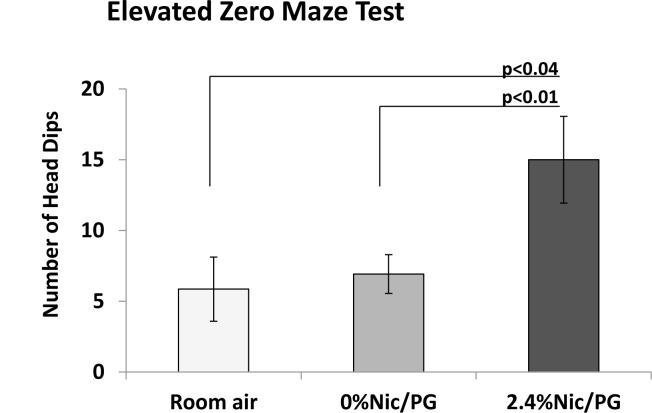
Adult male mice exposed to 2.4% nicotine/PG E-cigarette vapors had significantly more head dips in the zero maze test and higher levels of rearing activity in the open field test compared to 0% nicotine/PG exposed mice and untreated controls. In the water maze test after reversal training, the 2.4% nicotine/PG mice spent more than 25% of time in the new location whereas the other groups did not.
CONCLUSION
Adult male mice exhibited increased levels of activity in the zero maze and open field tests when exposed to E-cigarette vapor containing nicotine during late prenatal and early postnatal life. These findings indicate that nicotine exposure from E-cigarettes may cause persistent behavioral changes when exposure occurs during a period of rapid brain growth.
方法
将处于妊娠阶段的C57BL/6J小鼠从妊娠第15天至分娩期间,每天一次暴露于含有2.4%尼古丁的丙二醇(PG)中或不含尼古丁的PG中。分娩后,子代和母鼠从出生后第2天至16天再额外暴露于电子烟烟雾中14天。在最后一次暴露后,测量雌性幼鼠血清中可替宁水平。雄性小鼠在14周龄时进行行为测试,以评估感觉运动、情感和认知功能领域。
结果
与暴露于不含尼古丁的PG和未处理的对照组相比,暴露于含有2.4%尼古丁的PG电子烟烟雾中的成年雄性小鼠在零迷宫测试中头部下垂次数显著更多,在旷场测试中的竖毛活动水平更高。在反转训练后的水迷宫测试中,暴露于含有2.4%尼古丁的PG的小鼠在新位置花费的时间超过25%,而其他组则没有。
结论
成年雄性小鼠在产前后期和产后早期暴露于含尼古丁的电子烟烟雾时,在零迷宫和旷场测试中表现出活动水平增加。这些发现表明,在大脑快速生长期间暴露于电子烟中的尼古丁可能会导致持续的行为变化。

 Zotero 插件