
A 型护具的设计与初步验证:一种新型可穿戴式动态手臂支撑装置
Design and pilot validation of A-gear: a novel wearable dynamic arm support.
作者信息
Kooren Peter N, Dunning Alje G, Janssen Mariska M H P, Lobo-Prat Joan, Koopman Bart F J M, Paalman Micha I, de Groot Imelda J M, Herder Just L
机构信息
Department of Physics and Medical Technology, VU Medical Center, Amsterdam, The Netherlands.
Department of Precision & Microsystems Engineering, Delft University of Technology, Delft, The Netherlands.
出版信息
J Neuroeng Rehabil. 2015 Sep 18;12:83. doi: 10.1186/s12984-015-0072-y.
BACKGROUND
Persons suffering from progressive muscular weakness, like those with Duchenne muscular dystrophy (DMD), gradually lose the ability to stand, walk and to use their arms. This hinders them from performing daily activities, social participation and being independent. Wheelchairs are used to overcome the loss of walking. However, there are currently few efficient functional substitutes to support the arms. Arm supports or robotic arms can be mounted to wheelchairs to aid in arm motion, but they are quite visible (stigmatizing), and limited in their possibilities due to their fixation to the wheelchair. The users prefer inconspicuous arm supports that are comfortable to wear and easy to control.
METHODS
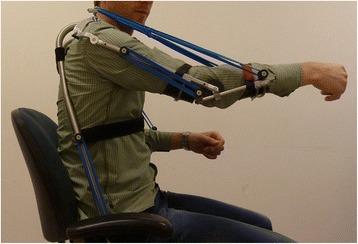
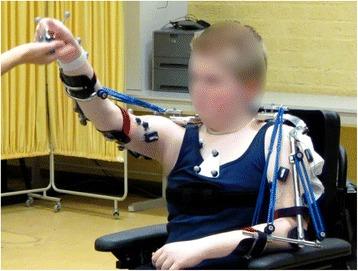
In this paper the design, characterization, and pilot validation of a passive arm support prototype, which is worn on the body, is presented. The A-gear runs along the body from the contact surface between seat and upper legs via torso and upper arm to the forearm. Freedom of motion is accomplished by mechanical joints, which are nearly aligned with the human joints. The system compensates for the arm weight, using elastic bands for static balance, in every position of the arm. As opposed to existing devices, the proposed kinematic structure allows trunk motion and requires fewer links and less joint space without compromising balancing precision. The functional prototype has been validated in three DMD patients, using 3D motion analysis.
RESULTS
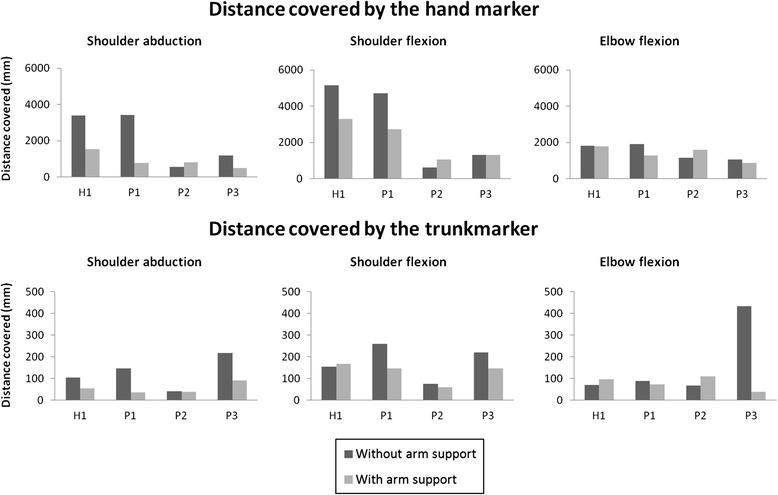
Measurements have shown increased arm performance when the subjects were wearing the prototype. Upward and forward movements were easier to perform. The arm support is easy to put on and remove. Moreover, the device felt comfortable for the subjects. However, downward movements were more difficult, and the patients would prefer the device to be even more inconspicuous.
CONCLUSION
The A-gear prototype is a step towards inconspicuousness and therefore well-received dynamic arm supports for people with muscular weakness.
背景
患有进行性肌肉无力的人,如杜氏肌营养不良症(DMD)患者,逐渐失去站立、行走和使用手臂的能力。这阻碍了他们进行日常活动、参与社交和实现独立。轮椅用于克服行走能力的丧失。然而,目前几乎没有有效的功能替代品来支撑手臂。手臂支撑装置或机械手臂可以安装在轮椅上以辅助手臂运动,但它们很显眼(有污名化问题),并且由于固定在轮椅上而功能有限。用户更喜欢不显眼、佩戴舒适且易于控制的手臂支撑装置。
方法
本文介绍了一种穿戴在身体上的被动手臂支撑原型的设计、特性及初步验证。A形装置从座椅与大腿上部的接触面沿着身体,经躯干、上臂延伸至前臂。运动自由度通过与人体关节几乎对齐的机械关节实现。该系统在手臂的每个位置使用弹性带进行静态平衡,以补偿手臂重量。与现有装置不同,所提出的运动结构允许躯干运动,并且在不影响平衡精度的情况下需要更少的连杆和关节空间。该功能原型已在三名DMD患者中使用三维运动分析进行了验证。
结果
测量结果表明,受试者佩戴原型时手臂性能有所提高。向上和向前的动作更容易完成。手臂支撑装置易于穿戴和拆卸。此外,受试者感觉该装置很舒适。然而,向下的动作更困难,并且患者希望该装置更加不显眼。
结论
A形装置原型朝着不显眼迈出了一步,因此是一种很受肌肉无力患者欢迎的动态手臂支撑装置。






 Zotero 插件