
达卡市孕妇中与孕产妇贫血相关的因素。
Factors associated with maternal anaemia among pregnant women in Dhaka city.
作者信息
Chowdhury Hasina Akhter, Ahmed Kazi Rumana, Jebunessa Fatema, Akter Jesmin, Hossain Sharmin, Shahjahan Md
机构信息
Department of Biostatistics, Bangladesh University of Health Sciences, Dhaka, Bangladesh.
Department of Health Promotion and Health Education, Bangladesh University of Health Sciences, Dhaka, Bangladesh.
出版信息
BMC Womens Health. 2015 Sep 22;15:77. doi: 10.1186/s12905-015-0234-x.
BACKGROUND
Maternal anaemia is a common problem in pregnancy, particularly in developing countries. The study was aimed at determining the factors associated with anaemia among a group of pregnant mothers who attended an antenatal clinic in Dhaka city.
METHODS
This cross-sectional study included 224 pregnant women, who visited the antenatal clinic of the Marie Stops, Dhaka. Demographic data and information on maternal age, gestational age, educational and income level, and socioeconomic status were collected from all the subjects. Haemoglobin status was measured to assess their anaemia. A qualified technician drew venous blood samples from them. The reference values of haemoglobin were categorized according to the World Health Organization (WHO) criteria as follows: normal (11 g/dL or higher), mild (10-10.9 g/dL), and moderate (7-9.9 g/dL). Mild and moderate levels of haemoglobin were defined as anaemic (haemoglobin levels of <11 g/dL). The SPSS software (Windows version 16.0. SPSS Inc, Chicago, USA) was used for analyzing data.
RESULTS
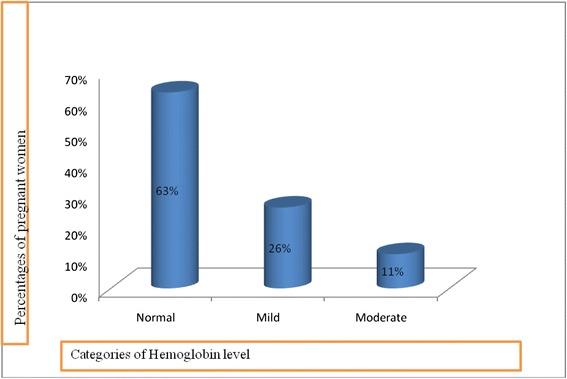
The mean (±SD) age of the subjects was 26.4 ± 2.81 years. Sixty-three percent of the subjects had normal level of haemoglobin, and 37% were anaemic 26% mild and 11% moderate. Maternal anaemia was significantly associated with age (p = 0.036), education (p = 0.002), income (p = 0.001), living area (p = 0.031). Results of binary logistic regression analysis showed that maternal anaemia was also significantly associated with age (p = 0.006), educational status (primary to 8th grade, p = 0.004; secondary and above, p = 0.002), living area (0.022), and income (0.021).
DISCUSSION
A significant proportion of pregnant women were found anaemic. Most data showed education has animpact on awareness to use of health services and iron supplementation should be encouraged to improve the haemoglobin levels in pregnancy.
CONCLUSIONS
The results indicate that anaemia is alarmingly high among pregnant women in Dhaka city. Maternal anaemia is associated with age, education level, income level, and living area. The results suggest that pregnant women and members of their families should be urgently educated to understand the importance of antenatal care.
背景
孕产妇贫血是孕期常见问题,在发展中国家尤为如此。本研究旨在确定达卡市一家产前诊所的一组孕妇中与贫血相关的因素。
方法
这项横断面研究纳入了224名前往达卡玛丽斯特普斯产前诊所就诊的孕妇。收集了所有受试者的人口统计学数据以及产妇年龄、孕周、教育程度、收入水平和社会经济地位等信息。测量血红蛋白水平以评估她们是否贫血。由一名合格技术人员采集她们的静脉血样。根据世界卫生组织(WHO)标准,血红蛋白参考值分类如下:正常(11 g/dL或更高)、轻度(10 - 10.9 g/dL)和中度(7 - 9.9 g/dL)。血红蛋白水平轻度和中度被定义为贫血(血红蛋白水平<11 g/dL)。使用SPSS软件(Windows版本16.0。SPSS公司,美国芝加哥)进行数据分析。
结果
受试者的平均(±标准差)年龄为26.4±2.81岁。63%的受试者血红蛋白水平正常,37%贫血,其中26%为轻度,11%为中度。孕产妇贫血与年龄(p = 0.03)、教育程度(p = 0.02)、收入(p = 0.001)、居住地区(p = 0.031)显著相关。二元逻辑回归分析结果表明,孕产妇贫血还与年龄(p = 0.006)、教育状况(小学至八年级,p = 0.004;初中及以上,p = 0.002)、居住地区(0.022)和收入(0.021)显著相关。
讨论
发现相当比例的孕妇贫血。大多数数据表明教育对利用卫生服务的意识有影响,应鼓励补充铁剂以提高孕期血红蛋白水平。
结论
结果表明达卡市孕妇贫血情况惊人地高。孕产妇贫血与年龄、教育水平、收入水平和居住地区有关。结果表明应紧急教育孕妇及其家庭成员,使其了解产前护理的重要性。
 Zotero 插件