
越南人畜共患感染疾病倡议(VIZIONS):研究新出现的人畜共患传染病的战略方法。
The Vietnam Initiative on Zoonotic Infections (VIZIONS): A Strategic Approach to Studying Emerging Zoonotic Infectious Diseases.
作者信息
Rabaa Maia A, Tue Ngo Tri, Phuc Tran My, Carrique-Mas Juan, Saylors Karen, Cotten Matthew, Bryant Juliet E, Nghia Ho Dang Trung, Cuong Nguyen Van, Pham Hong Anh, Berto Alessandra, Phat Voong Vinh, Dung Tran Thi Ngoc, Bao Long Hoang, Hoa Ngo Thi, Wertheim Heiman, Nadjm Behzad, Monagin Corina, van Doorn H Rogier, Rahman Motiur, Tra My Phan Vu, Campbell James I, Boni Maciej F, Tam Pham Thi Thanh, van der Hoek Lia, Simmonds Peter, Rambaut Andrew, Toan Tran Khanh, Van Vinh Chau Nguyen, Hien Tran Tinh, Wolfe Nathan, Farrar Jeremy J, Thwaites Guy, Kellam Paul, Woolhouse Mark E J, Baker Stephen
机构信息
Centre for Immunity, Infection & Evolution, The University of Edinburgh, Edinburgh, UK.
Oxford University Clinical Research Unit, Wellcome Trust Major Overseas Programme, Ho Chi Minh City, Vietnam.
出版信息
Ecohealth. 2015 Dec;12(4):726-35. doi: 10.1007/s10393-015-1061-0. Epub 2015 Sep 24.
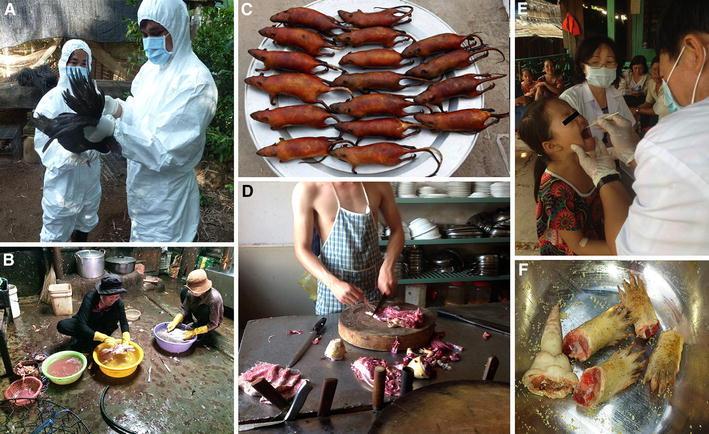
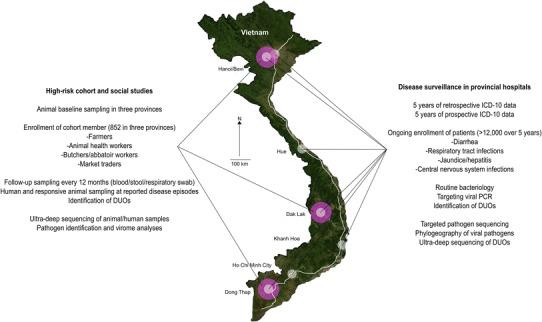
The effect of newly emerging or re-emerging infectious diseases of zoonotic origin in human populations can be potentially catastrophic, and large-scale investigations of such diseases are highly challenging. The monitoring of emergence events is subject to ascertainment bias, whether at the level of species discovery, emerging disease events, or disease outbreaks in human populations. Disease surveillance is generally performed post hoc, driven by a response to recent events and by the availability of detection and identification technologies. Additionally, the inventory of pathogens that exist in mammalian and other reservoirs is incomplete, and identifying those with the potential to cause disease in humans is rarely possible in advance. A major step in understanding the burden and diversity of zoonotic infections, the local behavioral and demographic risks of infection, and the risk of emergence of these pathogens in human populations is to establish surveillance networks in populations that maintain regular contact with diverse animal populations, and to simultaneously characterize pathogen diversity in human and animal populations. Vietnam has been an epicenter of disease emergence over the last decade, and practices at the human/animal interface may facilitate the likelihood of spillover of zoonotic pathogens into humans. To tackle the scientific issues surrounding the origins and emergence of zoonotic infections in Vietnam, we have established The Vietnam Initiative on Zoonotic Infections (VIZIONS). This countrywide project, in which several international institutions collaborate with Vietnamese organizations, is combining clinical data, epidemiology, high-throughput sequencing, and social sciences to address relevant one-health questions. Here, we describe the primary aims of the project, the infrastructure established to address our scientific questions, and the current status of the project. Our principal objective is to develop an integrated approach to the surveillance of pathogens circulating in both human and animal populations and assess how frequently they are exchanged. This infrastructure will facilitate systematic investigations of pathogen ecology and evolution, enhance understanding of viral cross-species transmission events, and identify relevant risk factors and drivers of zoonotic disease emergence.
新出现或再度出现的人畜共患传染病对人类群体的影响可能是灾难性的,对此类疾病进行大规模调查极具挑战性。无论是在物种发现、新发疾病事件还是人类群体中的疾病暴发层面,对新发事件的监测都存在确诊偏倚。疾病监测通常是事后进行的,由对近期事件的应对以及检测和鉴定技术的可用性驱动。此外,哺乳动物和其他宿主中存在的病原体清单并不完整,而且很少能够提前识别出那些有可能在人类中致病的病原体。了解人畜共患感染的负担和多样性、当地感染的行为和人口风险以及这些病原体在人类群体中出现的风险的一个主要步骤,是在与多种动物群体保持定期接触的人群中建立监测网络,并同时描述人类和动物群体中的病原体多样性。在过去十年中,越南一直是疾病新发的中心,人畜接触界面的行为可能会增加人畜共患病原体传播给人类的可能性。为了解决越南人畜共患感染的起源和出现所涉及的科学问题,我们设立了越南人畜共患感染倡议(VIZIONS)。这个全国性项目由几个国际机构与越南组织合作开展,正在整合临床数据、流行病学、高通量测序和社会科学,以解决相关的一体化健康问题。在此,我们描述该项目的主要目标、为解决我们的科学问题而建立的基础设施以及项目的当前状况。我们的主要目标是开发一种综合方法,用于监测在人类和动物群体中传播的病原体,并评估它们的交换频率。这种基础设施将有助于对病原体生态和进化进行系统调查,增进对病毒跨物种传播事件的了解,并识别相关的风险因素和人畜共患病出现的驱动因素。

 Zotero 插件