
B5是一种硫氧还蛋白还原酶抑制剂,它通过抑制硫氧还蛋白系统、破坏线粒体依赖性途径并引发自噬,诱导人宫颈癌细胞凋亡。
B5, a thioredoxin reductase inhibitor, induces apoptosis in human cervical cancer cells by suppressing the thioredoxin system, disrupting mitochondrion-dependent pathways and triggering autophagy.
作者信息
Shao Fang-Yuan, Du Zhi-Yun, Ma Dong-Lei, Chen Wen-Bo, Fu Wu-Yu, Ruan Bi-Bo, Rui Wen, Zhang Jia-Xuan, Wang Sheng, Wong Nai Sum, Xiao Hao, Li Man-Mei, Liu Xiao, Liu Qiu-Ying, Zhou Xiao-Dong, Yan Hai-Zhao, Wang Yi-Fei, Chen Chang-Yan, Liu Zhong, Chen Hong-Yuan
机构信息
Department of Pathogen Biology and Immunology, School of Basic Course, Guangdong Pharmaceutical University, Guangzhou, China.
Institute of Natural Medicine & Green Chemistry, School of Chemical Engineering and Light Industry, Guangdong University of Technology, Guangzhou, China.
出版信息
Oncotarget. 2015 Oct 13;6(31):30939-56. doi: 10.18632/oncotarget.5132.
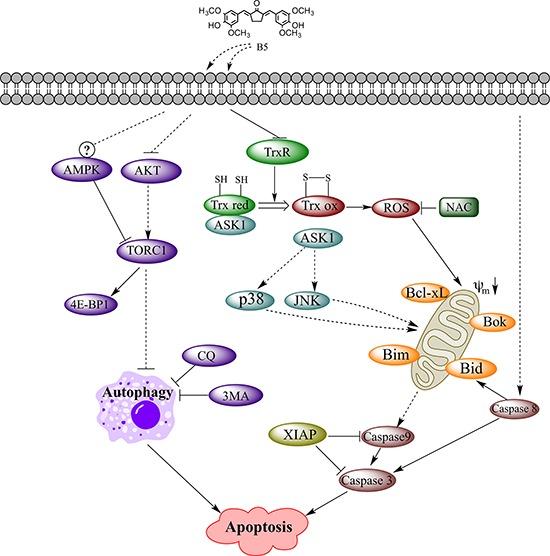
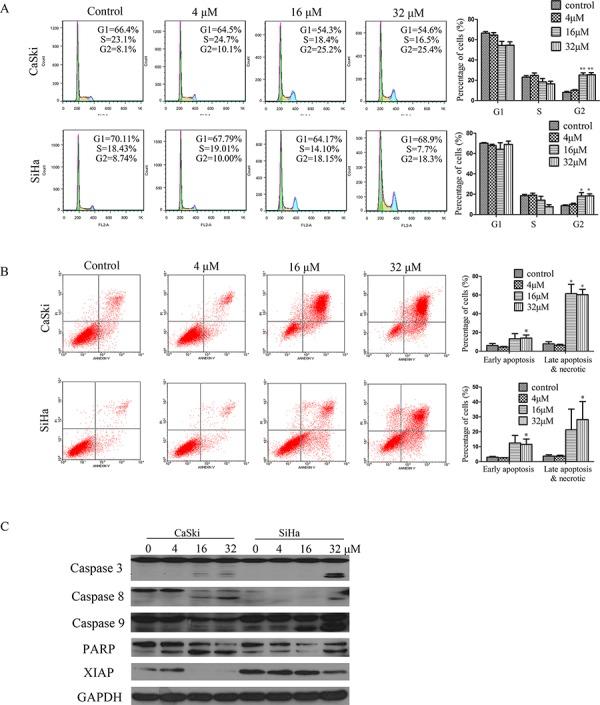
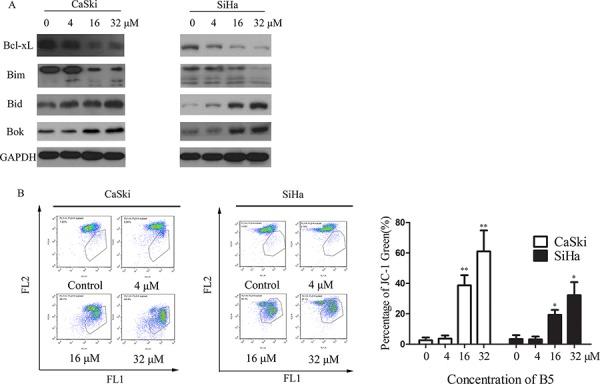
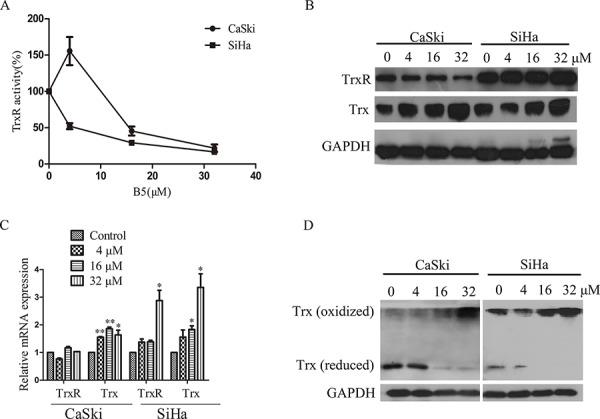
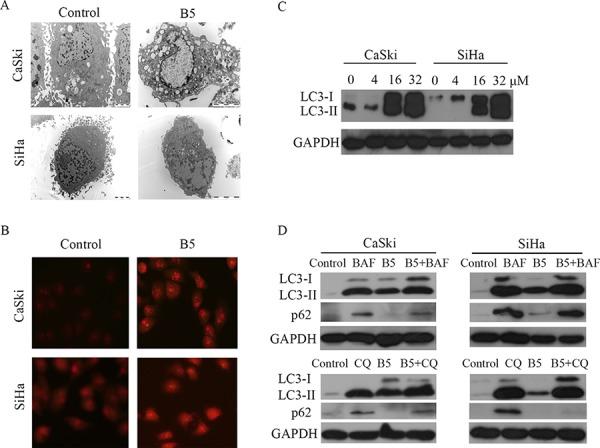
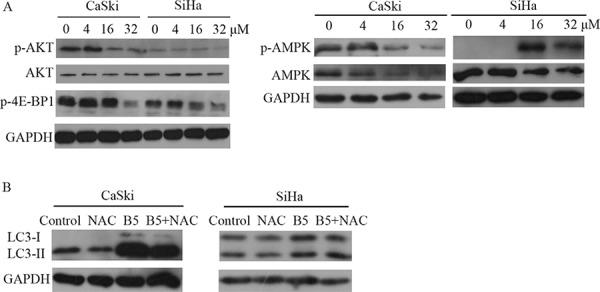
The synthetic curcumin analog B5 is a potent inhibitor of thioredoxin reductase (TrxR) that has potential anticancer effects. The molecular mechanism underlying B5 as an anticancer agent is not yet fully understood. In this study, we report that B5 induces apoptosis in two human cervical cancer cell lines, CaSki and SiHa, as evidenced by the downregulation of XIAP, activation of caspases and cleavage of PARP. The involvement of the mitochondrial pathway in B5-induced apoptosis was suggested by the dissipation of mitochondrial membrane potential and increased expression of pro-apoptotic Bcl-2 family proteins. In B5-treated cells, TrxR activity was markedly inhibited with concomitant accumulation of oxidized thioredoxin, increased formation of reactive oxygen species (ROS), and activation of ASK1 and its downstream regulatory target p38/JNK. B5-induced apoptosis was significantly inhibited in the presence of N-acetyl-l-cysteine. Microscopic examination of B5-treated cells revealed increased presence of cytoplasmic vacuoles. The ability of B5 to activate autophagy in cells was subsequently confirmed by cell staining with acridine orange, accumulation of LC3-II, and measurement of autophagic flux. Unlike B5-induced apoptosis, autophagy induced by B5 is not ROS-mediated but a role for the AKT and AMPK signaling pathways is implied. In SiHa cells but not CaSki cells, B5-induced apoptosis was promoted by autophagy. These data suggest that the anticarcinogenic effects of B5 is mediated by complex interplay between cellular mechanisms governing redox homeostasis, apoptosis and autophagy.
合成姜黄素类似物B5是硫氧还蛋白还原酶(TrxR)的有效抑制剂,具有潜在的抗癌作用。B5作为抗癌剂的分子机制尚未完全明确。在本研究中,我们报告B5可诱导两种人宫颈癌细胞系CaSki和SiHa发生凋亡,这可通过XIAP的下调、半胱天冬酶的激活及PARP的裂解得以证实。线粒体膜电位的消散及促凋亡Bcl-2家族蛋白表达的增加提示线粒体途径参与了B5诱导的凋亡。在B5处理的细胞中,TrxR活性受到显著抑制,同时氧化型硫氧还蛋白积累、活性氧(ROS)生成增加以及ASK1及其下游调节靶点p38/JNK被激活。在N-乙酰-L-半胱氨酸存在的情况下,B5诱导的凋亡受到显著抑制。对B5处理细胞的显微镜检查显示细胞质空泡增多。随后通过吖啶橙细胞染色、LC3-II的积累及自噬通量的测定证实了B5激活细胞自噬的能力。与B5诱导的凋亡不同,B5诱导的自噬不是由ROS介导的,但暗示了AKT和AMPK信号通路的作用。在SiHa细胞而非CaSki细胞中,自噬促进了B5诱导的凋亡。这些数据表明,B5的抗癌作用是由调控氧化还原稳态、凋亡和自噬的细胞机制之间的复杂相互作用介导的。




 Zotero 插件