
近缘类群通过DNA条形码影响木本植物物种鉴别:来自全球森林动态监测样地的证据
Closely-related taxa influence woody species discrimination via DNA barcoding: evidence from global forest dynamics plots.
作者信息
Pei Nancai, Erickson David L, Chen Bufeng, Ge Xuejun, Mi Xiangcheng, Swenson Nathan G, Zhang Jin-Long, Jones Frank A, Huang Chun-Lin, Ye Wanhui, Hao Zhanqing, Hsieh Chang-Fu, Lum Shawn, Bourg Norman A, Parker John D, Zimmerman Jess K, McShea William J, Lopez Ida C, Sun I-Fang, Davies Stuart J, Ma Keping, Kress W John
机构信息
State Key Laboratory of Tree Genetics and Breeding, Chinese Academy of Forestry, Beijing 100091, PR China.
Research Institute of Tropical Forestry, Chinese Academy of Forestry, Guangzhou 510520, PR China.
出版信息
Sci Rep. 2015 Oct 12;5:15127. doi: 10.1038/srep15127.
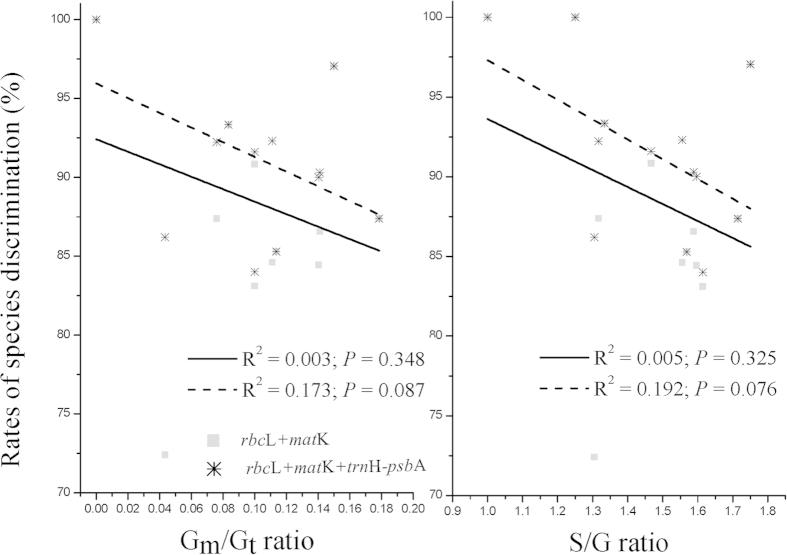
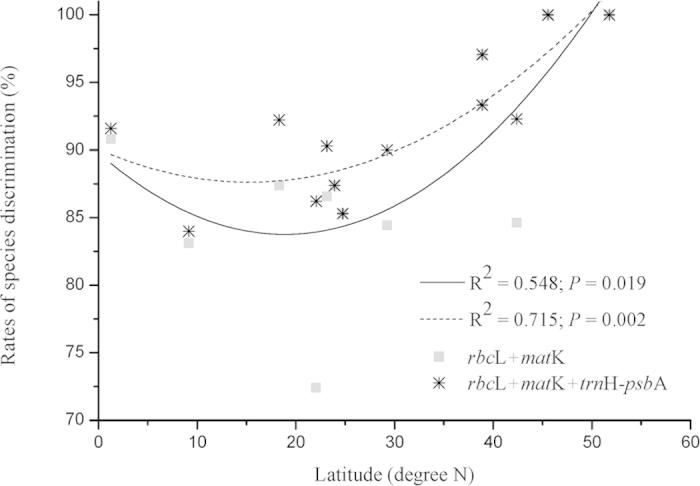
To determine how well DNA barcodes from the chloroplast region perform in forest dynamics plots (FDPs) from global CTFS-ForestGEO network, we analyzed DNA barcoding sequences of 1277 plant species from a wide phylogenetic range (3 FDPs in tropics, 5 in subtropics and 5 in temperate zone) and compared the rates of species discrimination (RSD). We quantified RSD by two DNA barcode combinations (rbcL + matK and rbcL + matK + trnH-psbA) using a monophyly-based method (GARLI). We defined two indexes of closely-related taxa (Gm/Gt and S/G ratios) and correlated these ratios with RSD. The combination of rbcL + matK averagely discriminated 88.65%, 83.84% and 72.51% at the local, regional and global scales, respectively. An additional locus trnH-psbA increased RSD by 2.87%, 1.49% and 3.58% correspondingly. RSD varied along a latitudinal gradient and were negatively correlated with ratios of closely-related taxa. Successes of species discrimination generally depend on scales in global FDPs. We suggested that the combination of rbcL + matK + trnH-psbA is currently applicable for DNA barcoding-based phylogenetic studies on forest communities.
为了确定来自叶绿体区域的DNA条形码在全球CTFS - 森林全球生态网络的森林动态监测点(FDPs)中的表现如何,我们分析了来自广泛系统发育范围的1277种植物的DNA条形码序列(热带地区3个FDPs,亚热带地区5个,温带地区5个),并比较了物种识别率(RSD)。我们使用基于单系性的方法(GARLI)通过两种DNA条形码组合(rbcL + matK和rbcL + matK + trnH - psbA)对RSD进行了量化。我们定义了两个近缘类群的指标(Gm/Gt和S/G比率),并将这些比率与RSD进行关联。rbcL + matK组合在局部、区域和全球尺度上分别平均鉴别出88.65%、83.84%和72.51%的物种。额外的trnH - psbA位点相应地使RSD提高了2.87%、1.49%和3.58%。RSD沿纬度梯度变化,且与近缘类群的比率呈负相关。在全球FDPs中,物种识别的成功率通常取决于尺度。我们建议,rbcL + matK + trnH - psbA组合目前适用于基于DNA条形码的森林群落系统发育研究。

 Zotero 插件