
多能性因子LIN28B参与口腔癌发生,并与肿瘤侵袭性和不良预后相关。
The pluripotency factor LIN28B is involved in oral carcinogenesis and associates with tumor aggressiveness and unfavorable prognosis.
作者信息
Wang Dongmiao, Zhu Yuming, Wang Yanling, Li Zhongwu, Yuan Chunping, Zhang Wei, Yuan Hua, Ye Jinhai, Yang Jianrong, Jiang Hongbing, Cheng Jie
机构信息
Department of Oral and Maxillofacial Surgery, Nanjing Medical University, Nanjing, 210029 China.
Jiangsu Key Laboratory of Oral Disease, Nanjing Medical University, Nanjing, 210029 China.
出版信息
Cancer Cell Int. 2015 Oct 15;15:99. doi: 10.1186/s12935-015-0252-7. eCollection 2015.
OBJECTIVE
LIN28B is a conserved RNA-binding protein critically involved in development, cellular metabolism and tumorigenesis. It is frequently overexpressed in human cancers and correlates with tumor aggressiveness as well as unfavorable prognosis. However, the expression pattern and oncogenic roles of LIN28B during oral squamous cell carcinoma (OSCC) development and progression has not been well established yet. Here, we sought to determine the expression of LIN28B and its clinical significance using chemical-induced OSCC animal model, cell lines and primary specimens.
METHOD
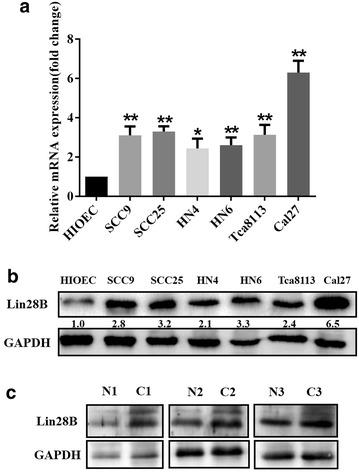
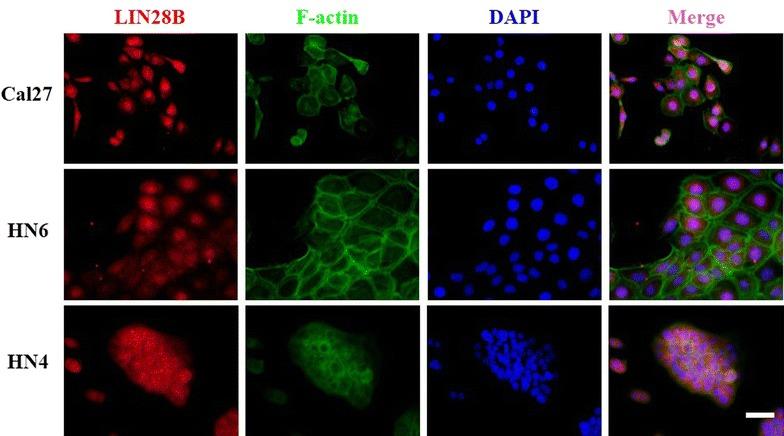
The OSCC animal model was induced using 7,12-dimethyl-1,2-bezan-tracene (DMBA) painting in the hamster buccal pouch. Buccal lesions from animals were obtained from different time points and subjected to routine histological analyses and immunohistochemical staining of LIN28B. The mRNA, protein abundance and subcellular localization of LIN28B was determined in a panel of OSCC cell lines by real-time RT-PCR, western blot and immunofluorescence. The expression levels of LIN28B in human primary OSCC samples were further evaluated by immunohistochemical staining. Moreover, the relationship between LIN28B and several clinicopathological parameters as well as patients' prognosis were also assessed.
RESULTS
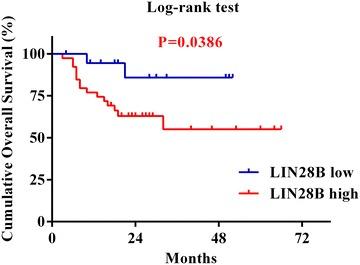
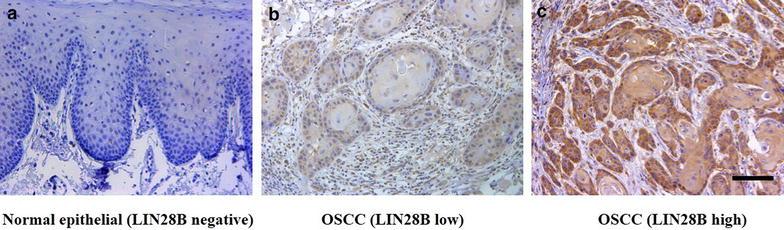
Our results revealed that negative or low LIN28B expression was commonly observed in normal epithelial, whereas more LIN28B abundance was identified in epithelial dysplasia and invasive SCC in the DMBA-induced OSCC animal model. Overexpression of LIN28B was identified in a major fraction of OSCC samples(39/58) and significantly associated with tumor size (P = 0.049) and advanced clinical stages (P = 0.0286). Patients with increased LIN28B had markedly reduced overall survival as compared to those with low LIN28B. Multivariate survival analyses further indicated that LIN28B abundance served as an independent prognostic factor for patients' overall survival.
CONCLUSIONS
Our findings reveal that LIN28B is critically involved in OSCC initiation and progression and aberrantly overexpressed in human OSCC. It might represent a novel diagnostic and prognostic biomarker for oral cancer.
目的
LIN28B是一种保守的RNA结合蛋白,在发育、细胞代谢和肿瘤发生过程中起关键作用。它在人类癌症中经常过度表达,与肿瘤侵袭性以及不良预后相关。然而,LIN28B在口腔鳞状细胞癌(OSCC)发生和发展过程中的表达模式及致癌作用尚未完全明确。在此,我们试图利用化学诱导的OSCC动物模型、细胞系和原发性标本,确定LIN28B的表达及其临床意义。
方法
使用7,12 - 二甲基苯并[a]蒽(DMBA)涂抹仓鼠颊囊诱导建立OSCC动物模型。在不同时间点获取动物的颊部病变组织,进行常规组织学分析及LIN28B的免疫组织化学染色。通过实时逆转录 - 聚合酶链反应(RT - PCR)、蛋白质免疫印迹法和免疫荧光法,测定一组OSCC细胞系中LIN28B的mRNA、蛋白质丰度及亚细胞定位。通过免疫组织化学染色进一步评估LIN28B在人类原发性OSCC样本中的表达水平。此外,还评估了LIN28B与几个临床病理参数以及患者预后之间的关系。
结果
我们的研究结果显示,在正常上皮组织中通常观察到LIN28B呈阴性或低表达,而在DMBA诱导的OSCC动物模型的上皮发育异常和浸润性鳞状细胞癌中,LIN28B丰度更高。在大部分OSCC样本(39/58)中检测到LIN28B过表达,且与肿瘤大小(P = 0.049)和临床晚期(P = 0.0286)显著相关。与LIN28B低表达的患者相比,LIN28B表达增加的患者总生存期明显缩短。多因素生存分析进一步表明,LIN28B丰度是患者总生存期的独立预后因素。
结论
我们的研究结果表明,LIN28B在OSCC的起始和进展过程中起关键作用,并且在人类OSCC中异常过表达。它可能是口腔癌一种新的诊断和预后生物标志物。

 Zotero 插件