
嵌合抗原受体T细胞衍生外泌体的治疗潜力:一种用于靶向癌症治疗的无细胞模式
Therapeutic potential of CAR-T cell-derived exosomes: a cell-free modality for targeted cancer therapy.
作者信息
Tang Xiang-Jun, Sun Xu-Yong, Huang Kuan-Ming, Zhang Li, Yang Zhuo-Shun, Zou Dan-Dan, Wang Bin, Warnock Garth L, Dai Long-Jun, Luo Jie
机构信息
Department of Neurosurgery, Taihe Hospital, Hubei University of Medicine, Shiyan, China.
Guangxi Key Laboratory for Transplantation Medicine, Institute of Transplant Medicine, 303 Hospital of People's Liberation Army, Nanning, China.
出版信息
Oncotarget. 2015 Dec 29;6(42):44179-90. doi: 10.18632/oncotarget.6175.
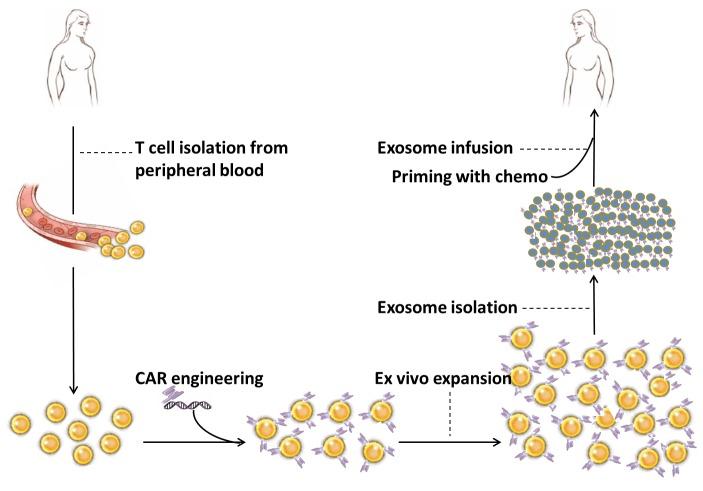
Chimeric antigen receptor (CAR)-based T-cell adoptive immunotherapy is a distinctively promising therapy for cancer. The engineering of CARs into T cells provides T cells with tumor-targeting capabilities and intensifies their cytotoxic activity through stimulated cell expansion and enhanced cytokine production. As a novel and potent therapeutic modality, there exists some uncontrollable processes which are the potential sources of adverse events. As an extension of this impactful modality, CAR-T cell-derived exosomes may substitute CAR-T cells to act as ultimate attackers, thereby overcoming some limitations. Exosomes retain most characteristics of parent cells and play an essential role in intercellular communications via transmitting their cargo to recipient cells. The application of CAR-T cell-derived exosomes will make this cell-based therapy more clinically controllable as it also provides a cell-free platform to diversify anticancer mediators, which responds effectively to the complexity and volatility of cancer. It is believed that the appropriate application of both cellular and exosomal platforms will make this effective treatment more practicable.
基于嵌合抗原受体(CAR)的T细胞过继性免疫疗法是一种极具前景的癌症治疗方法。将CAR工程化到T细胞中,赋予T细胞肿瘤靶向能力,并通过刺激细胞扩增和增强细胞因子产生来强化其细胞毒性活性。作为一种新型强效治疗方式,存在一些不可控过程,这些过程是不良事件的潜在来源。作为这种有影响力的治疗方式的延伸,CAR-T细胞衍生的外泌体可能替代CAR-T细胞,充当最终攻击者,从而克服一些局限性。外泌体保留了母细胞的大部分特征,并通过将其内含物传递给受体细胞,在细胞间通讯中发挥重要作用。CAR-T细胞衍生的外泌体的应用将使这种基于细胞的疗法在临床上更具可控性,因为它还提供了一个无细胞平台,使抗癌介质多样化,从而有效应对癌症的复杂性和多变性。相信细胞和外泌体平台的适当应用将使这种有效治疗更具实用性。
 Zotero 插件