
肾上腺髓质素通过抑制内质网应激来保护肾脏免受缺血再灌注损伤。
Intermedin protects against renal ischemia-reperfusion injury by inhibiting endoplasmic reticulum stress.
作者信息
Wang Yanhong, Tian Jihua, Qiao Xi, Su Xiaole, Mi Yang, Zhang Ruijing, Li Rongshan
机构信息
Department of Microbiology and Immunology, Shanxi Medical University, Taiyuan, Shanxi, China.
Department of Nephrology, Second Hospital of Shanxi Medical University, Taiyuan, Shanxi, China.
出版信息
BMC Nephrol. 2015 Oct 23;16:169. doi: 10.1186/s12882-015-0157-7.
BACKGROUND
Intermedin (IMD) is a novel member of the calcitonin/calcitonin gene-related peptide family. Endoplasmic reticulum stress (ERS) has been implicated in the pathology of renal ischemia/reperfusion (IRI). In the present study, we investigated whether IMD could reduce ERS damage after renal ischemia.
METHODS
The kidneys of SD rats were subjected to 45 min of warm ischemia followed by 24 h of reperfusion. The hypoxia/reoxygenation(H/R) model in NRK-52E cells consisted of hypoxia for 1 h and reoxygenation for 2 h. IMD was over-expressed in vivo and in vitro using the vector pcDNA3.1-IMD. The serum creatinine concentration and lactate dehydrogenase (LDH) activity in the plasma were determined. Histologic examinations of renal tissues were performed with PAS staining. Real-time PCR and Western blotting were used to determine the mRNA and protein levels, respectively. Additionally, ER staining was used to detect the ERS response.
RESULTS
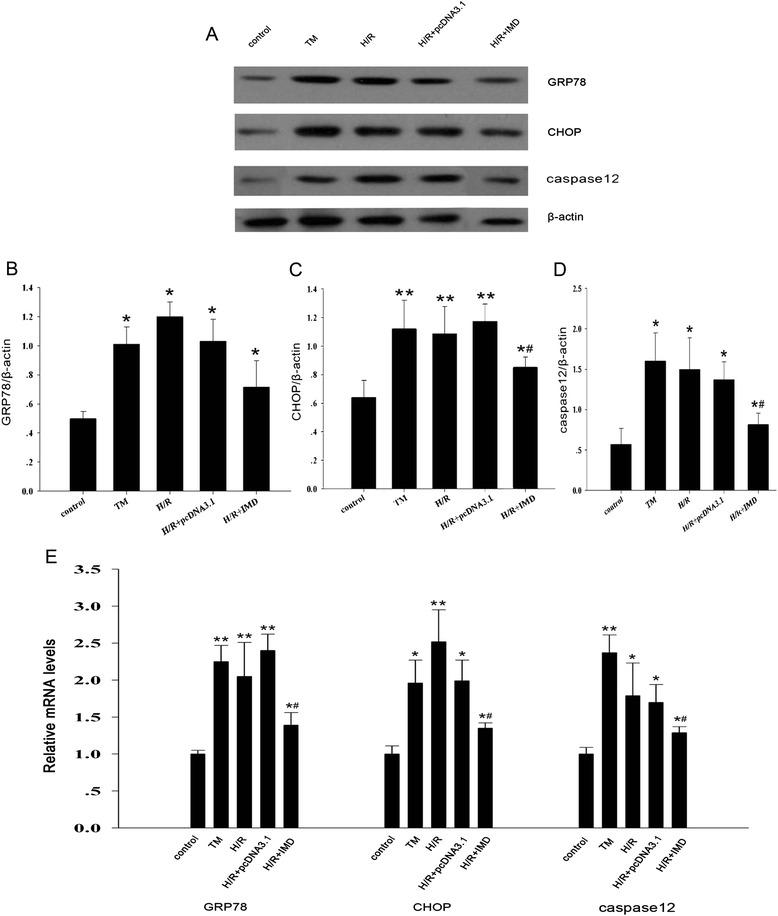
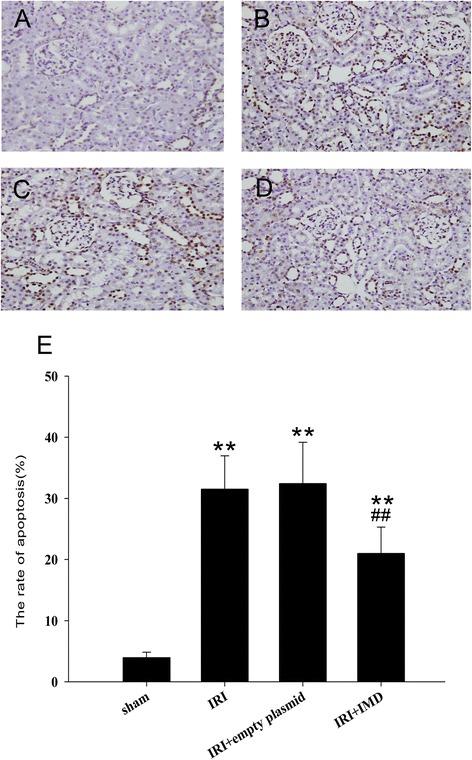
In the rat renal IRI model, we found that IMD gene transfer markedly improved renal function and pathology and decreased LDH activity and cell apoptosis compared with the kidneys that were transfected with the control plasmid. IMD significantly attenuated the ERS stress parameters compared with IRI group. Indeed, IMD down-regulated glucose-regulated protein 78 (GRP78), C/EBP homologous protein(CHOP), and caspase 12 protein and mRNA levels. Moreover, in the NRK-52E cell H/R model, IMD overexpression prevented the apoptosis induced by H/R. Furthermore, IMD ameliorated the ER structural changes and concomitantly decreased the levels of GRP78, CHOP and caspase-12.
CONCLUSION
This study revealed that IMD protects against renal IRI by suppressing ERS and ERS-related apoptosis.
背景
肾上腺髓质素(IMD)是降钙素/降钙素基因相关肽家族的一个新成员。内质网应激(ERS)与肾缺血/再灌注(IRI)的病理过程有关。在本研究中,我们调查了IMD是否能减轻肾缺血后的ERS损伤。
方法
SD大鼠肾脏进行45分钟的热缺血,随后再灌注24小时。NRK-52E细胞中的缺氧/复氧(H/R)模型包括缺氧1小时和复氧2小时。使用载体pcDNA3.1-IMD在体内和体外过表达IMD。测定血浆中的血清肌酐浓度和乳酸脱氢酶(LDH)活性。用PAS染色对肾组织进行组织学检查。分别用实时PCR和蛋白质印迹法测定mRNA和蛋白质水平。此外,用ER染色检测ERS反应。
结果
在大鼠肾IRI模型中,我们发现与转染对照质粒的肾脏相比,IMD基因转移显著改善了肾功能和病理状况,并降低了LDH活性和细胞凋亡。与IRI组相比,IMD显著减轻了ERS应激参数。事实上,IMD下调了葡萄糖调节蛋白78(GRP78)、C/EBP同源蛋白(CHOP)和半胱天冬酶12的蛋白质和mRNA水平。此外,在NRK-52E细胞H/R模型中,IMD过表达可防止H/R诱导的细胞凋亡。此外,IMD改善了内质网结构变化,并同时降低了GRP78、CHOP和半胱天冬酶- l2的水平。
结论
本研究表明,IMD通过抑制ERS和ERS相关的细胞凋亡来保护肾脏免受IRI损伤。




 Zotero 插件