
体外心肺复苏与传统心肺复苏的比较:体外心肺复苏有益吗?
Comparison of Extracorporeal Cardiopulmonary Resuscitation with Conventional Cardiopulmonary Resuscitation: Is Extracorporeal Cardiopulmonary Resuscitation Beneficial?
作者信息
Lee Seung-Hun, Jung Jae-Seung, Lee Kwang-Hyung, Kim Hee-Jung, Son Ho-Sung, Sun Kyung
机构信息
Department of Thoracic and Cardiovascular Surgery, Korea University Anam Hospital, Korea University School of Medicine.
出版信息
Korean J Thorac Cardiovasc Surg. 2015 Oct;48(5):318-27. doi: 10.5090/kjtcs.2015.48.5.318. Epub 2015 Oct 5.
BACKGROUND
With improvements in cardiopulmonary resuscitation (CPR) techniques, the quality and the effectiveness of CPR have been established; nevertheless, the survival rate after cardiac arrest still remains poor. Recently, many reports have shown good outcomes in cases where extracorporeal membrane oxygenation (ECMO) was used during prolonged CPR. Accordingly, we attempted to evaluate the impact of extracorporeal cardiopulmonary resuscitation (ECPR) on the survival of patients who experienced a prolonged cardiac arrest and compared it with that of conventional CPR (CCPR).
METHODS
Between March 2009 and April 2014, CPR, including both in-hospital and out-of-hospital CPR, was carried out in 955 patients. The ECPR group, counted from the start of the ECPR program in March 2010, included 81 patients in total, and the CCPR group consisted of 874 patients. All data were retrospectively collected from the patients' medical records.
RESULTS
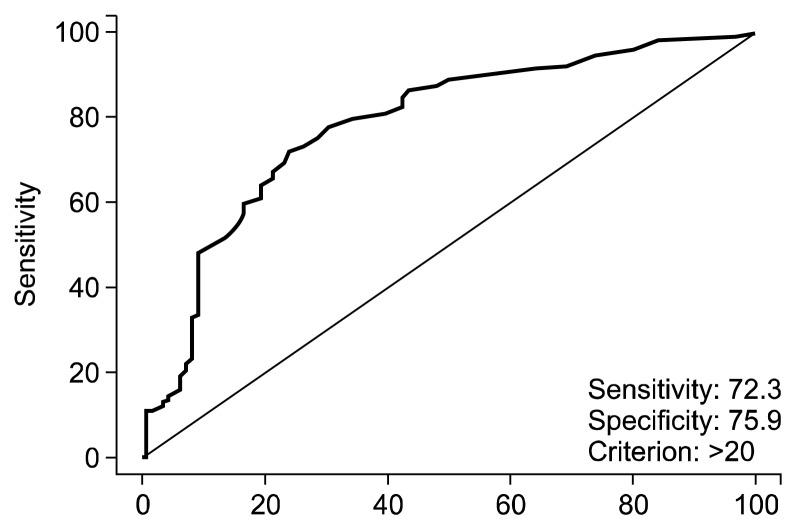
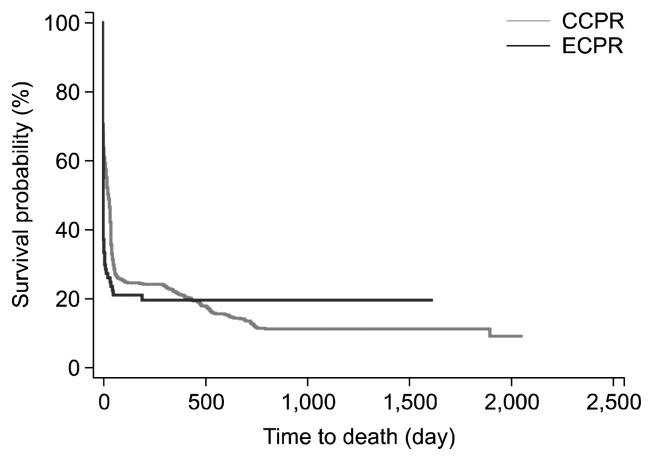
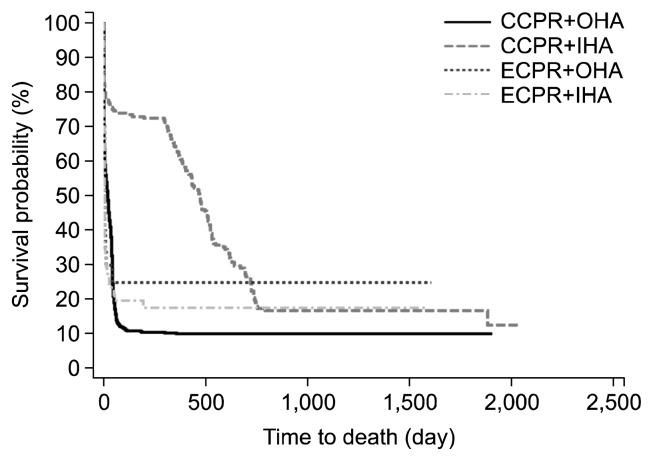
The return of spontaneous circulation (ROSC) rate was 2.24 times better in CPR of in-hospital cardiac arrest (IHCA) patients than in CPR of out-of-hospital CA (OHCA) patients (p=0.0012). For every 1-minute increase in the CPR duration, the ROSC rate decreased by 1% (p=0.0228). Further, for every 10-year decrease in the age, the rate of survival discharge increased by 31%. The CPR of IHCA patients showed a 2.49 times higher survival discharge rate than the CPR of OHCA patients (p=0.03). For every 1-minute increase in the CPR duration, the rate of survival discharge was decreased by 4%. ECPR showed superiority in terms of the survival discharge in the univariate analysis, although with no statistical significance in the multivariate analysis.
CONCLUSION
The survival discharge rate of the ECPR group was comparable to that of the CCPR group. As the CPR duration increased, the survival discharge and the ROSC rate decreased. Therefore, a continuous effort to reduce the time for the decision of ECMO initiation and ECMO team activation is necessary, particularly during the CPR of relatively young patients and IHCA patients.
背景
随着心肺复苏(CPR)技术的改进,CPR的质量和效果已得到确立;然而,心脏骤停后的生存率仍然很低。最近,许多报告显示在长时间CPR期间使用体外膜肺氧合(ECMO)的病例取得了良好的结果。因此,我们试图评估体外心肺复苏(ECPR)对经历长时间心脏骤停患者生存的影响,并将其与传统CPR(CCPR)进行比较。
方法
2009年3月至2014年4月期间,对955例患者进行了CPR,包括院内和院外CPR。从2010年3月开始实施ECPR计划起计算,ECPR组共有81例患者,CCPR组由874例患者组成。所有数据均从患者病历中回顾性收集。
结果
院内心脏骤停(IHCA)患者CPR的自主循环恢复(ROSC)率比院外心脏骤停(OHCA)患者CPR的ROSC率高2.24倍(p = 0.0012)。CPR持续时间每增加1分钟,ROSC率下降1%(p = 0.0228)。此外,年龄每降低10岁,出院生存率增加31%。IHCA患者的CPR出院生存率比OHCA患者的CPR高2.49倍(p = 0.03)。CPR持续时间每增加1分钟,出院生存率下降4%。单因素分析中,ECPR在出院生存方面显示出优势,尽管多因素分析中无统计学意义。
结论
ECPR组的出院生存率与CCPR组相当。随着CPR持续时间的增加,出院生存率和ROSC率下降。因此,有必要持续努力减少启动ECMO和激活ECMO团队的决策时间,特别是在相对年轻患者和IHCA患者的CPR期间。
 Zotero 插件