
南地中海欧洲地区老年初级卫生保健患者的多重疾病模式:一项聚类分析
Multimorbidity Patterns in Elderly Primary Health Care Patients in a South Mediterranean European Region: A Cluster Analysis.
作者信息
Foguet-Boreu Quintí, Violán Concepción, Rodriguez-Blanco Teresa, Roso-Llorach Albert, Pons-Vigués Mariona, Pujol-Ribera Enriqueta, Cossio Gil Yolima, Valderas Jose M
机构信息
Institut Universitari d'Investigació en Atenció Primària Jordi Gol (IDIAP Jordi Gol). Universitat Autònoma de Barcelona, Gran Via Corts Catalanes, 587 àtic, Barcelona, Spain; University of Girona, Carrer Emili Grahit, 77, Girona, Catalonia, Spain.
Institut Universitari d'Investigació en Atenció Primària Jordi Gol (IDIAP Jordi Gol). Universitat Autònoma de Barcelona, Gran Via Corts Catalanes, 587 àtic, Barcelona, Spain.
出版信息
PLoS One. 2015 Nov 2;10(11):e0141155. doi: 10.1371/journal.pone.0141155. eCollection 2015.
OBJECTIVE
The purpose of this study was to identify clusters of diagnoses in elderly patients with multimorbidity, attended in primary care.
DESIGN
Cross-sectional study.
SETTING
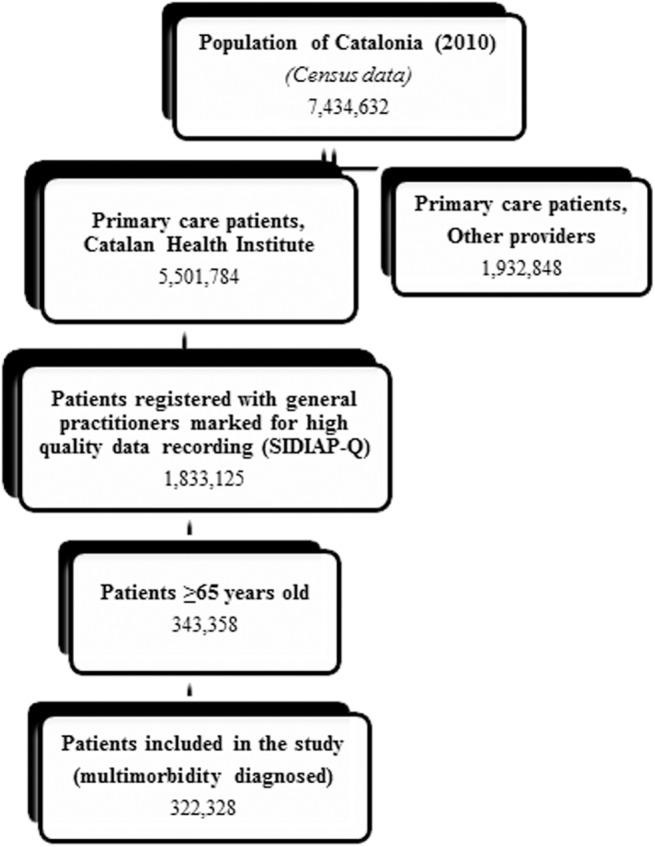
251 primary care centres in Catalonia, Spain.
PARTICIPANTS
Individuals older than 64 years registered with participating practices.
MAIN OUTCOME MEASURES
Multimorbidity, defined as the coexistence of 2 or more ICD-10 disease categories in the electronic health record. Using hierarchical cluster analysis, multimorbidity clusters were identified by sex and age group (65-79 and ≥80 years).
RESULTS
322,328 patients with multimorbidity were included in the analysis (mean age, 75.4 years [Standard deviation, SD: 7.4], 57.4% women; mean of 7.9 diagnoses [SD: 3.9]). For both men and women, the first cluster in both age groups included the same two diagnoses: Hypertensive diseases and Metabolic disorders. The second cluster contained three diagnoses of the musculoskeletal system in the 65- to 79-year-old group, and five diseases coincided in the ≥80 age group: varicose veins of the lower limbs, senile cataract, dorsalgia, functional intestinal disorders and shoulder lesions. The greatest overlap (54.5%) between the three most common diagnoses was observed in women aged 65-79 years.
CONCLUSION
This cluster analysis of elderly primary care patients with multimorbidity, revealed a single cluster of circulatory-metabolic diseases that were the most prevalent in both age groups and sex, and a cluster of second-most prevalent diagnoses that included musculoskeletal diseases. Clusters unknown to date have been identified. The clusters identified should be considered when developing clinical guidance for this population.
目的
本研究旨在识别在初级保健机构就诊的患有多种疾病的老年患者的诊断聚类。
设计
横断面研究。
地点
西班牙加泰罗尼亚的251个初级保健中心。
参与者
在参与研究的医疗机构登记的64岁以上个体。
主要观察指标
多种疾病,定义为电子健康记录中存在2种或更多ICD - 10疾病类别。使用层次聚类分析,按性别和年龄组(65 - 79岁和≥80岁)识别多种疾病聚类。
结果
322328例患有多种疾病的患者纳入分析(平均年龄75.4岁[标准差,SD:7.4],57.4%为女性;平均诊断数7.9个[SD:3.9])。对于男性和女性,两个年龄组的第一个聚类都包含相同的两种诊断:高血压疾病和代谢紊乱。第二个聚类在65至79岁年龄组包含三种肌肉骨骼系统诊断,在≥80岁年龄组有五种疾病重合:下肢静脉曲张、老年性白内障、背痛、功能性肠道疾病和肩部病变。在65 - 79岁女性中观察到三种最常见诊断之间的最大重叠(54.5%)。
结论
对患有多种疾病的老年初级保健患者进行的聚类分析显示,在两个年龄组和性别中最普遍的是单一的循环 - 代谢疾病聚类,以及包含肌肉骨骼疾病的第二普遍诊断聚类。已识别出迄今未知的聚类。在为该人群制定临床指南时应考虑所识别出的聚类。

 Zotero 插件