
植物中的非生物胁迫反应:钙调蛋白调节蛋白的作用。
Abiotic stress responses in plants: roles of calmodulin-regulated proteins.
作者信息
Virdi Amardeep S, Singh Supreet, Singh Prabhjeet
机构信息
Texture Analysis Laboratory, Department of Food Science & Technology, Guru Nanak Dev University Amritsar, India.
Plant Molecular Biology Laboratory, Department of Biotechnology, Guru Nanak Dev University Amritsar, India.
出版信息
Front Plant Sci. 2015 Oct 14;6:809. doi: 10.3389/fpls.2015.00809. eCollection 2015.
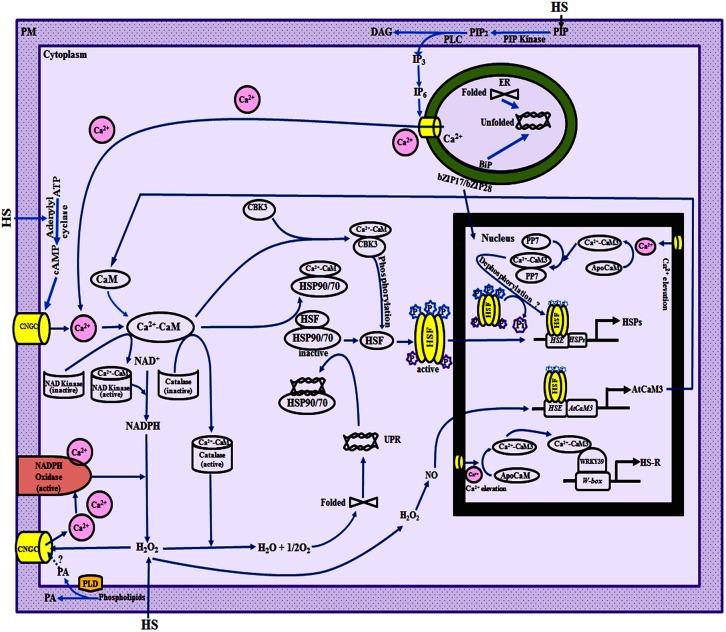
Intracellular changes in calcium ions (Ca(2+)) in response to different biotic and abiotic stimuli are detected by various sensor proteins in the plant cell. Calmodulin (CaM) is one of the most extensively studied Ca(2+)-sensing proteins and has been shown to be involved in transduction of Ca(2+) signals. After interacting with Ca(2+), CaM undergoes conformational change and influences the activities of a diverse range of CaM-binding proteins. A number of CaM-binding proteins have also been implicated in stress responses in plants, highlighting the central role played by CaM in adaptation to adverse environmental conditions. Stress adaptation in plants is a highly complex and multigenic response. Identification and characterization of CaM-modulated proteins in relation to different abiotic stresses could, therefore, prove to be essential for a deeper understanding of the molecular mechanisms involved in abiotic stress tolerance in plants. Various studies have revealed involvement of CaM in regulation of metal ions uptake, generation of reactive oxygen species and modulation of transcription factors such as CAMTA3, GTL1, and WRKY39. Activities of several kinases and phosphatases have also been shown to be modulated by CaM, thus providing further versatility to stress-associated signal transduction pathways. The results obtained from contemporary studies are consistent with the proposed role of CaM as an integrator of different stress signaling pathways, which allows plants to maintain homeostasis between different cellular processes. In this review, we have attempted to present the current state of understanding of the role of CaM in modulating different stress-regulated proteins and its implications in augmenting abiotic stress tolerance in plants.
植物细胞中的各种传感蛋白可检测到钙离子(Ca(2+))对不同生物和非生物刺激的细胞内变化。钙调蛋白(CaM)是研究最为广泛的Ca(2+)传感蛋白之一,已被证明参与Ca(2+)信号的转导。与Ca(2+)相互作用后,CaM会发生构象变化,并影响多种CaM结合蛋白的活性。许多CaM结合蛋白也与植物的应激反应有关,这突出了CaM在适应不利环境条件中所起的核心作用。植物的应激适应是一种高度复杂的多基因反应。因此,鉴定和表征与不同非生物胁迫相关的CaM调节蛋白,对于深入了解植物非生物胁迫耐受性的分子机制可能至关重要。各种研究表明,CaM参与金属离子吸收的调节、活性氧的产生以及转录因子如CAMTA3、GTL1和WRKY39的调节。几种激酶和磷酸酶的活性也已被证明受CaM调节,从而为与胁迫相关的信号转导途径提供了更多的多样性。当代研究结果与CaM作为不同胁迫信号转导途径整合者的 proposed role一致,这使植物能够维持不同细胞过程之间的稳态。在本综述中,我们试图介绍目前对CaM在调节不同胁迫调节蛋白中的作用及其对增强植物非生物胁迫耐受性的影响的理解现状。

 Zotero 插件