
通过细菌蛋白MinE的淀粉样生成区域在云母和支撑脂质双分子层上形成的蛋白纤维的原子力显微镜表征
Atomic Force Microscopy Characterization of Protein Fibrils Formed by the Amyloidogenic Region of the Bacterial Protein MinE on Mica and a Supported Lipid Bilayer.
作者信息
Chiang Ya-Ling, Chang Yuan-Chih, Chiang I-Chen, Mak Huey-Ming, Hwang Ing-Shouh, Shih Yu-Ling
机构信息
Institute of Physics, Academia Sinica, Taipei, Taiwan.
Department of Materials Science and Engineering, National Tsing Hua University, Hsinchu, Taiwan.
出版信息
PLoS One. 2015 Nov 12;10(11):e0142506. doi: 10.1371/journal.pone.0142506. eCollection 2015.
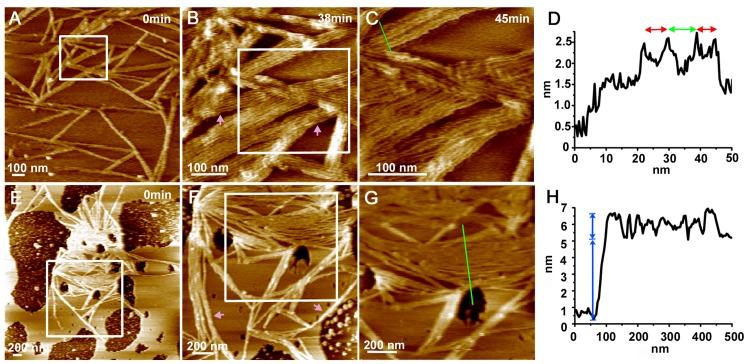
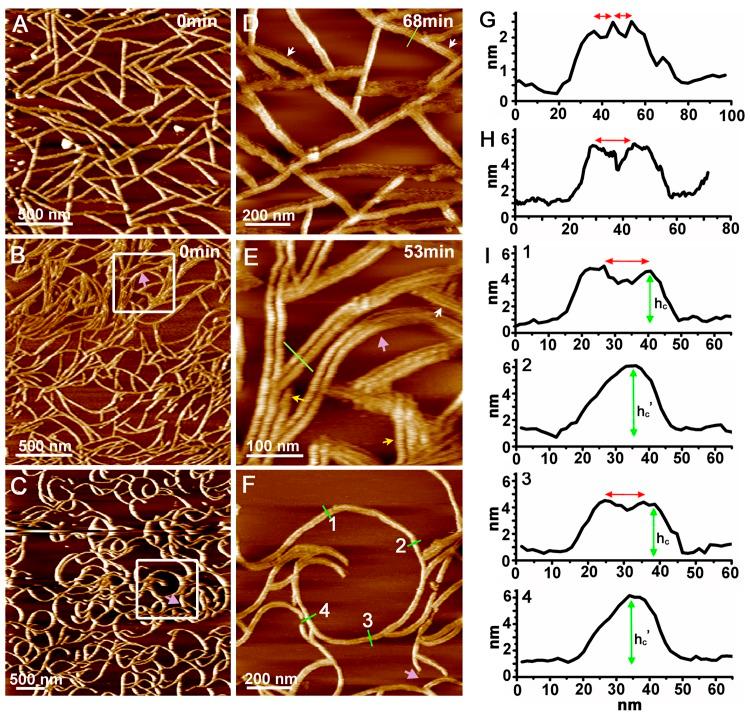
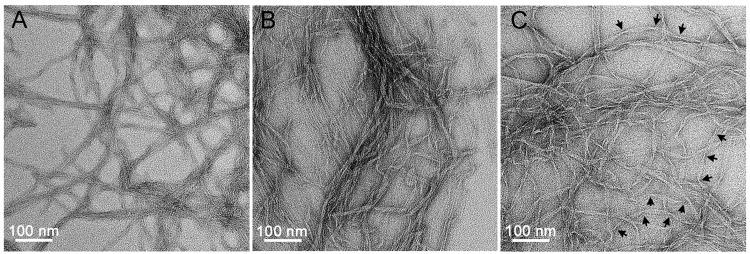
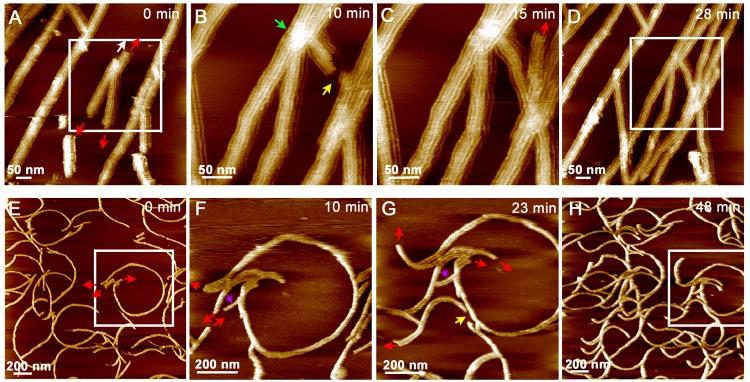
Amyloid fibrils play a crucial role in many human diseases and are found to function in a range of physiological processes from bacteria to human. They have also been gaining importance in nanotechnology applications. Understanding the mechanisms behind amyloid formation can help develop strategies towards the prevention of fibrillation processes or create new technological applications. It is thus essential to observe the structures of amyloids and their self-assembly processes at the nanometer-scale resolution under physiological conditions. In this work, we used highly force-sensitive frequency-modulation atomic force microscopy (FM-AFM) to characterize the fibril structures formed by the N-terminal domain of a bacterial division protein MinE in solution. The approach enables us to investigate the fibril morphology and protofibril organization over time progression and in response to changes in ionic strength, molecular crowding, and upon association with different substrate surfaces. In addition to comparison of the fibril structure and behavior of MinE1-31 under varying conditions, the study also broadens our understanding of the versatile behavior of amyloid-substrate surface interactions.
淀粉样纤维在许多人类疾病中起着关键作用,并且在从细菌到人类的一系列生理过程中都发挥着作用。它们在纳米技术应用中也越来越重要。了解淀粉样蛋白形成背后的机制有助于制定预防纤维化过程的策略或创造新的技术应用。因此,在生理条件下以纳米级分辨率观察淀粉样蛋白的结构及其自组装过程至关重要。在这项工作中,我们使用高力敏频率调制原子力显微镜(FM-AFM)来表征溶液中细菌分裂蛋白MinE的N端结构域形成的纤维结构。该方法使我们能够随着时间的推移以及响应离子强度、分子拥挤的变化以及与不同底物表面结合时,研究纤维形态和原纤维组织。除了比较不同条件下MinE1-31的纤维结构和行为外,该研究还拓宽了我们对淀粉样蛋白-底物表面相互作用的多样行为的理解。


 Zotero 插件