
使用16S rRNA基因扩增技术重建古代微生物群落所面临的内在挑战。
Intrinsic challenges in ancient microbiome reconstruction using 16S rRNA gene amplification.
作者信息
Ziesemer Kirsten A, Mann Allison E, Sankaranarayanan Krithivasan, Schroeder Hannes, Ozga Andrew T, Brandt Bernd W, Zaura Egija, Waters-Rist Andrea, Hoogland Menno, Salazar-García Domingo C, Aldenderfer Mark, Speller Camilla, Hendy Jessica, Weston Darlene A, MacDonald Sandy J, Thomas Gavin H, Collins Matthew J, Lewis Cecil M, Hofman Corinne, Warinner Christina
机构信息
Faculty of Archaeology, Leiden University, Einsteinweg 2, 2333 CC, Leiden, the Netherlands.
Department of Anthropology, University of Oklahoma, Norman, OK, USA.
出版信息
Sci Rep. 2015 Nov 13;5:16498. doi: 10.1038/srep16498.
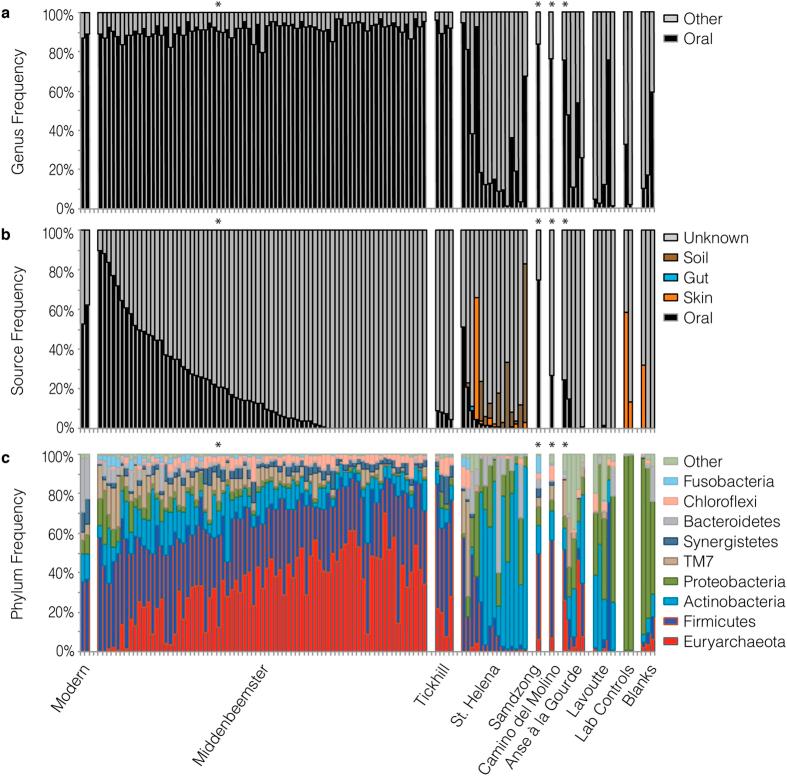
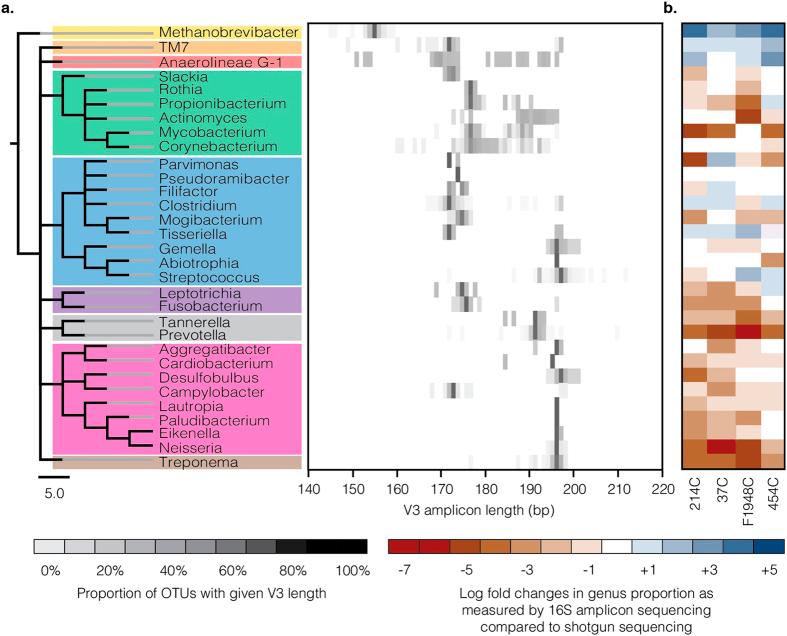
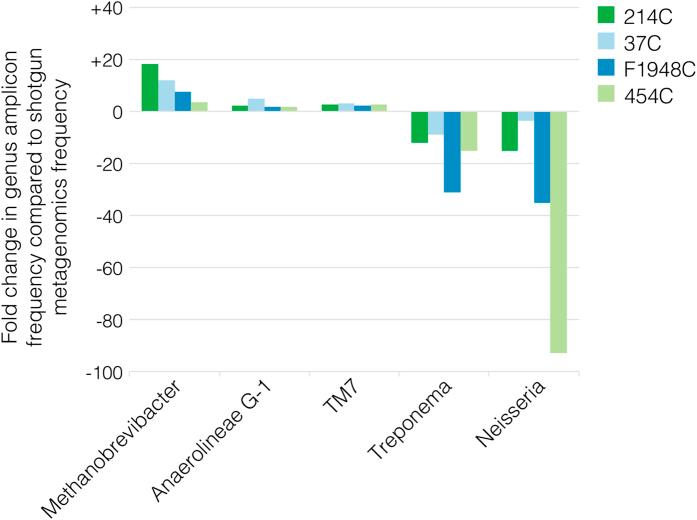
To date, characterization of ancient oral (dental calculus) and gut (coprolite) microbiota has been primarily accomplished through a metataxonomic approach involving targeted amplification of one or more variable regions in the 16S rRNA gene. Specifically, the V3 region (E. coli 341-534) of this gene has been suggested as an excellent candidate for ancient DNA amplification and microbial community reconstruction. However, in practice this metataxonomic approach often produces highly skewed taxonomic frequency data. In this study, we use non-targeted (shotgun metagenomics) sequencing methods to better understand skewed microbial profiles observed in four ancient dental calculus specimens previously analyzed by amplicon sequencing. Through comparisons of microbial taxonomic counts from paired amplicon (V3 U341F/534R) and shotgun sequencing datasets, we demonstrate that extensive length polymorphisms in the V3 region are a consistent and major cause of differential amplification leading to taxonomic bias in ancient microbiome reconstructions based on amplicon sequencing. We conclude that systematic amplification bias confounds attempts to accurately reconstruct microbiome taxonomic profiles from 16S rRNA V3 amplicon data generated using universal primers. Because in silico analysis indicates that alternative 16S rRNA hypervariable regions will present similar challenges, we advocate for the use of a shotgun metagenomics approach in ancient microbiome reconstructions.
迄今为止,古代口腔(牙结石)和肠道(粪化石)微生物群的特征描述主要是通过一种元分类学方法来完成的,该方法涉及对16S rRNA基因中一个或多个可变区域进行靶向扩增。具体而言,该基因的V3区域(大肠杆菌341 - 534)已被认为是古代DNA扩增和微生物群落重建的极佳候选区域。然而,在实际操作中,这种元分类学方法往往会产生高度偏态的分类频率数据。在本研究中,我们使用非靶向(鸟枪法宏基因组学)测序方法,以更好地理解在之前通过扩增子测序分析的四个古代牙结石样本中观察到的微生物图谱偏态情况。通过比较配对的扩增子(V3 U341F/534R)和鸟枪法测序数据集的微生物分类计数,我们证明V3区域广泛的长度多态性是差异扩增的一致且主要原因,这导致基于扩增子测序的古代微生物组重建中出现分类偏差。我们得出结论,系统性扩增偏差混淆了从使用通用引物生成的16S rRNA V3扩增子数据准确重建微生物组分类图谱的尝试。因为计算机模拟分析表明,其他16S rRNA高变区也会带来类似挑战,所以我们主张在古代微生物组重建中使用鸟枪法宏基因组学方法。



 Zotero 插件