
在《国际疾病分类第11版》(ICD - 11)的背景下将衰老归类为一种疾病。
Classifying aging as a disease in the context of ICD-11.
作者信息
Zhavoronkov Alex, Bhullar Bhupinder
机构信息
The Biogerontology Research Foundation , Oxford, UK ; Insilico Medicine Inc , Baltimore, MD, USA.
Novartis Pharma AG, Department of Developmental and Molecular Pathways, Novartis Institute for Biomedical Research , Basel, Switzerland.
出版信息
Front Genet. 2015 Nov 4;6:326. doi: 10.3389/fgene.2015.00326. eCollection 2015.
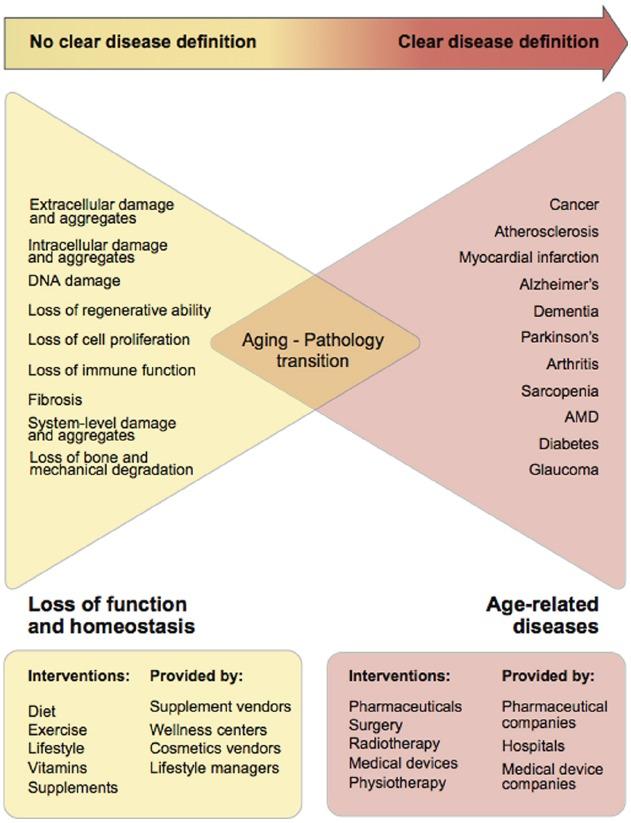
Aging is a complex continuous multifactorial process leading to loss of function and crystalizing into the many age-related diseases. Here, we explore the arguments for classifying aging as a disease in the context of the upcoming World Health Organization's 11th International Statistical Classification of Diseases and Related Health Problems (ICD-11), expected to be finalized in 2018. We hypothesize that classifying aging as a disease with a "non-garbage" set of codes will result in new approaches and business models for addressing aging as a treatable condition, which will lead to both economic and healthcare benefits for all stakeholders. Actionable classification of aging as a disease may lead to more efficient allocation of resources by enabling funding bodies and other stakeholders to use quality-adjusted life years (QALYs) and healthy-years equivalent (HYE) as metrics when evaluating both research and clinical programs. We propose forming a Task Force to interface the WHO in order to develop a multidisciplinary framework for classifying aging as a disease with multiple disease codes facilitating for therapeutic interventions and preventative strategies.
衰老 是一个复杂的、持续的多因素过程,会导致功能丧失,并逐渐发展为多种与年龄相关的疾病。在此,我们探讨在即将到来的世界卫生组织第11版《国际疾病分类及相关健康问题统计分类》(ICD - 11)(预计2018年定稿)的背景下,将衰老归类为一种疾病的相关论据。我们假设,将衰老归类为一种具有“非垃圾”代码集的疾病,将产生新的方法和商业模式,把衰老作为一种可治疗的状况来应对,这将为所有利益相关者带来经济和医疗保健方面的益处。将衰老作为一种疾病进行可操作的分类,可能会通过使资助机构和其他利益相关者在评估研究和临床项目时,将质量调整生命年(QALY)和健康等效年(HYE)作为衡量标准,从而实现更有效的资源分配。我们提议成立一个特别工作组与世界卫生组织对接,以便制定一个多学科框架,将衰老归类为一种具有多种疾病代码的疾病,便于进行治疗干预和预防策略。
 Zotero 插件