
通过调节沟道厚度实现用于生物电子学的高性能晶体管。
High-performance transistors for bioelectronics through tuning of channel thickness.
作者信息
Rivnay Jonathan, Leleux Pierre, Ferro Marc, Sessolo Michele, Williamson Adam, Koutsouras Dimitrios A, Khodagholy Dion, Ramuz Marc, Strakosas Xenofon, Owens Roisin M, Benar Christian, Badier Jean-Michel, Bernard Christophe, Malliaras George G
机构信息
Department of Bioelectronics, École Nationale Supérieure des Mines, CMP-EMSE, MOC, 13541 Gardanne, France.
Department of Bioelectronics, École Nationale Supérieure des Mines, CMP-EMSE, MOC, 13541 Gardanne, France. ; MicroVitae Technologies, Pôle d'Activité Y. Morandat, 1480 rue d'Arménie, 13120 Gardanne, France.
出版信息
Sci Adv. 2015 May 22;1(4):e1400251. doi: 10.1126/sciadv.1400251. eCollection 2015 May.
UNLABELLED
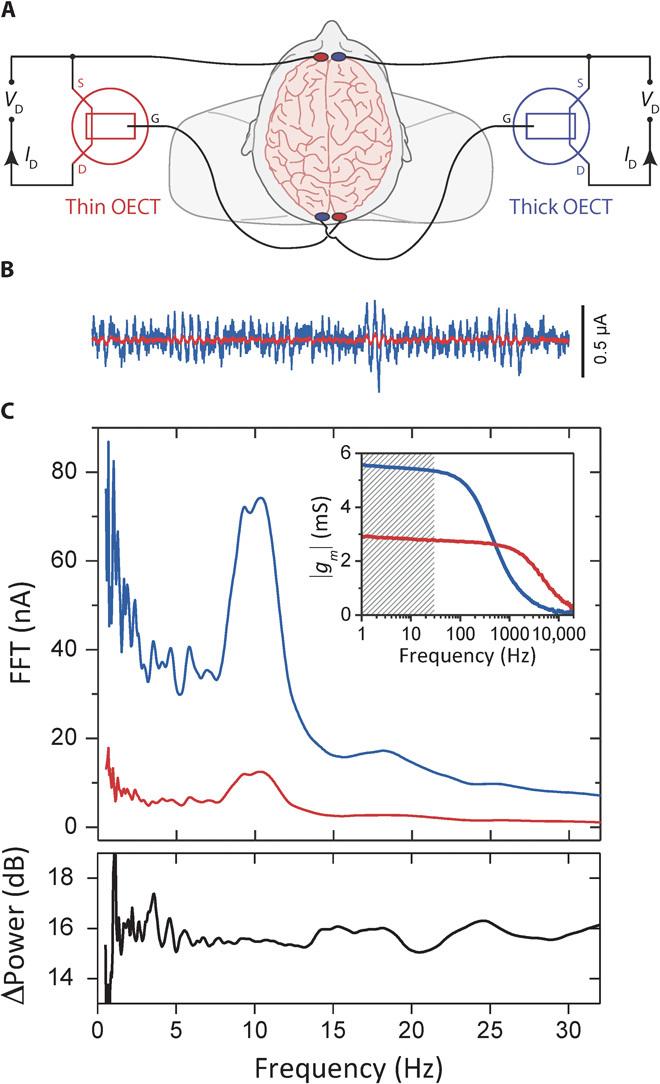
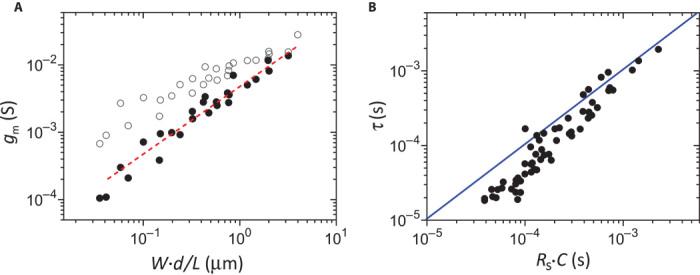
Despite recent interest in organic electrochemical transistors (OECTs), sparked by their straightforward fabrication and high performance, the fundamental mechanism behind their operation remains largely unexplored. OECTs use an electrolyte in direct contact with a polymer channel as part of their device structure. Hence, they offer facile integration with biological milieux and are currently used as amplifying transducers for bioelectronics. Ion exchange between electrolyte and channel is believed to take place in OECTs, although the extent of this process and its impact on device characteristics are still unknown. We show that the uptake of ions from an electrolyte into a film of poly(3,4-ethylenedioxythiophene) doped with polystyrene sulfonate (
PEDOT
PSS) leads to a purely volumetric capacitance of 39 F/cm(3). This results in a dependence of the transconductance on channel thickness, a new degree of freedom that we exploit to demonstrate high-quality recordings of human brain rhythms. Our results bring to the forefront a transistor class in which performance can be tuned independently of device footprint and provide guidelines for the design of materials that will lead to state-of-the-art transistor performance.
未标注
尽管近期有机电化学晶体管(OECT)因其制造工艺简单和高性能引发了人们的兴趣,但其工作背后的基本机制在很大程度上仍未得到探索。OECT在其器件结构中使用与聚合物通道直接接触的电解质。因此,它们便于与生物环境集成,目前被用作生物电子学的放大换能器。尽管电解质与通道之间离子交换的程度及其对器件特性的影响尚不清楚,但人们认为OECT中会发生这种离子交换。我们表明,从电解质中摄取离子到掺杂有聚苯乙烯磺酸盐的聚(3,4 - 亚乙二氧基噻吩)(PEDOT:PSS)薄膜中会产生39 F/cm³的纯体积电容。这导致跨导对通道厚度的依赖性,这是一个新的自由度,我们利用它来展示高质量的人类脑电波记录。我们的结果将一类晶体管推到前沿,这类晶体管的性能可以独立于器件尺寸进行调整,并为设计能实现先进晶体管性能的材料提供了指导方针。

 Zotero 插件