
帕金森病和路易体痴呆患者脑脊液来源外泌体诱导α-突触核蛋白聚集体形成
Induction of α-synuclein aggregate formation by CSF exosomes from patients with Parkinson's disease and dementia with Lewy bodies.
作者信息
Stuendl Anne, Kunadt Marcel, Kruse Niels, Bartels Claudia, Moebius Wiebke, Danzer Karin M, Mollenhauer Brit, Schneider Anja
机构信息
1 Department of Psychiatry and Psychotherapy, University Medicine Göttingen, Von-Siebold-Str. 5, 37075 Göttingen, Germany 2 Max-Planck-Institute for Experimental Medicine, Hermann-Rein-Str. 3, 37075 Göttingen, Germany.
1 Department of Psychiatry and Psychotherapy, University Medicine Göttingen, Von-Siebold-Str. 5, 37075 Göttingen, Germany 2 Max-Planck-Institute for Experimental Medicine, Hermann-Rein-Str. 3, 37075 Göttingen, Germany 3 Cluster of Excellence 'Nanoscale Microscopy and Molecular Physiology of the Brain' (CNMPB), Göttingen, Germany.
出版信息
Brain. 2016 Feb;139(Pt 2):481-94. doi: 10.1093/brain/awv346. Epub 2015 Dec 8.
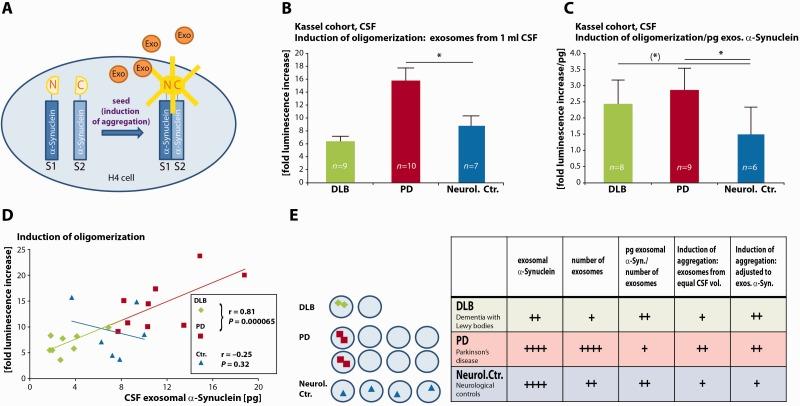
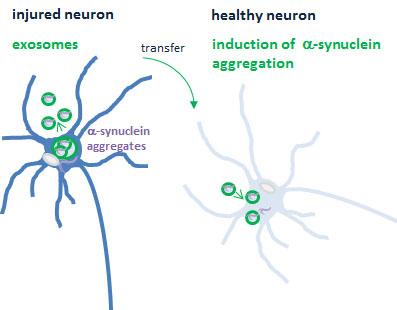
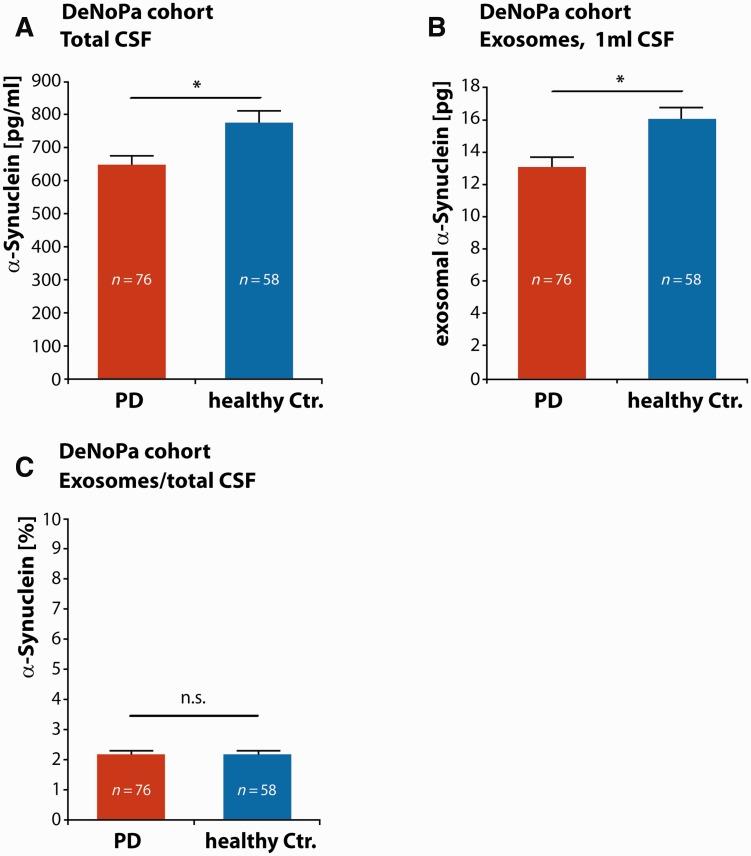
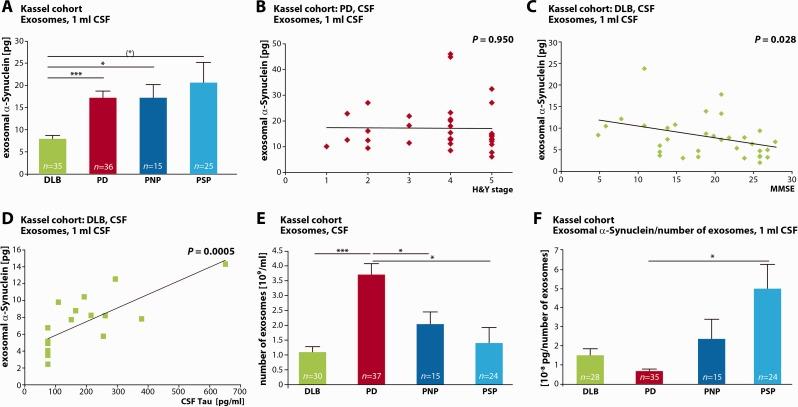
Extracellular α-synuclein has been proposed as a crucial mechanism for induction of pathological aggregate formation in previously healthy cells. In vitro, extracellular α-synuclein is partially associated with exosomal vesicles. Recently, we have provided evidence that exosomal α-synuclein is present in the central nervous system in vivo. We hypothesized that exosomal α-synuclein species from patients with α-synuclein related neurodegeneration serve as carriers for interneuronal disease transmission. We isolated exosomes from cerebrospinal fluid from patients with Parkinson's disease, dementia with Lewy bodies, progressive supranuclear palsy as a non-α-synuclein related disorder that clinically overlaps with Parkinson's disease, and neurological controls. Cerebrospinal fluid exosome numbers, α-synuclein protein content of cerebrospinal fluid exosomes and their potential to induce oligomerization of α-synuclein were analysed. The quantification of cerebrospinal fluid exosomal α-synuclein showed distinct differences between patients with Parkinson's disease and dementia with Lewy bodies. In addition, exosomal α-synuclein levels correlated with the severity of cognitive impairment in cross-sectional samples from patients with dementia with Lewy bodies. Importantly, cerebrospinal fluid exosomes derived from Parkinson's disease and dementia with Lewy bodies induce oligomerization of α-synuclein in a reporter cell line in a dose-dependent manner. Our data suggest that cerebrospinal fluid exosomes from patients with Parkinson's disease and dementia with Lewy bodies contain a pathogenic species of α-synuclein, which could initiate oligomerization of soluble α-synuclein in target cells and confer disease pathology.
细胞外α-突触核蛋白被认为是诱导先前健康细胞中病理性聚集体形成的关键机制。在体外,细胞外α-突触核蛋白部分与外泌体囊泡相关。最近,我们提供了证据表明体内中枢神经系统中存在外泌体α-突触核蛋白。我们假设来自α-突触核蛋白相关神经退行性疾病患者的外泌体α-突触核蛋白作为神经元间疾病传播的载体。我们从帕金森病、路易体痴呆、进行性核上性麻痹(作为一种临床上与帕金森病重叠的非α-突触核蛋白相关疾病)患者以及神经学对照的脑脊液中分离出外泌体。分析了脑脊液外泌体数量、脑脊液外泌体α-突触核蛋白含量及其诱导α-突触核蛋白寡聚化的潜力。脑脊液外泌体α-突触核蛋白的定量分析显示帕金森病患者和路易体痴呆患者之间存在明显差异。此外,在路易体痴呆患者的横断面样本中,外泌体α-突触核蛋白水平与认知障碍的严重程度相关。重要的是,源自帕金森病和路易体痴呆的脑脊液外泌体在报告细胞系中以剂量依赖方式诱导α-突触核蛋白寡聚化。我们的数据表明,帕金森病和路易体痴呆患者的脑脊液外泌体含有一种致病性α-突触核蛋白,它可以引发靶细胞中可溶性α-突触核蛋白的寡聚化并导致疾病病理。

 Zotero 插件