
孕期及产后耻骨直肠肌平均回声性及面积的变化。
Changes in the mean echogenicity and area of the puborectalis muscle during pregnancy and postpartum.
作者信息
Grob Anique T M, Withagen Mariella I J, van de Waarsenburg Maria K, Schweitzer Karlijn J, van der Vaart Carl H
机构信息
Department of Reproductive Medicine and Gynecology, University Medical Center, PO box 85500, 3508 GA, Utrecht, Netherlands.
MIRA Institute for Biomedical Technology and Technical Medicine, University of Twente, Enschede, Netherlands.
出版信息
Int Urogynecol J. 2016 Jun;27(6):895-901. doi: 10.1007/s00192-015-2905-4. Epub 2015 Dec 16.
INTRODUCTION AND HYPOTHESIS
Three-dimensional (3D) and four-dimensional (4D) volume transperineal ultrasound imaging is increasingly used to assess changes in the dimensions of the pelvic floor during pregnancy and after delivery. Little is known with regard to the area of the puborectalis muscle and its structural changes. Echogenicity measurement, a parameter that provides information on the structure of muscles, is increasingly used in orthopaedics and neuromuscular disease evaluation. This study is aimed at assessing the changes in the mean echogenicity of the puborectalis muscle (MEP) and the puborectalis muscle area (PMA) during first pregnancy and after childbirth.
METHODS
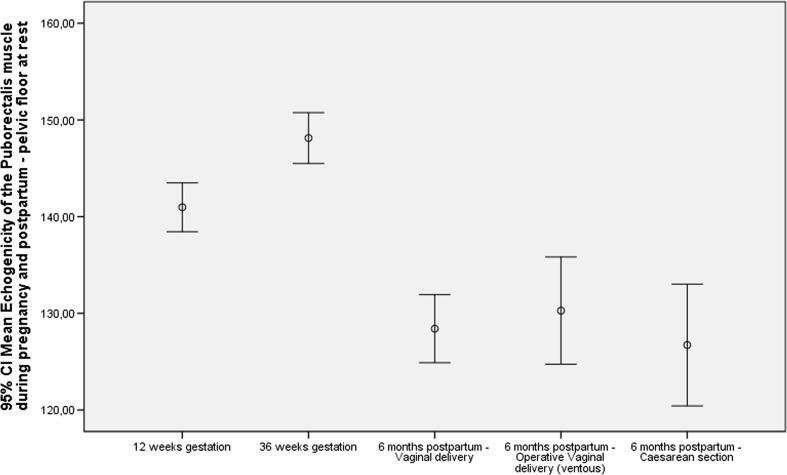
The MEP and PMA of 254 women during first pregnancy were measured at 12 and 36 weeks' gestation and 6 months postpartum. To determine the effect of child-birth on MEP and PMA, the results at 6 months postpartum were separately analysed for vaginal deliveries, operative vaginal deliveries (ventouse) and caesarean section deliveries. Mean differences in MEP and PMA were analysed using ANOVA statistics.
RESULTS
The MEP at 6 months postpartum was, independent of manoeuvre, significantly (p < 0.001) lower than MEP values during pregnancy. After caesarean delivery, the PMA was significantly smaller at maximum pelvic floor contraction than PMA after vaginal delivery (p = 0.003) or operative vaginal delivery (p = 0.002).
CONCLUSION
Our study indicates that structural changes in the puborectalis muscle during and after pregnancy, as measured by MEP, occur and can be analysed. In addition, the mode of delivery affects the area of the puborectalis during contraction after delivery. For true volume analysis, as part of an assessment of contractility of the puborectalis muscle we will need 3D volume analysis.
引言与假设
三维(3D)和四维(4D)经会阴容积超声成像越来越多地用于评估孕期和产后盆底维度的变化。关于耻骨直肠肌的面积及其结构变化,我们了解得很少。回声强度测量是一种可提供肌肉结构信息的参数,越来越多地用于骨科和神经肌肉疾病评估。本研究旨在评估首次怀孕期间及产后耻骨直肠肌的平均回声强度(MEP)和耻骨直肠肌面积(PMA)的变化。
方法
对254名首次怀孕的女性在妊娠12周和36周以及产后6个月时测量其MEP和PMA。为了确定分娩对MEP和PMA的影响,分别分析了阴道分娩、产钳助产术阴道分娩和剖宫产分娩产后6个月时的结果。使用方差分析统计方法分析MEP和PMA中的平均差异。
结果
产后6个月时的MEP,无论分娩方式如何,均显著低于孕期的MEP值(p<0.001)。剖宫产分娩后,在最大盆底收缩时的PMA显著小于阴道分娩(p=0.003)或产钳助产术阴道分娩(p=0.002)后的PMA。
结论
我们的研究表明,通过MEP测量可知,孕期及产后耻骨直肠肌会发生结构变化,且可以进行分析。此外,分娩方式会影响产后收缩时耻骨直肠肌的面积。对于真正的容积分析,作为耻骨直肠肌收缩力评估的一部分,我们需要3D容积分析。


 Zotero 插件