
1998年至2012年韩国儿童肥胖指标的趋势
Trends in Measures of Childhood Obesity in Korea From 1998 to 2012.
作者信息
Bahk Jinwook, Khang Young-Ho
机构信息
Institute of Health Policy and Management, Seoul National University Medical Research Center.
出版信息
J Epidemiol. 2016;26(4):199-207. doi: 10.2188/jea.JE20140270. Epub 2015 Dec 19.
BACKGROUND
During the last several decades, the number of children who are overweight or obese has reached alarming levels worldwide. The purpose of the present study was to examine trends in measures of childhood obesity among Korean children aged 2-19 from 1998 to 2012.
METHODS
Height, weight, and waist circumference (WC) were measured, and body mass index (BMI) was calculated. Age-adjusted means of WC and BMI were compared between years. We used three international criteria (International Obesity Task Force [IOTF], World Health Organization [WHO], United States Centers for Disease Control and Prevention [CDC]) and a Korean national reference standard (Korea Centers for Disease Control and Prevention [KCDC]) to calculate age-standardized prevalence of childhood overweight and obesity.
RESULTS
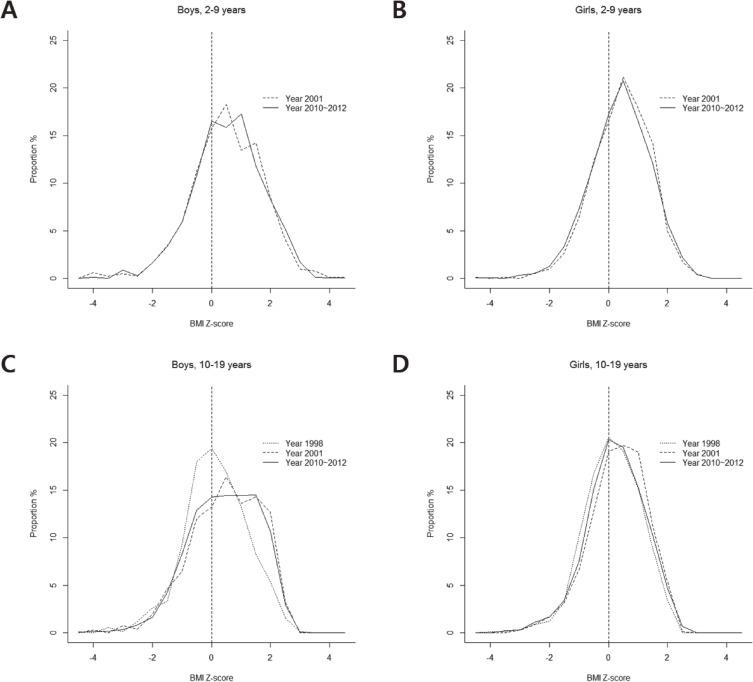
Despite differences in absolute prevalence of childhood overweight and obesity according to the four different criteria, the time trends of prevalence were generally similar across criteria. The prevalence of childhood overweight and obesity generally stabilized from 2001-2012 in both boys and girls. WC decreased from 2001-2012 in both boys and girls aged 2-19.
CONCLUSIONS
Further studies exploring the factors causing plateaued trends of childhood obesity measures are needed to implement effective policies for reducing the prevalence of childhood overweight and obesity.
背景
在过去几十年间,全球超重或肥胖儿童的数量已达到惊人水平。本研究的目的是调查1998年至2012年韩国2至19岁儿童肥胖指标的变化趋势。
方法
测量身高、体重和腰围(WC),并计算体重指数(BMI)。比较各年份之间年龄调整后的WC和BMI均值。我们使用三种国际标准(国际肥胖特别工作组[IOTF]、世界卫生组织[WHO]、美国疾病控制与预防中心[CDC])以及韩国国家参考标准(韩国疾病控制与预防中心[KCDC])来计算儿童超重和肥胖的年龄标准化患病率。
结果
尽管根据四种不同标准得出的儿童超重和肥胖的绝对患病率存在差异,但各标准下患病率的时间趋势总体相似。2001年至2012年期间,男孩和女孩的儿童超重和肥胖患病率总体趋于稳定。2001年至2012年期间,2至19岁男孩和女孩的WC均有所下降。
结论
需要进一步研究探讨导致儿童肥胖指标趋势趋于平稳的因素,以便实施有效政策来降低儿童超重和肥胖的患病率。
 Zotero 插件