
肺癌呼吸生物标志物的盲法验证:胸部CT筛查的潜在辅助手段
Blinded Validation of Breath Biomarkers of Lung Cancer, a Potential Ancillary to Chest CT Screening.
作者信息
Phillips Michael, Bauer Thomas L, Cataneo Renee N, Lebauer Cassie, Mundada Mayur, Pass Harvey I, Ramakrishna Naren, Rom William N, Vallières Eric
机构信息
Breath Research Laboratory, Menssana Research Inc, 211 Warren St, Newark, NJ, 07103, United States of America.
Department of Medicine, New York Medical College, Valhalla, NY, United States of America.
出版信息
PLoS One. 2015 Dec 23;10(12):e0142484. doi: 10.1371/journal.pone.0142484. eCollection 2015.
BACKGROUND
Breath volatile organic compounds (VOCs) have been reported as biomarkers of lung cancer, but it is not known if biomarkers identified in one group can identify disease in a separate independent cohort. Also, it is not known if combining breath biomarkers with chest CT has the potential to improve the sensitivity and specificity of lung cancer screening.
METHODS
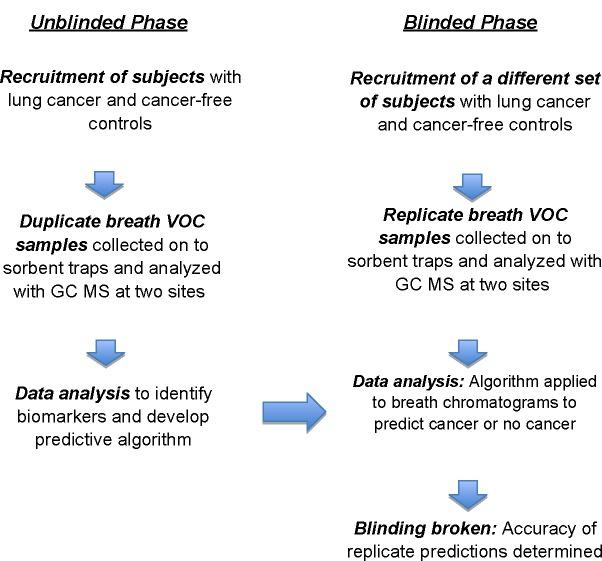
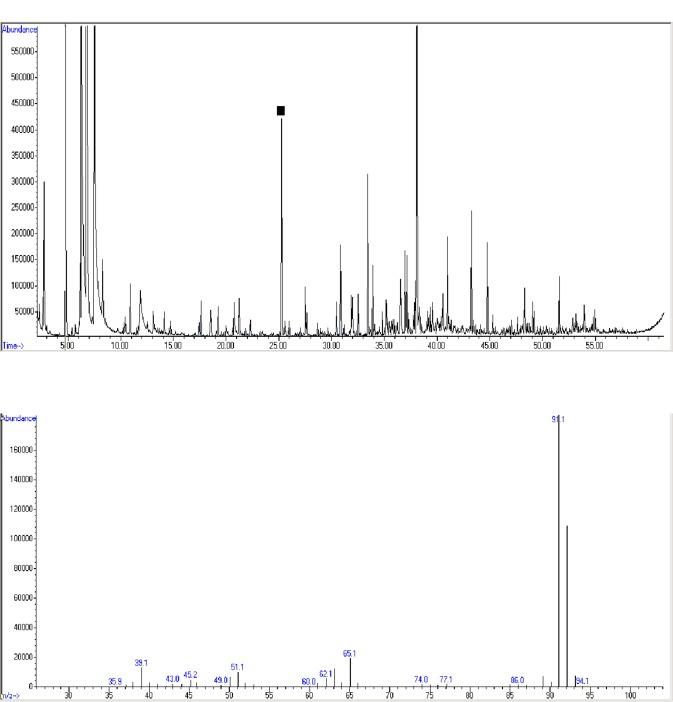
Model-building phase (unblinded): Breath VOCs were analyzed with gas chromatography mass spectrometry in 82 asymptomatic smokers having screening chest CT, 84 symptomatic high-risk subjects with a tissue diagnosis, 100 without a tissue diagnosis, and 35 healthy subjects. Multiple Monte Carlo simulations identified breath VOC mass ions with greater than random diagnostic accuracy for lung cancer, and these were combined in a multivariate predictive algorithm. Model-testing phase (blinded validation): We analyzed breath VOCs in an independent cohort of similar subjects (n = 70, 51, 75 and 19 respectively). The algorithm predicted discriminant function (DF) values in blinded replicate breath VOC samples analyzed independently at two laboratories (A and B). Outcome modeling: We modeled the expected effects of combining breath biomarkers with chest CT on the sensitivity and specificity of lung cancer screening.
RESULTS
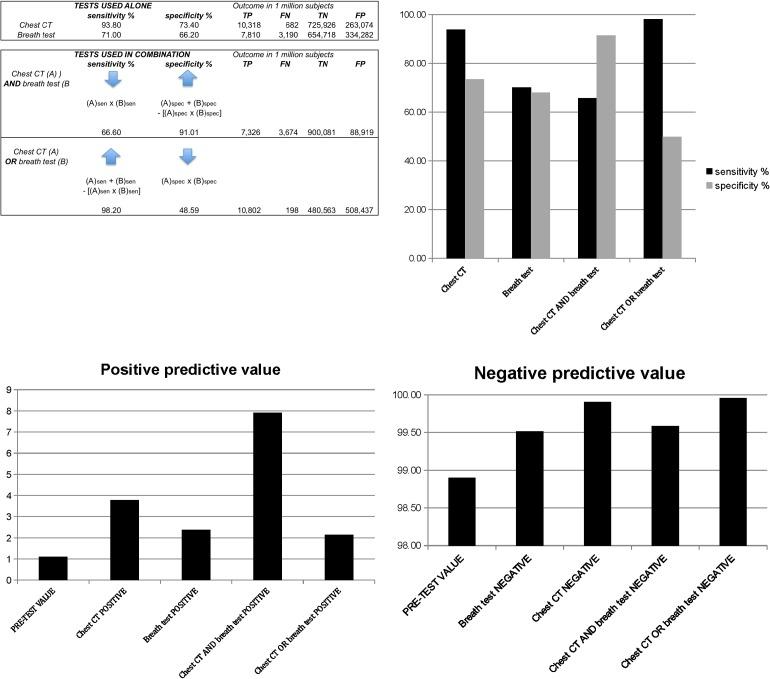
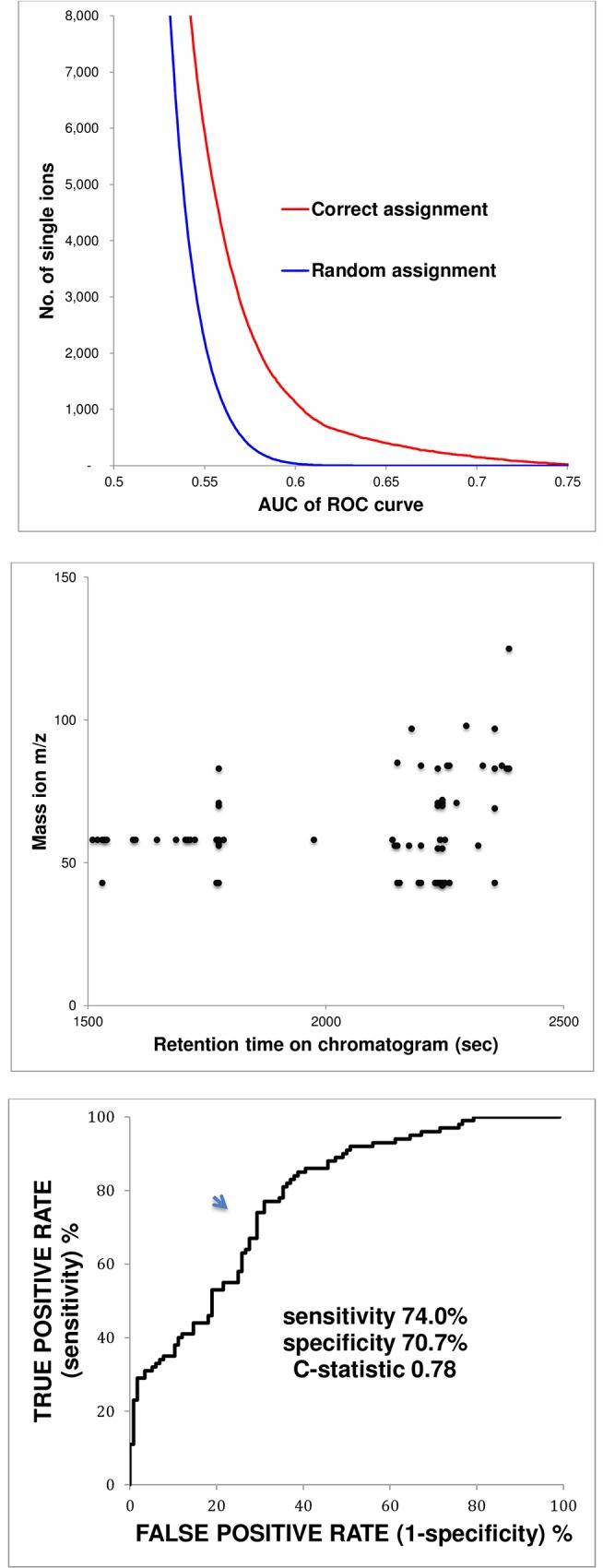
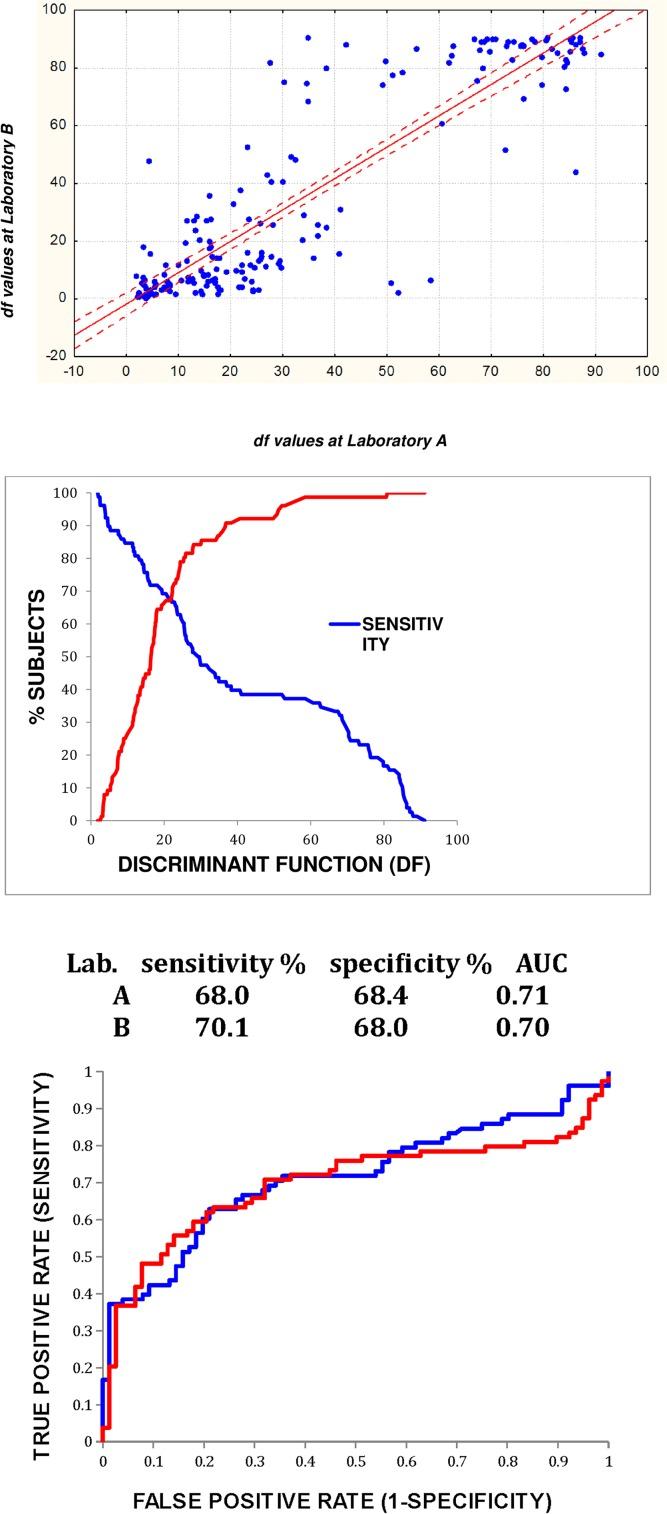
Unblinded model-building phase. The algorithm identified lung cancer with sensitivity 74.0%, specificity 70.7% and C-statistic 0.78. Blinded model-testing phase: The algorithm identified lung cancer at Laboratory A with sensitivity 68.0%, specificity 68.4%, C-statistic 0.71; and at Laboratory B with sensitivity 70.1%, specificity 68.0%, C-statistic 0.70, with linear correlation between replicates (r = 0.88). In a projected outcome model, breath biomarkers increased the sensitivity, specificity, and positive and negative predictive values of chest CT for lung cancer when the tests were combined in series or parallel.
CONCLUSIONS
Breath VOC mass ion biomarkers identified lung cancer in a separate independent cohort, in a blinded replicated study. Combining breath biomarkers with chest CT could potentially improve the sensitivity and specificity of lung cancer screening.
TRIAL REGISTRATION
ClinicalTrials.gov NCT00639067.
背景
呼气挥发性有机化合物(VOCs)已被报道为肺癌的生物标志物,但尚不清楚在一组中鉴定出的生物标志物能否在另一独立队列中识别疾病。此外,尚不清楚将呼气生物标志物与胸部CT相结合是否有提高肺癌筛查敏感性和特异性的潜力。
方法
模型构建阶段(非盲法):采用气相色谱 - 质谱法分析了82名进行胸部CT筛查的无症状吸烟者、84名有组织学诊断的有症状高危受试者、100名无组织学诊断的受试者以及35名健康受试者的呼气VOCs。多次蒙特卡罗模拟确定了对肺癌具有高于随机诊断准确性的呼气VOC质量离子,并将这些离子组合成多变量预测算法。模型测试阶段(盲法验证):我们在一个类似受试者的独立队列中分析了呼气VOCs(分别为n = 70、51、75和19)。该算法在两个独立实验室(A和B)对盲法重复的呼气VOC样本进行分析时预测判别函数(DF)值。结果建模:我们模拟了将呼气生物标志物与胸部CT相结合对肺癌筛查敏感性和特异性的预期效果。
结果
非盲法模型构建阶段。该算法识别肺癌的敏感性为74.0%,特异性为70.7%,C统计量为0.78。盲法模型测试阶段:该算法在实验室A识别肺癌的敏感性为68.0%,特异性为68.4%,C统计量为0.71;在实验室B识别肺癌的敏感性为70.1%,特异性为68.0%,C统计量为0.70,重复检测之间存在线性相关性(r = 0.88)。在一个预测结果模型中,当呼气生物标志物与胸部CT串联或并联组合时,可提高胸部CT对肺癌的敏感性、特异性以及阳性和阴性预测值。
结论
在一项盲法重复研究中,呼气VOC质量离子生物标志物在一个独立队列中识别出了肺癌。将呼气生物标志物与胸部CT相结合可能会提高肺癌筛查的敏感性和特异性。
试验注册
ClinicalTrials.gov NCT00639067。
 Zotero 插件