
基于高分辨率计算机断层扫描的硬皮病相关间质性肺疾病肺功能下降的预测因素:对系统性硬化症相关间质性肺疾病试验中队列富集的意义。
Predictors of lung function decline in scleroderma-related interstitial lung disease based on high-resolution computed tomography: implications for cohort enrichment in systemic sclerosis-associated interstitial lung disease trials.
作者信息
Khanna Dinesh, Nagaraja Vivek, Tseng Chi-Hong, Abtin Fereidoun, Suh Robert, Kim Grace, Wells Athol, Furst Daniel E, Clements Philip J, Roth Michael D, Tashkin Donald P, Goldin Jonathan
机构信息
University of Michigan Scleroderma Program, Division of Rheumatology, Department of Internal Medicine, University of Michigan, Suite 7C27, 300 North Ingalls Street, SPC 5422, Ann Arbor, MI, 48109, USA.
Division of Rheumatology, University of Toledo, Toledo, OH, USA.
出版信息
Arthritis Res Ther. 2015 Dec 23;17:372. doi: 10.1186/s13075-015-0872-2.
BACKGROUND
The extent of lung involvement visualized by high-resolution computed tomography (HRCT) is a predictor of decline in forced vital capacity (FVC) in scleroderma-interstitial lung disease. Our objective was to evaluate the performance of three different HRCT-defined staging systems in the Scleroderma Lung Study I (SLS I) over a 1-year period.
METHODS
We assessed two visual semiquantitative scores: the maximum fibrosis score (MaxFib, the fibrosis score in the zone of maximal lung involvement) and visual assessment of total lung involvement (TLI) as proposed by Goh and Wells. In addition, we evaluated the computer-aided diagnosis and calculated the quantitative percentage with fibrosis (QLF) and TLI.
RESULTS
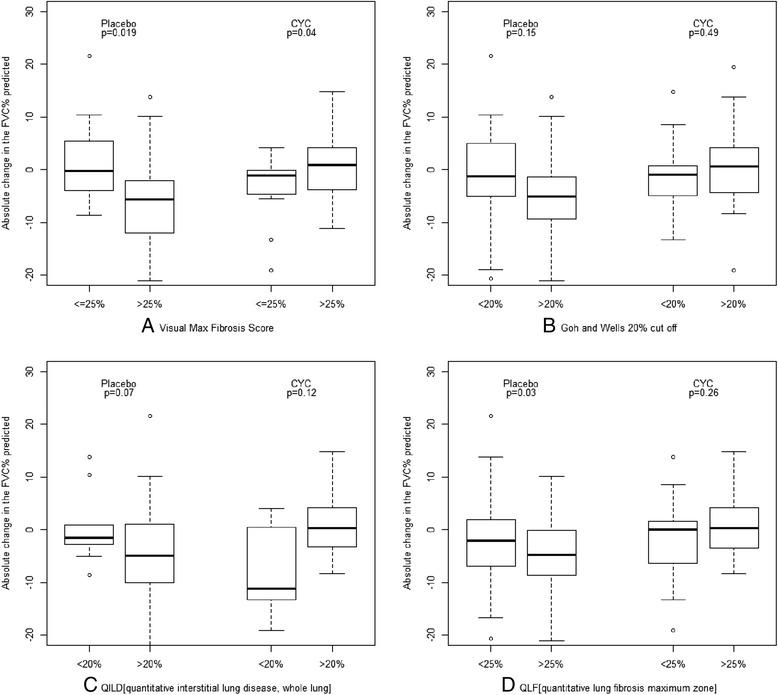
The mean duration of the disease was 3.2 years, and the mean FVC was 67.7 %. Regardless of the staging system used, a greater degree of fibrosis/TLI on HRCT scans was associated with a greater decline in FVC in the placebo group. Using the MaxFib and QLF, the mean absolute changes in FVC from baseline were 0.1% and -1.4%, respectively, in <25% lung involvement vs. a change of -6.2% and -6.9%, respectively, with >25% involvement (negative score denotes worsening in FVC). Conversely, cyclophosphamide was able to stabilize decline in FVC in subjects with greater degree of involvement detected by HRCT. Using the visual MaxFib and QLF, the mean absolute improvements in FVC were 1.2 and 1.1, respectively, with >25% involvement.
CONCLUSIONS
HRCT-defined lung involvement was a predictor of decline in FVC in SLS I. The choice of staging system for cohort enrichment in a clinical trial depends on feasibility.
TRIAL REGISTRATION
ClinicalTrials.gov identifier: NCT00004563 (Scleroderma Lung Study I) ISRCTN15982171. Registered 19 Aug 2015.
背景
高分辨率计算机断层扫描(HRCT)显示的肺部受累程度是硬皮病-间质性肺疾病中用力肺活量(FVC)下降的一个预测指标。我们的目的是在硬皮病肺部研究I(SLS I)中评估三种不同的HRCT定义的分期系统在1年期间的表现。
方法
我们评估了两个视觉半定量评分:最大纤维化评分(MaxFib,最大肺部受累区域的纤维化评分)和如Goh和Wells所提出的对全肺受累的视觉评估(TLI)。此外,我们评估了计算机辅助诊断并计算了纤维化定量百分比(QLF)和TLI。
结果
疾病的平均病程为3.2年,平均FVC为67.7%。无论使用何种分期系统,在安慰剂组中,HRCT扫描上更高程度的纤维化/TLI与FVC更大程度的下降相关。使用MaxFib和QLF,肺部受累<25%时,FVC相对于基线的平均绝对变化分别为0.1%和 -1.4%,而肺部受累>25%时,变化分别为 -6.2%和 -6.9%(负评分表示FVC恶化)。相反,环磷酰胺能够稳定HRCT检测到的受累程度较高的受试者的FVC下降。使用视觉MaxFib和QLF,肺部受累>25%时,FVC的平均绝对改善分别为1.2和1.1。
结论
HRCT定义的肺部受累是SLS I中FVC下降的一个预测指标。在临床试验中用于队列富集的分期系统的选择取决于可行性。
试验注册
ClinicalTrials.gov标识符:NCT00004563(硬皮病肺部研究I)ISRCTN15982171。于2015年8月19日注册。
 Zotero 插件