
2010 - 2012年北京地区急性上呼吸道感染抗菌药物的处方情况
Prescription of antibacterial agents for acute upper respiratory tract infections in Beijing, 2010-2012.
作者信息
Wu Yiqun, Yang Chao, Xi Hanxu, Zhang Yang, Zhou Zijun, Hu Yonghua
机构信息
Department of Epidemiology and Biostatistics, School of Public Health, Peking University Health Science Centre, 38 Xueyuan Rd., Haidian district, Beijing, 100191, People's Republic of China.
Department of Health Policy and Management, School of Public Health, Peking University Health Science Centre, Beijing, China.
出版信息
Eur J Clin Pharmacol. 2016 Mar;72(3):359-64. doi: 10.1007/s00228-015-1997-6. Epub 2015 Dec 26.
PURPOSE
The purpose of this study was to describe the prescription of antibacterial agents for acute upper respiratory tract infections (URIs) in Beijing.
METHODS
A total of 8,588,699 outpatient cases in tertiary hospitals with acute upper respiratory tract infections (URIs) were selected from the Beijing Medical Claim Data for Employees (BMCDE) from Oct 2010 to Sep 2012. Second-generation cephalosporins, third-generation cephalosporins, fourth-generation cephalosporins, fluoroquinolones, macrolides (except for erythromycin), combinations of penicillins (including β-lactamase inhibitors), and streptomycins were classified as broad-spectrum antibacterial agents. The rates for antibiotic prescriptions and broad-spectrum antibiotic use were calculated in all cases as well as in various URI diagnosis subgroups and age (18-44, 45-64, and ≥65 years) subgroups. The most frequently prescribed antibiotic classes were identified by calculating the proportions of the different agents in all prescribed antibiotic agents.
RESULTS
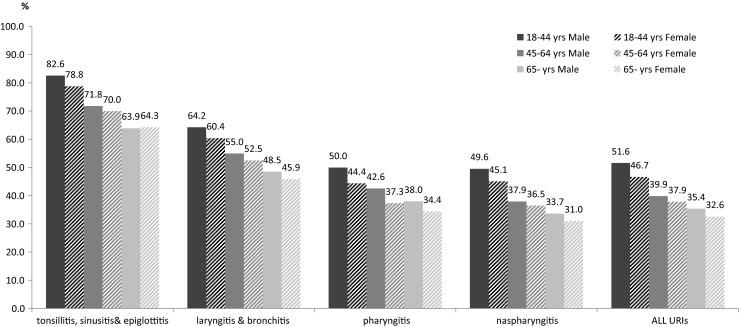
Overall, the rate of antibiotic prescription is 39.0%, and cases diagnosed with acute tonsillitis, sinusitis, and epiglottitis have the highest prescription rate (73.6%), followed by acute laryngitis and bronchitis (52.3%), acute pharyngitis (40.1%), and acute nasopharyngitis (37.2%). Broad-spectrum agents were chosen in 82.4% of the cases that were prescribed antibiotics, ranging from 81.9% of cases with naspharyngitis to 87.1% of the cases with tonsillitis, sinusitis, and epiglottitis. Second-generation cephalosporins, macrolides, fluoroquinolones, third-generation cephalosporins, and combinations of penicillins were most frequently prescribed, accounting for more than 80% of all prescribed antibacterials.
CONCLUSIONS
Antibacterial drug prescription for outpatients with acute URIs is common in tertiary hospitals in Beijing, and the prescribed antibacterials are usually broad-spectrum agents.
目的
本研究旨在描述北京地区急性上呼吸道感染(URI)抗菌药物的处方情况。
方法
从2010年10月至2012年9月的北京市职工医疗费用报销数据(BMCDE)中选取8588699例三级医院急性上呼吸道感染门诊病例。第二代头孢菌素、第三代头孢菌素、第四代头孢菌素、氟喹诺酮类、大环内酯类(除红霉素外)、青霉素类组合(包括β-内酰胺酶抑制剂)及链霉素被归类为广谱抗菌药物。计算所有病例以及不同URI诊断亚组和年龄(18 - 44岁、45 - 64岁及≥65岁)亚组的抗生素处方率和广谱抗生素使用率。通过计算不同药物在所有处方抗菌药物中的比例来确定最常处方的抗生素类别。
结果
总体而言,抗生素处方率为39.0%,诊断为急性扁桃体炎、鼻窦炎和会厌炎的病例处方率最高(73.6%),其次是急性喉炎和支气管炎(52.3%)、急性咽炎(40.1%)以及急性鼻咽炎(37.2%)。在开具抗生素的病例中,82.4%选用了广谱药物,范围从鼻咽炎病例的81.9%到扁桃体炎、鼻窦炎和会厌炎病例的87.1%。第二代头孢菌素、大环内酯类、氟喹诺酮类、第三代头孢菌素以及青霉素类组合是最常处方的药物,占所有处方抗菌药物的80%以上。
结论
北京地区三级医院急性URI门诊患者抗菌药物处方常见,且所开具的抗菌药物通常为广谱药物。
 Zotero 插件