
定量12基因表达检测法(Oncotype DX(®)结肠癌检测法)在韩国II期结肠癌患者中的验证:种族差异对基因表达差异的影响
Validation of a quantitative 12-multigene expression assay (Oncotype DX(®) Colon Cancer Assay) in Korean patients with stage II colon cancer: implication of ethnic differences contributing to differences in gene expression.
作者信息
Jeong Duck Hyoun, Kim Woo Ram, Min Byung Soh, Kim Young Wan, Song Mi Kyung, Kim Nam Kyu
机构信息
Department of Surgery, Yonsei University College of Medicine, Seoul, Seoul, Korea.
Department of Surgery, Wonju College of Medicine, Wonju, Seoul, Korea.
出版信息
Onco Targets Ther. 2015 Dec 17;8:3817-25. doi: 10.2147/OTT.S95543. eCollection 2015.
PURPOSE
To evaluate the Recurrence Score(®) of the quantitative 12-multigene expression assay and to determine risk groups based on the continuous Recurrence Score(®) in Korean patients.
METHOD
A total of 95 patients with pathological T3N0 tumors and mismatch repair-proficient tumors were enrolled. The Recurrence Score(®) was used to classify risk groups (low risk, <30; intermediate risk, 30-40; high risk, ≥41).
RESULTS
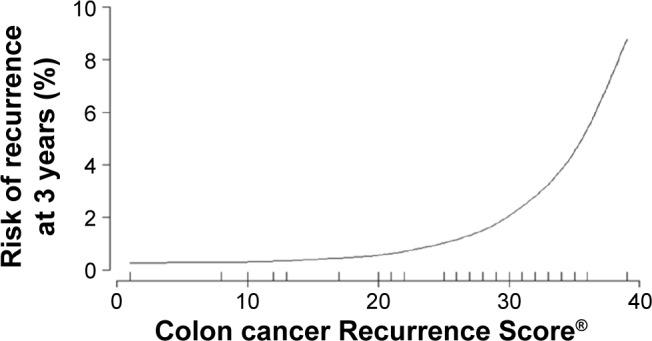
Fifty-four patients (56.8%) were aged over 70 years. There were 49 men (51.6%) and 56 cases of right-sided colon cancer (58.9%). Eight cases (8.4%) had well-differentiated tumors, and 86 cases (90.5%) showed moderate differentiation. Only one case (1.1%) had a poorly differentiated tumor. Three patients (3.2%) had lymphovascular invasion. Sixty-one patients were identified as low risk (64.2%) and 34 patients as intermediate risk (35.8%). There were no high-risk patients. Although not significant, the 3-year recurrence risk increased with the Recurrence Score(®).
CONCLUSION
Distribution patterns of risk groups based on the Recurrence Score(®), particularly the absence of a high-risk group, were different from the prior validation studies. These findings suggest that ethnic differences between Koreans and Western patients are potential contributing factors for different gene expressions in the quantitative 12-multigene expression assay.
目的
评估定量12基因表达检测的复发评分(Recurrence Score®),并根据韩国患者的连续复发评分确定风险组。
方法
共纳入95例病理T3N0肿瘤且错配修复功能正常的肿瘤患者。采用复发评分(Recurrence Score®)对风险组进行分类(低风险,<30;中风险,30 - 40;高风险,≥41)。
结果
54例患者(56.8%)年龄超过70岁。有49名男性(51.6%),56例右侧结肠癌(58.9%)。8例(8.4%)为高分化肿瘤,86例(90.5%)为中分化。仅1例(1.1%)为低分化肿瘤。3例患者(3.2%)有淋巴管侵犯。61例患者被确定为低风险(64.2%),34例为中风险(35.8%)。无高风险患者。尽管无统计学意义,但3年复发风险随复发评分(Recurrence Score®)增加。
结论
基于复发评分(Recurrence Score®)的风险组分布模式,尤其是无高风险组,与先前的验证研究不同。这些发现表明,韩国人和西方患者之间的种族差异是定量12基因表达检测中基因表达不同的潜在影响因素。

 Zotero 插件