
2000 - 2012年加拿大努纳武特地区侵袭性流感嗜血杆菌分离株的实验室特征分析
Laboratory characterization of invasive Haemophilus influenzae isolates from Nunavut, Canada, 2000-2012.
作者信息
Tsang Raymond S W, Li Y Anita, Mullen Angie, Baikie Maureen, Whyte Kathleen, Shuel Michelle, Tyrrell Gregory, Rotondo Jenny A L, Desai Shalini, Spika John
机构信息
National Microbiology Laboratory, Public Health Agency of Canada, Winnipeg, Manitoba;
Centre for Immunization and Respiratory Infectious Diseases, Public Health Agency of Canada, Ottawa, Ontario.
出版信息
Int J Circumpolar Health. 2016 Jan 12;75:29798. doi: 10.3402/ijch.v75.29798. eCollection 2016.
BACKGROUND
With invasive Haemophilus influenzae serotype b (Hib) disease controlled by vaccination with conjugate Hib vaccines, there is concern that invasive disease due to non-serotype b strains may emerge.
OBJECTIVE
This study characterized invasive H. influenzae (Hi) isolates from Nunavut, Canada, in the post-Hib vaccine era.
METHODS
Invasive H. influenzae isolates were identified by conventional methods at local hospitals; and further characterized at the provincial and federal public health laboratories, including detection of serotype antigens and genes, multi-locus sequence typing and antibiotic susceptibility.
RESULTS
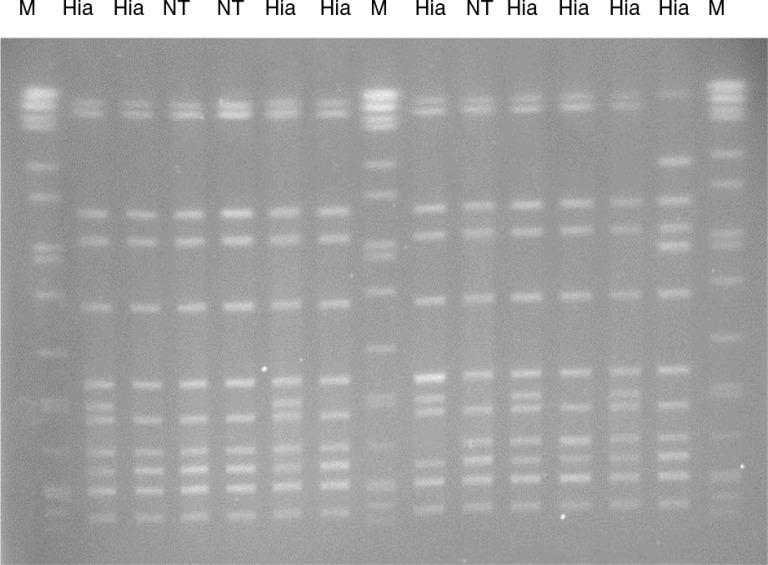
Of the 89 invasive H. influenzae cases identified from 2000 to 2012, 71 case isolates were available for study. There were 43 serotype a (Hia), 12 Hib, 2 Hic, 1 Hid, 1 Hie, 2 Hif and 10 were non-typeable (NT). All 43 Hia were biotype II, sequence type (ST)-23. Three related STs were found among the Hib isolates: ST-95 (n=9), ST-635 (n=2) and ST-44 (n=1). Both Hif belonged to ST-124 and the 2 Hic were typed as ST-9. The remaining Hid (ST-1288) and Hie (ST-18) belonged to 2 separate clones. Of the 10 NT strains, 3 were typed as ST-23 and the remaining 7 isolates each belonged to a unique ST. Eight Hib and 1 NT-Hi were found to be resistant to ampicillin due to β-lactamase production. No resistance to other antibiotics was detected.
CONCLUSION
During the period of 2000-2012, Hia was the predominant serotype causing invasive disease in Nunavut. This presents a public health concern due to an emerging clone of Hia as a cause of invasive H. influenzae disease and the lack of published guidelines for the prophylaxis of contacts. The clonal nature of Hia could be the result of spread within an isolated population, and/or unique characteristics of this strain to cause invasive disease. Further study of Hia in other populations may provide important information on this emerging pathogen. No antibiotic resistance was detected among Hia isolates; a small proportion of Hib and NT-Hi isolates demonstrated resistance to ampicillin due to β-lactamase production.
背景
随着通过接种b型流感嗜血杆菌结合疫苗控制了侵袭性b型流感嗜血杆菌(Hib)疾病,人们担心非b型菌株引起的侵袭性疾病可能会出现。
目的
本研究对加拿大努纳武特地区在Hib疫苗接种后时代的侵袭性流感嗜血杆菌(Hi)分离株进行了特征分析。
方法
在当地医院通过常规方法鉴定侵袭性流感嗜血杆菌分离株;并在省级和联邦公共卫生实验室进一步进行特征分析,包括血清型抗原和基因检测、多位点序列分型以及抗生素敏感性检测。
结果
在2000年至2012年期间确定的89例侵袭性流感嗜血杆菌病例中,有71例病例分离株可供研究。其中有43例为a型流感嗜血杆菌(Hia)、12例Hib、2例Hic、1例Hid、1例Hie、2例Hif以及10例不可分型(NT)。所有43例Hia均为生物型II,序列型(ST)-23。在Hib分离株中发现了3个相关的ST:ST-95(n = 9)、ST-635(n = 2)和ST-44(n = 1)。2例Hif均属于ST-124,2例Hic分型为ST-9。其余的Hid(ST-1288)和Hie(ST-18)属于2个不同的克隆。在10例NT菌株中,3例分型为ST-23,其余7株分离株各属于一个独特的ST。发现8例Hib和1例NT-Hi因产生β-内酰胺酶而对氨苄西林耐药。未检测到对其他抗生素的耐药性。
结论
在2000 - 2012年期间,Hia是努纳武特地区引起侵袭性疾病的主要血清型。由于出现了作为侵袭性流感嗜血杆菌疾病病因的Hia克隆,且缺乏针对接触者预防的已发表指南,这引起了公共卫生方面的关注。Hia的克隆性质可能是在孤立人群中传播的结果,和/或该菌株导致侵袭性疾病的独特特征。对其他人群中的Hia进行进一步研究可能会提供有关这种新兴病原体的重要信息。在Hia分离株中未检测到抗生素耐药性;一小部分Hib和NT-Hi分离株因产生β-内酰胺酶而对氨苄西林耐药。
 Zotero 插件