
健康老年人触摸屏平板电脑上电子视觉模拟疼痛量表的准确性、有效性和可靠性:一项临床试验
Accuracy, Validity, and Reliability of an Electronic Visual Analog Scale for Pain on a Touch Screen Tablet in Healthy Older Adults: A Clinical Trial.
作者信息
Bird Marie-Louise, Callisaya Michele L, Cannell John, Gibbons Timothy, Smith Stuart T, Ahuja Kiran Dk
机构信息
School of Health Sciences, University of Tasmania, Launceston, Australia.
出版信息
Interact J Med Res. 2016 Jan 14;5(1):e3. doi: 10.2196/ijmr.4910.
BACKGROUND
New technology for clinical data collection is rapidly evolving and may be useful for both researchers and clinicians; however, this new technology has not been tested for accuracy, reliability, or validity.
OBJECTIVE
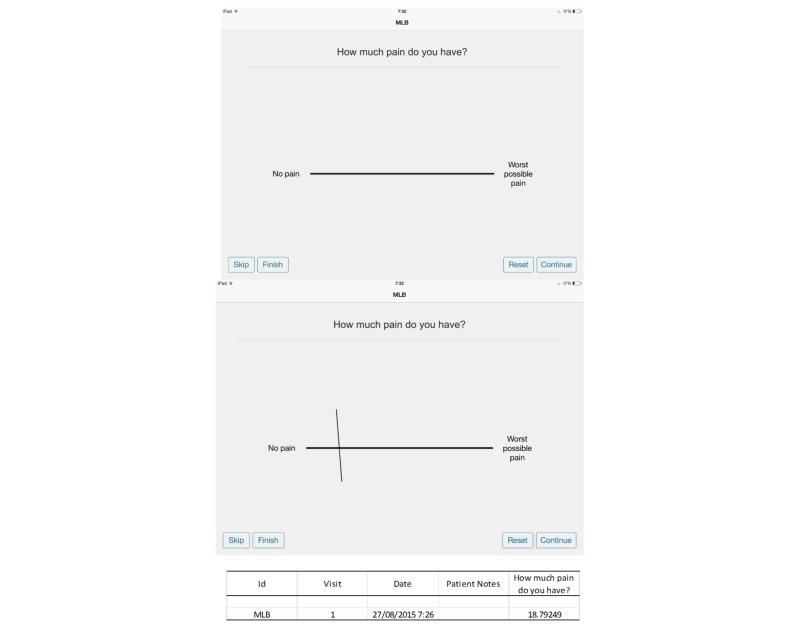
This study aims to test the accuracy of visual analog scale (VAS) for pain on a newly designed application on the iPad (iPadVAS) and measure the reliability and validity of iPadVAS compared to a paper copy (paperVAS).
METHODS
Accuracy was determined by physically measuring an iPad scale on screen and comparing it to the results from the program, with a researcher collecting 101 data points. A total of 22 healthy community dwelling older adults were then recruited to test reliability and validity. Each participant completed 8 VAS (4 using each tool) in a randomized order. Reliability was measured using interclass correlation coefficient (ICC) and validity measured using Bland-Altman graphs and correlations.
RESULTS
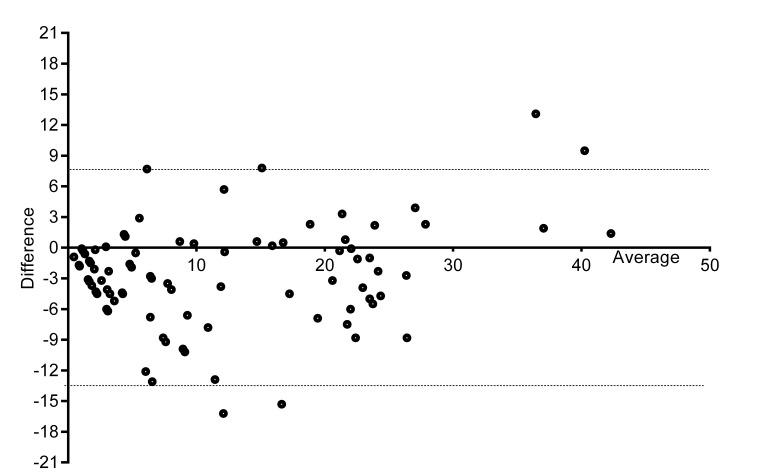
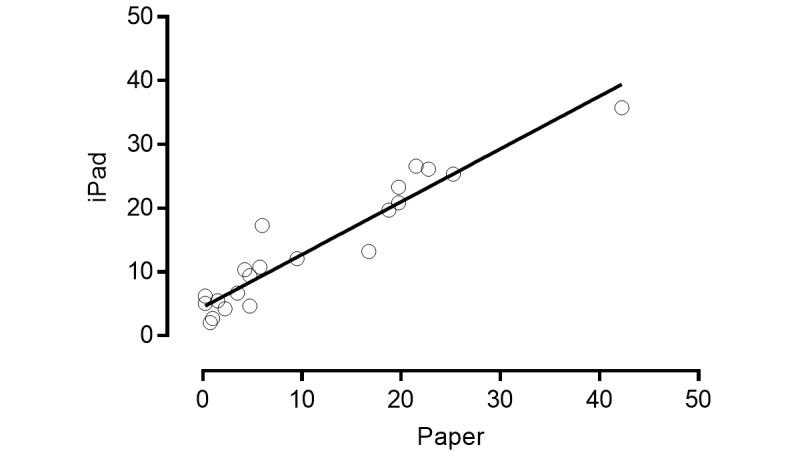
Of the measurements for accuracy, 64 results were identical, 2 results were manually measured as being 1 mm higher than the program, and 35 as 1 mm lower. Reliability for the iPadVAS was excellent with individual ICC 0.90 (95% CI 0.82-0.95) and averaged ICC 0.97 (95% CI 0.95-1.0) observed. Linear regression demonstrated a strong relationship with a small negative bias towards the iPad (-2.6, SD 5.0) with limits of agreement from -12.4 to 7.1.
CONCLUSIONS
The iPadVAS provides a convenient, user-friendly, and efficient way of collecting data from participants in measuring their current pain levels. It has potential use in documentation management and may encourage participatory healthcare.
TRIAL REGISTRATION
Australia New Zealand Clinical Trials Registry (ANZCTR): 367297; https://www.anzctr.org.au/Trial/Registration/TrialReview.aspx?id=367297&isReview=true (Archived by Webcite at http://www.webcitation.org/6d9xYoUbD).
背景
临床数据收集的新技术正在迅速发展,可能对研究人员和临床医生都有用;然而,这项新技术尚未经过准确性、可靠性或有效性测试。
目的
本研究旨在测试iPad上新设计的应用程序(iPadVAS)上视觉模拟量表(VAS)对疼痛评估的准确性,并与纸质版(paperVAS)相比,测量iPadVAS的可靠性和有效性。
方法
通过在屏幕上实际测量iPad量表并将其与程序结果进行比较来确定准确性,一名研究人员收集了101个数据点。然后招募了22名居住在社区的健康老年人来测试可靠性和有效性。每位参与者以随机顺序完成8次VAS(每种工具各使用4次)。使用组内相关系数(ICC)测量可靠性,使用布兰德-奥特曼图和相关性测量有效性。
结果
在准确性测量中,64个结果相同,2个结果手动测量比程序高1毫米,35个结果低1毫米。iPadVAS的可靠性极佳,个体ICC为0.90(95%CI 0.82 - 0.95),平均ICC为0.97(95%CI 0.95 - 1.0)。线性回归显示两者关系密切,对iPad存在小的负偏差(-2.6,标准差5.0),一致性界限为-12.4至7.1。
结论
iPadVAS为从参与者那里收集测量其当前疼痛水平的数据提供了一种方便、用户友好且高效的方式。它在文档管理中具有潜在用途,并可能促进参与式医疗保健。
试验注册
澳大利亚新西兰临床试验注册中心(ANZCTR):367297;https://www.anzctr.org.au/Trial/Registration/TrialReview.aspx?id=367297&isReview=true(由Webcite存档于http://www.webcitation.org/6d9xYoUbD)

 Zotero 插件