
白细胞介素-37通过抑制非小细胞肺癌中的血管生成来抑制肿瘤生长。
Interleukin-37 suppresses tumor growth through inhibition of angiogenesis in non-small cell lung cancer.
作者信息
Ge Guanqun, Wang Aiqin, Yang Jingyue, Chen Yan, Yang Jin, Li Yize, Xue Yan
机构信息
Department of Surgical Oncology, The First Affiliated Hospital of Xi'an Jiaotong University, 277, Yantaxi Road, Xi'an, 710061, Shaanxi, China.
Department of Neurosurgery, The Ninth Hospital of Xian, Xi'an, 710054, China.
出版信息
J Exp Clin Cancer Res. 2016 Jan 20;35:13. doi: 10.1186/s13046-016-0293-3.
BACKGROUND
Interleukin-37 (IL-37), a newly identified member of the IL-1 family, has been known to play an immunosuppressive role in a variety of inflammatory disorders, but whether it participates in the regulation of pathogenesis of non-small cell lung cancer (NSCLC) has not been investigated.
METHODS
Real-time polymerase chain reaction (PCR), western blotting, and immunohistochemical staining were employed to detect IL-37 expression in NSCLC tissues and corresponding adjacent tissues. The correlations between IL-37 expression and clinicopathological characteristics, prognosis were analyzed. Stable clone with overexpression of IL-37 was generated in H1299 cell lines. Cell growth, cell cycle and cell apoptosis assays were carried out for detecting proliferation and apoptosis of H1299 cells. The effects of IL-37 on NSCLC progression in vivo was performed in a xenografted lung tumor model in nude mice. The concentrations of IL-37 and VEGF in the s growth medium supernatants were quantified by ELISA. The antiangiogenic effect of IL-37 on HUVEC was measured by tube formation assay.
RESULTS
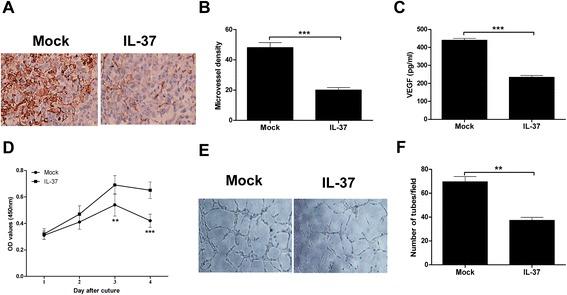
IL-37 mRNA and protein expressions were significantly decreased in NSCLC tissues, and decreased intratumoral IL-37 expression was significantly associated with tumor state, TNM stage and poor prognosis in NSCLC patients. In addition, intratumoral IL-37 expression was an independent prognostic factors for Overall survival (hazard ratio = 2.047; P = 0.011). Overexpression of IL-37 exerted no direct effect on cell proliferation and apoptosis of H1299 lung cancer cells in vitro, but significantly inhibited tumor growth in a H1299 xenograft model in vivo. Furthermore, there was no significant change in immune cell infiltration in IL-37 over-expressing tumors; instead, we found decreased microvessel density (MVD) and VEGF levels in IL-37-expressing tumors. Additional studies showed IL-37 could directly inhibit HUVEC cells growth and capillary structure formation. Finally, we found that decreased IL-37 expression was associated with high MVD in NSCLC patients.
CONCLUSIONS
Our findings demonstrate a protective role for IL-37 in lung cancer development, possibly through inhibiting tumor angiogenesis. IL-37 could serve as a promising therapeutic target for NSCLC.
背景
白细胞介素-37(IL-37)是白细胞介素-1家族新发现的成员,已知其在多种炎症性疾病中发挥免疫抑制作用,但它是否参与非小细胞肺癌(NSCLC)发病机制的调控尚未见研究报道。
方法
采用实时聚合酶链反应(PCR)、蛋白质印迹法和免疫组织化学染色检测NSCLC组织及相应癌旁组织中IL-37的表达。分析IL-37表达与临床病理特征、预后的相关性。在H1299细胞系中构建IL-37过表达的稳定克隆。进行细胞生长、细胞周期和细胞凋亡检测,以检测H1299细胞的增殖和凋亡情况。在裸鼠异种移植肺肿瘤模型中研究IL-37对NSCLC体内进展的影响。通过酶联免疫吸附测定(ELISA)定量检测生长培养基上清液中IL-37和血管内皮生长因子(VEGF)的浓度。通过管腔形成实验检测IL-37对人脐静脉内皮细胞(HUVEC)的抗血管生成作用。
结果
NSCLC组织中IL-37的mRNA和蛋白表达显著降低,肿瘤内IL-37表达降低与NSCLC患者的肿瘤状态、TNM分期及预后不良显著相关。此外,肿瘤内IL-37表达是总生存期的独立预后因素(风险比=2.047;P=0.011)。IL-37过表达对体外H1299肺癌细胞的增殖和凋亡无直接影响,但在体内H1299异种移植模型中显著抑制肿瘤生长。此外,IL-37过表达肿瘤中的免疫细胞浸润无显著变化;相反,我们发现IL-37表达肿瘤中的微血管密度(MVD)和VEGF水平降低。进一步研究表明,IL-37可直接抑制HUVEC细胞生长和毛细血管结构形成。最后,我们发现NSCLC患者中IL-37表达降低与高MVD相关。
结论
我们的研究结果表明IL-37在肺癌发展中起保护作用,可能是通过抑制肿瘤血管生成实现的。IL-37有望成为NSCLC的治疗靶点。


 Zotero 插件