
撒哈拉以南非洲城市私人医疗保健部门扩张背景下的自付费用及其决定因素:来自布基纳法索瓦加杜古家庭调查的证据
Out-of-pocket expenditure and its determinants in the context of private healthcare sector expansion in sub-Saharan Africa urban cities: evidence from household survey in Ouagadougou, Burkina Faso.
作者信息
Beogo Idrissa, Huang Nicole, Gagnon Marie-Pierre, Amendah Djesika D
机构信息
École Nationale de Santé Publique, Ouagadougou, Burkina Faso.
Faculté Des Sciences Infirmières, Université Laval, Pavillon Ferdinand-Vandry, 1050, Avenue de la Médecine, Quebec, G1V 0A6, Canada.
出版信息
BMC Res Notes. 2016 Jan 21;9:34. doi: 10.1186/s13104-016-1846-4.
BACKGROUND
Conventional wisdom suggests that out-of-pocket (OOP) expenditure reduces healthcare utilization. However, little is known about the expenditure borne in urban settings with the current development of the private health sector in sub-Saharan Africa. In an effort to update knowledge on medical expenditure, this study investigated the level and determinants of OOP among individuals reporting illness or injury in Ouagadougou, Burkina Faso and who either self-treated or received healthcare in either a private or public facility.
METHODS
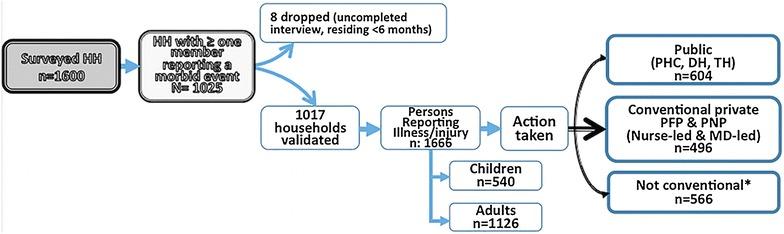
A cross-sectional study was conducted with a representative sample of 1017 households (5638 individuals) between August and November 2011. Descriptive statistics and multivariate techniques including generalized estimating equations were used to analyze the data.
RESULTS
Among the surveyed sample, 29.6% (n = 1666) persons reported a sickness or injury. Public providers were the single most important providers of care (36.3%), whereas private and informal providers (i.e.: self-treatment, traditional healers) accounted for 29.8 and 34.0%, respectively. Almost universally (96%), households paid directly for care OOP. The average expenditure per episode of illness was 8404XOF (17.4USD) (median 3750XOF (7.8USD). The total expenditure was higher for those receiving care in private facilities compared to public ones [14,613.3XOF (30.3USD) vs. 8544.1XOF (17.7USD); p < 0.001], and the insured patients' bill almost tripled uninsured (p < 0.001). Finally, medication was the most expensive component of expenditure in both public and private facilities with a mean of 8022.1XOF (16.7USD) and 12,270.5 (25.5USD), respectively.
CONCLUSION
OOP was the principal payment mechanism of households. A significant difference in OOP was found between public and private provider users. Considering the importance of private healthcare in Burkina Faso, regulatory oversight is necessary. Furthermore, an extensive protection policy to shield households from catastrophic health expenditure is required.
背景
传统观点认为,自付支出会降低医疗保健利用率。然而,随着撒哈拉以南非洲地区私营卫生部门的当前发展,对于城市地区的支出情况却知之甚少。为了更新有关医疗支出的知识,本研究调查了布基纳法索瓦加杜古报告患病或受伤且自行治疗或在私立或公立医疗机构接受治疗的个人的自付支出水平及其决定因素。
方法
2011年8月至11月期间,对1017户家庭(5638人)的代表性样本进行了横断面研究。使用描述性统计和多变量技术(包括广义估计方程)对数据进行分析。
结果
在被调查样本中,29.6%(n = 1666)的人报告患有疾病或受伤。公立医疗机构是最重要的单一医疗服务提供者(36.3%),而私立和非正规医疗服务提供者(即自行治疗、传统治疗师)分别占29.8%和34.0%。几乎所有家庭(96%)都直接自掏腰包支付医疗费用。每次患病的平均支出为8404非洲法郎(17.4美元)(中位数为3750非洲法郎(7.8美元))。与公立医疗机构相比,在私立医疗机构接受治疗的人的总支出更高[14613.3非洲法郎(30.3美元)对8544.1非洲法郎(17.7美元);p < 0.001],参保患者的费用几乎是未参保患者的三倍(p < 0.001)。最后,药品是公立和私立医疗机构中最昂贵的支出组成部分,平均分别为8022.1非洲法郎(16.7美元)和12270.5非洲法郎(25.5美元)。
结论
自付支出是家庭的主要支付机制。公立和私立医疗机构的使用者在自付支出方面存在显著差异。鉴于私立医疗保健在布基纳法索的重要性,监管监督是必要的。此外,需要一项广泛的保护政策,以使家庭免受灾难性医疗支出的影响。
 Zotero 插件