
杂合子优势可能维持恒河猴因子血型多态性:生态回归研究。
Heterozygote Advantage Probably Maintains Rhesus Factor Blood Group Polymorphism: Ecological Regression Study.
作者信息
Flegr Jaroslav
机构信息
Division of Biology, Faculty of Science, Charles University in Prague, Prague, Czech Republic.
出版信息
PLoS One. 2016 Jan 26;11(1):e0147955. doi: 10.1371/journal.pone.0147955. eCollection 2016.
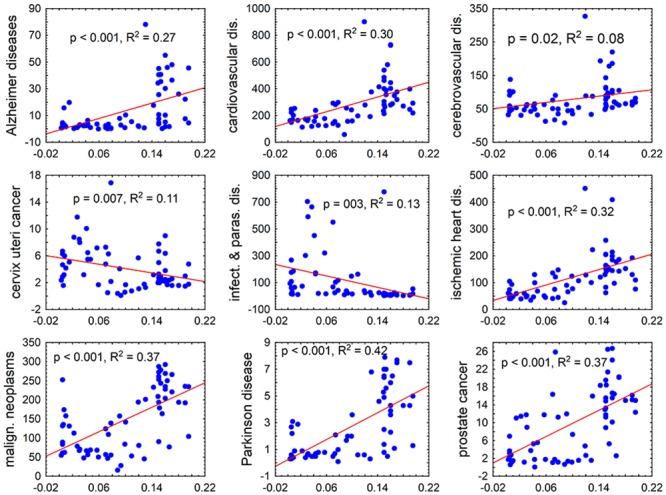
Rhesus factor polymorphism has been an evolutionary enigma since its discovery in 1939. Carriers of the rarer allele should be eliminated by selection against Rhesus positive children born to Rhesus negative mothers. Here I used an ecologic regression study to test the hypothesis that Rhesus factor polymorphism is stabilized by heterozygote advantage. The study was performed in 65 countries for which the frequencies of RhD phenotypes and specific disease burden data were available. I performed multiple multivariate covariance analysis with five potential confounding variables: GDP, latitude (distance from the equator), humidity, medical care expenditure per capita and frequencies of smokers. The results showed that the burden associated with many diseases correlated with the frequencies of particular Rhesus genotypes in a country and that the direction of the relation was nearly always the opposite for the frequency of Rhesus negative homozygotes and that of Rhesus positive heterozygotes. On the population level, a Rhesus-negativity-associated burden could be compensated for by the heterozygote advantage, but for Rhesus negative subjects this burden represents a serious problem.
自1939年发现以来,恒河猴因子多态性一直是一个进化谜团。稀有等位基因的携带者应该会因对恒河猴阴性母亲所生的恒河猴阳性孩子进行选择而被淘汰。在此,我使用了一项生态回归研究来检验恒河猴因子多态性因杂合子优势而得以稳定的假设。该研究在65个可获取RhD表型频率和特定疾病负担数据的国家进行。我对五个潜在的混杂变量进行了多元协方差分析:国内生产总值、纬度(距赤道的距离)、湿度、人均医疗保健支出和吸烟者频率。结果表明,许多疾病的负担与一个国家特定恒河猴基因型的频率相关,并且对于恒河猴阴性纯合子频率和恒河猴阳性杂合子频率而言,这种关系的方向几乎总是相反的。在群体水平上,与恒河猴阴性相关的负担可以通过杂合子优势得到补偿,但对于恒河猴阴性个体来说,这种负担是一个严重问题。
 Zotero 插件