
非监督式低强度有氧运动训练对1型糖尿病患者微血管内皮功能的影响:一项非药物干预研究。
Effects of non-supervised low intensity aerobic excise training on the microvascular endothelial function of patients with type 1 diabetes: a non-pharmacological interventional study.
作者信息
de Moraes Roger, Van Bavel Diogo, Gomes Marília de Brito, Tibiriçá Eduardo
机构信息
National Institute of Cardiology, Rio de Janeiro, Brazil.
Laboratory of Cardiovascular Investigation, Oswaldo Cruz Institute, Av. Brasil, 4365, 21045-900, Rio de Janeiro, Brazil.
出版信息
BMC Cardiovasc Disord. 2016 Jan 27;16:23. doi: 10.1186/s12872-016-0191-9.
BACKGROUND
The aim of the present study was to evaluate changes in microvascular density and reactivity in patients with type 1 diabetes (T1D) resulting from low intensity chronic exercise training.
METHODS
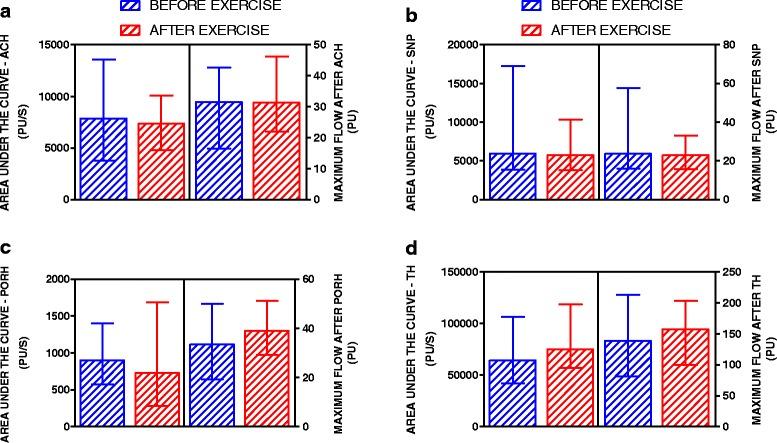
This study included 22 (34 ± 7 ears) consecutive outpatients with T1D and disease duration > 6 years. We used intravital video-microscopy to measure basal skin capillary density and capillary recruitment using post-occlusive reactive hyperemia (PORH) in the dorsum of the fingers. Endothelium-dependent and -independent vasodilation of the skin microcirculation was evaluated in the forearm with a laser Doppler flow monitoring (LDF) system in combination with acetylcholine and sodium nitroprusside iontophoresis, PORH and local thermal hyperemia.
RESULTS
The basal mean capillary density (MCD) after exercise training was significantly higher than before exercise (134 ± 25 vs. 119 ± 19 capillaries/mm(2), respectively; P = 0.0013). MCD during PORH was also higher after exercise (140 ± 26 vs. 121 ± 24 capillaries/mm(2), respectively; P < 0.0001). Endothelium-dependent capillary recruitment during PORH was also significantly higher after exercise (140 ± 26 vs. 134 ± 25 capillaries/mm(2), respectively; P < 0.0012). There were no significant changes in skin microvascular reactivity after exercise as investigated using LDF.
CONCLUSIONS
Our results showed that low intensity aerobic exercise, performed four times per week for 12 weeks by patients with T1D, induces significant increases in microvascular density and endothelial-dependent capillary reactivity.
TRIAL REGISTRATION
ClinicalTrials.gov NCT02441504. Registered 7 May 2015.
背景
本研究旨在评估1型糖尿病(T1D)患者因低强度慢性运动训练导致的微血管密度和反应性变化。
方法
本研究纳入了22名(年龄34±7岁)病程超过6年的T1D门诊连续患者。我们使用活体视频显微镜测量手指背部基础皮肤毛细血管密度,并通过阻断后反应性充血(PORH)测量毛细血管募集情况。使用激光多普勒血流监测(LDF)系统结合乙酰胆碱和硝普钠离子导入、PORH和局部热充血,在前臂评估皮肤微循环的内皮依赖性和非内皮依赖性血管舒张。
结果
运动训练后的基础平均毛细血管密度(MCD)显著高于运动前(分别为134±25和119±19根毛细血管/mm²;P = 0.0013)。运动后PORH期间的MCD也更高(分别为140±26和121±24根毛细血管/mm²;P < 0.0001)。运动后PORH期间内皮依赖性毛细血管募集也显著更高(分别为140±26和134±25根毛细血管/mm²;P < 0.0012)。使用LDF研究发现,运动后皮肤微血管反应性无显著变化。
结论
我们的结果表明,T1D患者每周进行4次、持续12周的低强度有氧运动可显著提高微血管密度和内皮依赖性毛细血管反应性。
试验注册
ClinicalTrials.gov NCT02441504。于2015年5月7日注册。

 Zotero 插件