
选择性自噬的机制
Mechanisms of Selective Autophagy.
作者信息
Zaffagnini Gabriele, Martens Sascha
机构信息
Max F. Perutz Laboratories, University of Vienna, Vienna Biocenter, Dr. Bohr-Gasse 9, 1030 Vienna, Austria.
Max F. Perutz Laboratories, University of Vienna, Vienna Biocenter, Dr. Bohr-Gasse 9, 1030 Vienna, Austria.
出版信息
J Mol Biol. 2016 May 8;428(9 Pt A):1714-24. doi: 10.1016/j.jmb.2016.02.004. Epub 2016 Feb 12.
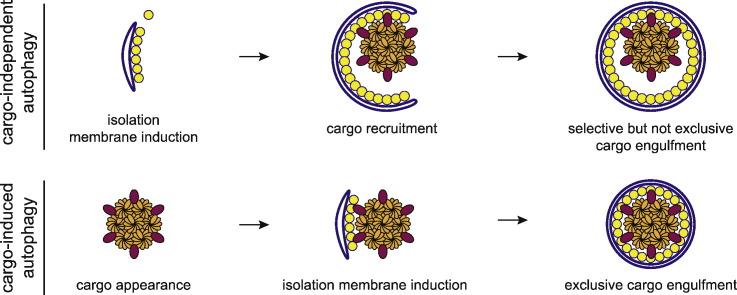
Selective autophagy contributes to intracellular homeostasis by mediating the degradation of cytoplasmic material such as aggregated proteins, damaged or over-abundant organelles, and invading pathogens. The molecular machinery for selective autophagy must ensure efficient recognition and sequestration of the cargo within autophagosomes. Cargo specificity can be mediated by autophagic cargo receptors that specifically bind the cargo material and the autophagosomal membrane. Here we review the recent insights into the mechanisms that enable cargo receptors to confer selectivity and exclusivity to the autophagic process. We also discuss their different roles during starvation-induced and selective autophagy. We propose to classify autophagic events into cargo-independent and cargo-induced autophagosome formation events.
选择性自噬通过介导细胞质物质(如聚集蛋白、受损或过剩的细胞器以及入侵病原体)的降解来维持细胞内稳态。选择性自噬的分子机制必须确保自噬小泡内货物的有效识别和隔离。货物特异性可由自噬货物受体介导,这些受体特异性结合货物材料和自噬体膜。本文综述了关于货物受体赋予自噬过程选择性和排他性机制的最新见解。我们还讨论了它们在饥饿诱导的自噬和选择性自噬过程中的不同作用。我们建议将自噬事件分为非货物依赖性和货物诱导性自噬小泡形成事件。


 Zotero 插件