
一项针对中国人群前列腺癌遗传易感性的基因研究与荟萃分析。
A genetic study and meta-analysis of the genetic predisposition of prostate cancer in a Chinese population.
作者信息
Marzec Jacek, Mao Xueying, Li Meiling, Wang Meilin, Feng Ninghan, Gou Xin, Wang Guomin, Sun Zan, Xu Jianfeng, Xu Hua, Zhang Xiaoping, Zhao Shan-Chao, Ren Guoping, Yu Yongwei, Wu Yudong, Wu Ji, Xue Yao, Zhou Bo, Zhang Yanling, Xu Xingxing, Li Jie, He Weiyang, Benlloch Sara, Ross-Adams Helen, Chen Li, Li Jucong, Hong Yingqia, Kote-Jarai Zsofia, Cui Xingang, Hou Jianguo, Guo Jianming, Xu Lei, Yin Changjun, Zhou Yuanping, Neal David E, Oliver Tim, Cao Guangwen, Zhang Zhengdong, Easton Douglas F, Chelala Claude, Al Olama Ali Amin, Eeles Rosalind A, Zhang Hongwei, Lu Yong-Jie
机构信息
Centre for Molecular Oncology, Barts Cancer Institute, Barts and the London School of Medicine and Dentistry, Queen Mary University of London, London, EC1M 6BQ, UK.
Department of Epidemiology, Second Military Medical University, Shanghai, 200433, China.
出版信息
Oncotarget. 2016 Apr 19;7(16):21393-403. doi: 10.18632/oncotarget.7250.
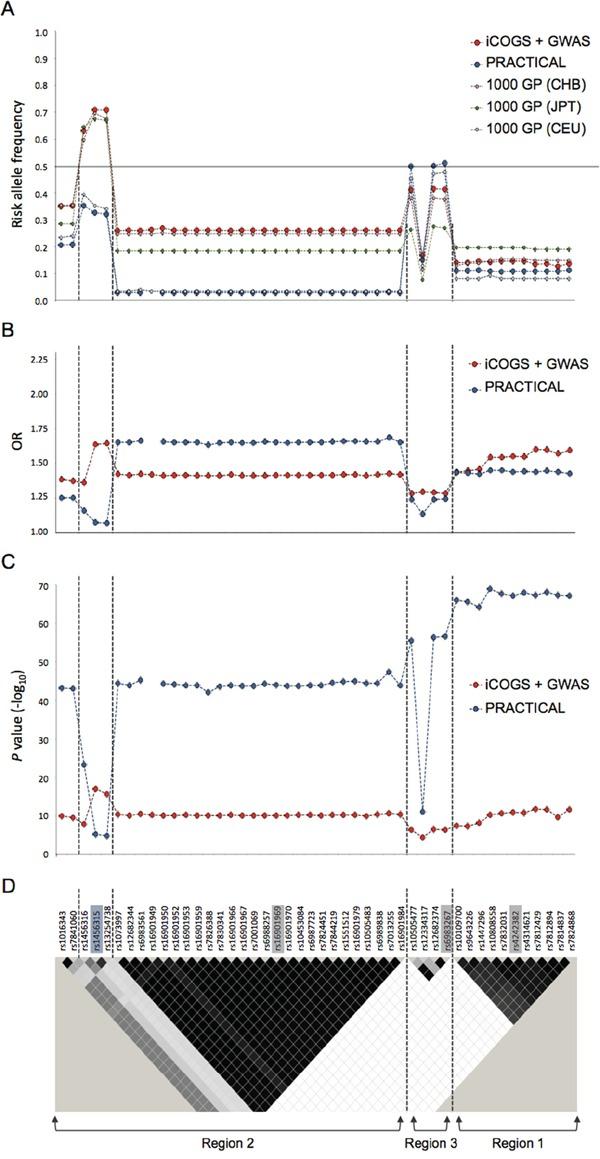
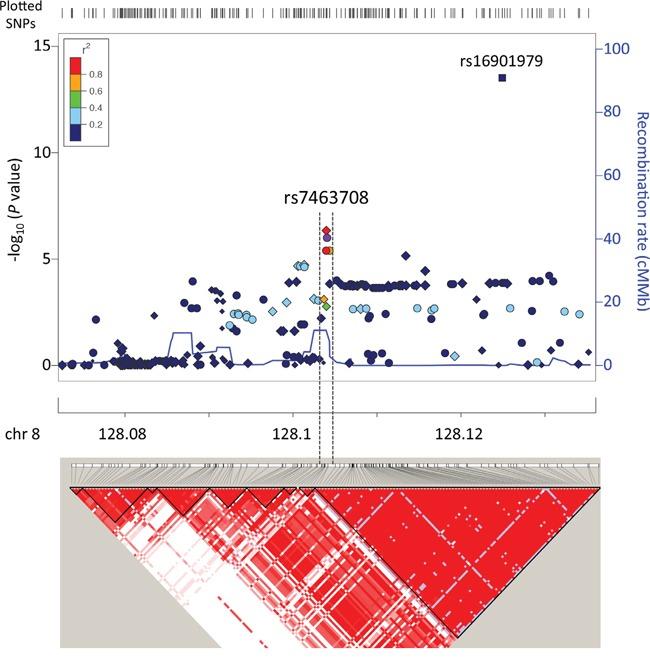
Prostate cancer predisposition has been extensively investigated in European populations, but there have been few studies of other ethnic groups. To investigate prostate cancer susceptibility in the under-investigated Chinese population, we performed single-nucleotide polymorphism (SNP) array analysis on a cohort of Chinese cases and controls and then meta-analysis with data from the existing Chinese prostate cancer genome-wide association study (GWAS). Genotyping 211,155 SNPs in 495 cases and 640 controls of Chinese ancestry identified several new suggestive Chinese prostate cancer predisposition loci. However, none of them reached genome-wide significance level either by meta-analysis or replication study. The meta-analysis with the Chinese GWAS data revealed that four 8q24 loci are the main contributors to Chinese prostate cancer risk and the risk alleles from three of them exist at much higher frequencies in Chinese than European populations. We also found that several predisposition loci reported in Western populations have different effect on Chinese men. Therefore, this first extensive single-nucleotide polymorphism study of Chinese prostate cancer in comparison with European population indicates that four loci on 8q24 contribute to a great risk of prostate cancer in a considerable large proportion of Chinese men. Based on those four loci, the top 10% of the population have six- or two-fold prostate cancer risk compared with men of the bottom 10% or median risk respectively, which may facilitate the design of prostate cancer genetic risk screening and prevention in Chinese men. These findings also provide additional insights into the etiology and pathogenesis of prostate cancer.
前列腺癌易感性在欧洲人群中已得到广泛研究,但对其他种族群体的研究较少。为了调查在研究较少的中国人群中的前列腺癌易感性,我们对一组中国病例和对照进行了单核苷酸多态性(SNP)阵列分析,然后与现有的中国前列腺癌全基因组关联研究(GWAS)数据进行荟萃分析。对495例中国血统病例和640例对照中的211,155个SNP进行基因分型,确定了几个新的提示性中国前列腺癌易感位点。然而,通过荟萃分析或重复研究,它们均未达到全基因组显著性水平。与中国GWAS数据的荟萃分析表明,四个8q24位点是中国前列腺癌风险的主要贡献者,其中三个位点的风险等位基因在中国人群中的频率远高于欧洲人群。我们还发现,西方人群中报道的几个易感位点对中国男性的影响不同。因此,这项首次对中国前列腺癌与欧洲人群进行的广泛单核苷酸多态性研究表明,8q24上的四个位点在相当大比例的中国男性中导致了较高的前列腺癌风险。基于这四个位点,与风险最低的10%或中等风险的男性相比,风险最高的10%人群患前列腺癌的风险分别高出六倍或两倍,这可能有助于设计中国男性前列腺癌的遗传风险筛查和预防方案。这些发现也为前列腺癌的病因和发病机制提供了更多见解。
 Zotero 插件