
联合疗法的单次给药可抑制骨中乳腺肿瘤的进展,并改变成骨细胞和破骨细胞。
A single administration of combination therapy inhibits breast tumour progression in bone and modifies both osteoblasts and osteoclasts.
作者信息
Brown H K, Ottewell P D, Evans C A, Coleman R E, Holen I
机构信息
Academic Unit of Clinical Oncology, CR-UK/YCR Sheffield Cancer Research Centre, University of Sheffield, UK.
出版信息
J Bone Oncol. 2012 Jun 19;1(2):47-56. doi: 10.1016/j.jbo.2012.05.001. eCollection 2012 Sep.
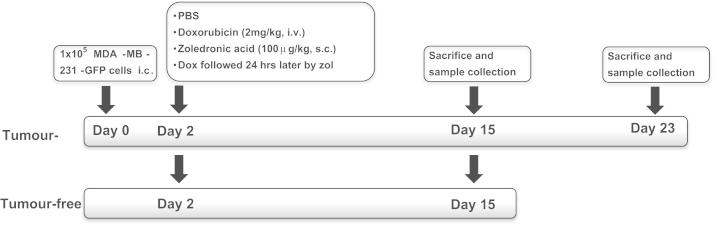
We have previously shown that repeated sequential administration of doxorubicin, followed 24 h later by zoledronic acid, inhibits tumour growth in models of established breast cancer bone metastasis. As breast cancer patients only receive zoledronic acid every 3-4 weeks, the aim of the current study was to establish the anti-tumour and bone effects of a single administration of doxorubicin/zoledronic acid combination therapy in a bone metastasis model. MDA-MB-231-GFP cells were injected i.c. in 6-week-old nude mice. On day 2, animals received PBS, doxorubicin (2 mg/kg i.v.), zoledronic acid (100 μg/kg s.c.) or doxorubicin followed 24 h later by zoledronic acid. Anti-tumour effects were assessed on days 15/23 by quantification of apoptotic and proliferating cells and changes in expression of genes implicated in apoptosis, proliferation and bone turnover. Bone effects were assessed by μCT analysis, bone histomorphometry and measurement of serum markers. A tumour-free control group was included. Combination treatment reduced bone tumour burden compared to single agent or PBS control and increased levels of tumour cell apoptosis on day 15, but this was no longer detectable on day 23. Animals receiving zoledronic acid had increased bone density, without evidence of tumour-induced lesions. Bone histomorphometry showed that zoledronic acid caused a decrease in osteoblast and osteoclast numbers and an increase in osteoclast size, in both tumour-free and tumour-bearing animals. Our data show that although zoledronic acid modifies the bone microenvironment through effects on both osteoblasts and osteoclasts, this does not result in a significant anti-tumour effect in the absence of doxorubicin.
我们之前已经表明,先反复序贯给予阿霉素,24小时后再给予唑来膦酸,可抑制已建立的乳腺癌骨转移模型中的肿瘤生长。由于乳腺癌患者每3 - 4周才接受一次唑来膦酸治疗,因此本研究的目的是在骨转移模型中确定单次给予阿霉素/唑来膦酸联合治疗的抗肿瘤和对骨的作用。将MDA - MB - 231 - GFP细胞经颅内注射到6周龄的裸鼠体内。在第2天,动物分别接受磷酸盐缓冲液(PBS)、阿霉素(静脉注射2mg/kg)、唑来膦酸(皮下注射100μg/kg),或先给予阿霉素,24小时后再给予唑来膦酸。在第15/23天通过定量凋亡和增殖细胞以及与凋亡、增殖和骨转换相关基因表达的变化来评估抗肿瘤作用。通过微计算机断层扫描(μCT)分析、骨组织形态计量学和血清标志物测量来评估对骨的作用。纳入了一个无肿瘤对照组。与单药或PBS对照组相比,联合治疗降低了骨肿瘤负荷,并在第15天增加了肿瘤细胞凋亡水平,但在第23天不再能检测到。接受唑来膦酸的动物骨密度增加,且没有肿瘤诱导病变的证据。骨组织形态计量学显示,唑来膦酸使无肿瘤和有肿瘤动物的成骨细胞和破骨细胞数量减少,破骨细胞大小增加。我们的数据表明,尽管唑来膦酸通过对成骨细胞和破骨细胞的作用改变了骨微环境,但在没有阿霉素的情况下,这并不会导致显著的抗肿瘤作用。
 Zotero 插件