
慢性阻塞性肺疾病(COPD)的诊断、评估及表型分析:超越第一秒用力呼气容积(FEV₁)
Diagnosis, assessment, and phenotyping of COPD: beyond FEV₁.
作者信息
Lange Peter, Halpin David M, O'Donnell Denis E, MacNee William
机构信息
Respiratory Section, Hvidovre Hospital, Copenhagen, Denmark; Department of Health, University of Copenhagen, Copenhagen, Denmark.
Royal Devon and Exeter Hospital, Exeter, UK.
出版信息
Int J Chron Obstruct Pulmon Dis. 2016 Feb 19;11 Spec Iss(Spec Iss):3-12. doi: 10.2147/COPD.S85976. eCollection 2016.
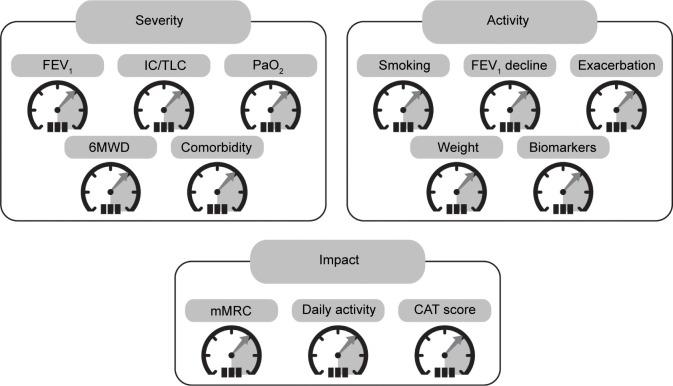
COPD is now widely recognized as a complex heterogeneous syndrome, having both pulmonary and extrapulmonary features. In clinical practice, the diagnosis of COPD is based on the presence of chronic airflow limitation, as assessed by post-bronchodilator spirometry. The severity of the airflow limitation, as measured by percent predicted FEV1, provides important information to the physician to enable optimization of management. However, in order to accurately assess the complexity of COPD, there need to be other measures made beyond FEV1. At present, there is a lack of reliable and simple blood biomarkers to confirm and further assess the diagnosis of COPD. However, it is possible to identify patients who display different phenotypic characteristics of COPD that relate to clinically relevant outcomes. Currently, validated phenotypes of COPD include alpha-1 antitrypsin deficiency, and "frequent exacerbators". Recently, a definition and assessment of a new phenotype comprising patients with overlapping features of asthma and COPD has been suggested and is known as "asthma COPD overlap syndrome". Several other phenotypes have been proposed, but require validation against clinical outcomes. Defining phenotypes requires the assessment of multiple factors indicating disease severity, its impact, and its activity. Recognition and validation of COPD phenotypes has an important role to play in the selection of evidence-based targeted therapy in the future management of COPD, but regardless of the diagnostic terms, patients with COPD should be assessed and treated according to their individual treatable characteristics.
慢性阻塞性肺疾病(COPD)现在已被广泛认为是一种复杂的异质性综合征,具有肺部和肺外特征。在临床实践中,COPD的诊断基于支气管扩张剂后肺功能测定评估的慢性气流受限的存在。通过预测FEV1百分比测量的气流受限严重程度,为医生提供重要信息,以优化治疗管理。然而,为了准确评估COPD的复杂性,除了FEV1之外还需要采取其他措施。目前,缺乏可靠且简单的血液生物标志物来确认和进一步评估COPD的诊断。然而,有可能识别出表现出与临床相关结局相关的不同COPD表型特征的患者。目前,已得到验证的COPD表型包括α-1抗胰蛋白酶缺乏症和“频繁急性加重者”。最近,有人提出了一种新表型的定义和评估,该表型包括具有哮喘和COPD重叠特征的患者,被称为“哮喘-COPD重叠综合征”。还提出了其他几种表型,但需要根据临床结局进行验证。定义表型需要评估表明疾病严重程度、其影响及其活动的多个因素。COPD表型的识别和验证在未来COPD管理中基于证据的靶向治疗选择中具有重要作用,但无论诊断术语如何,COPD患者都应根据其个体可治疗特征进行评估和治疗。

 Zotero 插件