
硼霉素可杀死结核分枝杆菌持留菌且未检测到耐药性。
Boromycin Kills Mycobacterial Persisters without Detectable Resistance.
作者信息
Moreira Wilfried, Aziz Dinah B, Dick Thomas
机构信息
Antibacterial Drug Discovery Laboratory, Department of Microbiology and Immunology, Yong Loo Lin School of Medicine, National University of Singapore Singapore, Singapore.
出版信息
Front Microbiol. 2016 Feb 22;7:199. doi: 10.3389/fmicb.2016.00199. eCollection 2016.
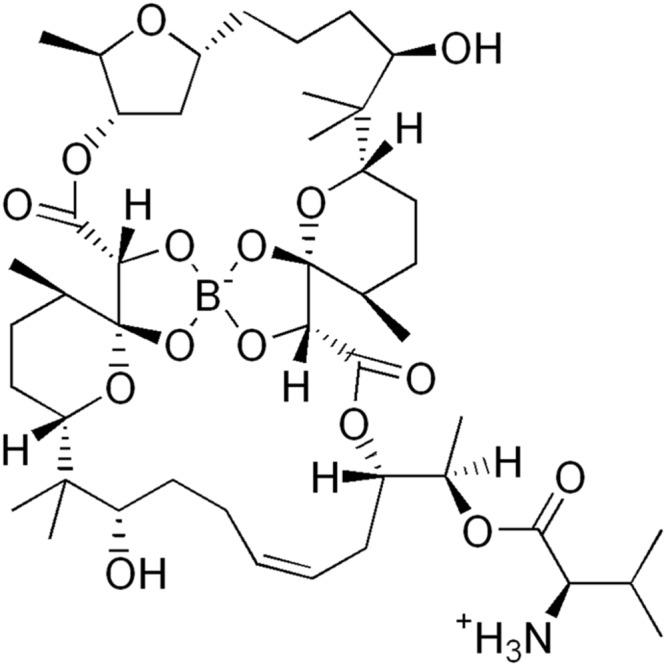
Boromycin is a boron-containing polyether macrolide antibiotic isolated from Streptomyces antibioticus. It was shown to be active against Gram positive bacteria and to act as an ionophore for potassium ions. The antibiotic is ineffective against Gram negative bacteria where the outer membrane appears to block access of the molecule to the cytoplasmic membrane. Here we asked whether boromycin is active against Mycobacterium tuberculosis which, similar to Gram negative bacteria, possesses an outer membrane. The results show that boromycin is a potent inhibitor of mycobacterial growth (MIC50 = 80 nM) with strong bactericidal activity against growing and non-growing drug tolerant persister bacilli. Exposure to boromycin resulted in a rapid loss of membrane potential, reduction of the intracellular ATP level and leakage of cytoplasmic protein. Consistent with boromycin acting as a potassium ionophore, addition of KCl to the medium blocked its antimycobacterial activity. In contrast to the potent antimycobacterial activities of the polyether macrolide, its cytotoxicity and haemolytic activity were low (CC50 = 30 μM, HC50 = 40 μM) with a selectivity index of more than 300. Spontaneous resistant mutants could not be isolated suggesting a mutation frequency of less than 10(-9)/CFU. Taken together, the results suggests that targeting mycobacterial transmembrane ion gradients may be an attractive chemotherapeutic intervention level to kill otherwise drug tolerant persister bacilli, and to slow down the development of genetic antibiotic resistance.
硼霉素是一种从抗生链霉菌中分离出的含硼聚醚大环内酯类抗生素。它对革兰氏阳性菌具有活性,并可作为钾离子载体。该抗生素对革兰氏阴性菌无效,因为其外膜似乎会阻碍该分子进入细胞质膜。在此,我们探究硼霉素对结核分枝杆菌是否有活性,结核分枝杆菌与革兰氏阴性菌类似,也具有外膜。结果表明,硼霉素是一种强效的分枝杆菌生长抑制剂(MIC50 = 80 nM),对生长中的和非生长状态的耐药物持留菌具有强大的杀菌活性。接触硼霉素会导致膜电位迅速丧失、细胞内ATP水平降低以及细胞质蛋白泄漏。与硼霉素作为钾离子载体的作用一致,向培养基中添加氯化钾可阻断其抗分枝杆菌活性。与聚醚大环内酯强大的抗分枝杆菌活性形成对比的是,其细胞毒性和溶血活性较低(CC50 = 30 μM,HC50 = 40 μM),选择性指数超过300。无法分离出自发抗性突变体,这表明突变频率低于10(-9)/CFU。综上所述,结果表明针对分枝杆菌跨膜离子梯度可能是一种有吸引力的化疗干预水平,以杀死其他耐药物持留菌,并减缓遗传抗生素抗性的发展。

 Zotero 插件