
营养物质、小胶质细胞衰老与脑衰老
Nutrients, Microglia Aging, and Brain Aging.
作者信息
Wu Zhou, Yu Janchun, Zhu Aiqin, Nakanishi Hiroshi
机构信息
Department of Aging Science and Pharmacology, Faculty of Dental Science, Kyushu University, Fukuoka 812-8582, Japan.
Department of General Surgery, Peking Union Medical College Hospital, Chinese Academy of Medical Sciences, Beijing 100730, China.
出版信息
Oxid Med Cell Longev. 2016;2016:7498528. doi: 10.1155/2016/7498528. Epub 2016 Jan 31.
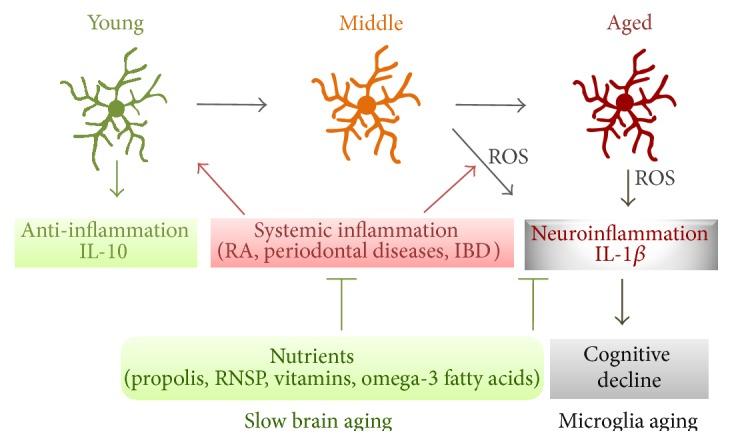
As the life expectancy continues to increase, the cognitive decline associated with Alzheimer's disease (AD) becomes a big major issue in the world. After cellular activation upon systemic inflammation, microglia, the resident immune cells in the brain, start to release proinflammatory mediators to trigger neuroinflammation. We have found that chronic systemic inflammatory challenges induce differential age-dependent microglial responses, which are in line with the impairment of learning and memory, even in middle-aged animals. We thus raise the concept of "microglia aging." This concept is based on the fact that microglia are the key contributor to the acceleration of cognitive decline, which is the major sign of brain aging. On the other hand, inflammation induces oxidative stress and DNA damage, which leads to the overproduction of reactive oxygen species by the numerous types of cells, including macrophages and microglia. Oxidative stress-damaged cells successively produce larger amounts of inflammatory mediators to promote microglia aging. Nutrients are necessary for maintaining general health, including the health of brain. The intake of antioxidant nutrients reduces both systemic inflammation and neuroinflammation and thus reduces cognitive decline during aging. We herein review our microglia aging concept and discuss systemic inflammation and microglia aging. We propose that a nutritional approach to controlling microglia aging will open a new window for healthy brain aging.
随着预期寿命不断延长,与阿尔茨海默病(AD)相关的认知衰退成为全球的一个重大问题。在全身炎症引发细胞活化后,大脑中的常驻免疫细胞小胶质细胞开始释放促炎介质,从而引发神经炎症。我们发现,慢性全身炎症刺激会引发不同的年龄依赖性小胶质细胞反应,即使在中年动物中,这种反应也与学习和记忆障碍有关。因此,我们提出了“小胶质细胞衰老”这一概念。这一概念基于这样一个事实,即小胶质细胞是认知衰退加速的关键因素,而认知衰退是大脑衰老的主要标志。另一方面,炎症会诱导氧化应激和DNA损伤,导致包括巨噬细胞和小胶质细胞在内的多种细胞产生过量的活性氧。氧化应激损伤的细胞会相继产生大量炎症介质,从而促进小胶质细胞衰老。营养物质对于维持包括大脑健康在内的整体健康是必要的。摄入抗氧化营养物质可减轻全身炎症和神经炎症,从而减少衰老过程中的认知衰退。我们在此回顾我们的小胶质细胞衰老概念,并讨论全身炎症和小胶质细胞衰老。我们提出,通过营养方法控制小胶质细胞衰老将为健康的大脑衰老打开一扇新窗口。
 Zotero 插件