
COX-2 根据胶原蛋白密度调节乳腺肿瘤进展。
COX-2 modulates mammary tumor progression in response to collagen density.
作者信息
Esbona Karla, Inman David, Saha Sandeep, Jeffery Justin, Schedin Pepper, Wilke Lee, Keely Patricia
机构信息
Department of Cell and Regenerative Biology, University of Wisconsin-Madison, Madison, WI, USA.
Institute for Clinical and Translational Research (ICTR), University of Wisconsin-Madison, Madison, WI, USA.
出版信息
Breast Cancer Res. 2016 Mar 22;18(1):35. doi: 10.1186/s13058-016-0695-3.
BACKGROUND
High breast density is linked to an increased risk of breast cancer, and correlates with changes in collagen. In a mouse model of mammary carcinoma in the context of increased collagen deposition, the MMTV-PyMT/Col1a1 (tm1jae) , there is accelerated mammary tumor formation and progression. Previous gene expression analysis suggests that increased collagen density elevates expression of PTGS2 (prostaglandin-endoperoxide synthase 2), the gene for cyclooxygenase-2 (COX-2).
METHODS
To understand the role of COX-2 in tumor progression within a collagen-dense microenvironment, we treated MMTV-PyMT or MMTV-PyMT/Col1a1 (tm1jae) tumors prior to and after tumor formation. Animals received treatment with celecoxib, a specific COX-2 inhibitor, or placebo. Mammary tumors were examined for COX-2, inflammatory and stromal cell components, and collagen deposition through immunohistochemical analysis, immunofluorescence, multiplex cytokine ELISA and tissue imaging techniques.
RESULTS
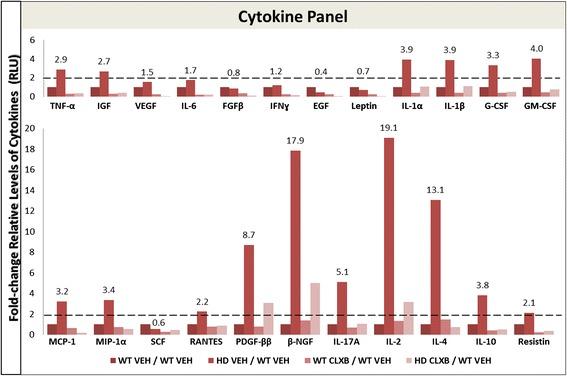
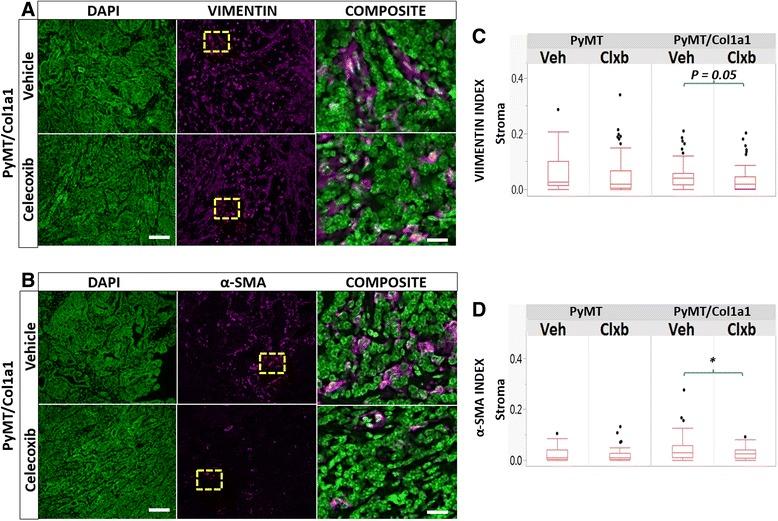
PyMT/Col1a1 (tm1jae) tumors were larger, more proliferative, and expressed higher levels of COX-2 and PGE2 than PyMT tumors in wild type (WT) mice. Treatment with celecoxib significantly decreased the induced tumor size and metastasis of the PyMT/Col1a1 tumors, such that their size was not different from the smaller PyMT tumors. Celecoxib had minimal effect on the PyMT tumors. Celecoxib decreased expression levels of COX-2, PGE2, and Ki-67. Several cytokines were over-expressed in PyMT/Col1a1 compared to PyMT, and celecoxib treatment prevented their over-expression. Furthermore, macrophage and neutrophil recruitment were enhanced in PyMT/Col1a1 tumors, and this effect was inhibited by celecoxib. Notably, COX-2 inhibition reduced overall collagen deposition. Finally, when celecoxib was used prior to tumor formation, PyMT/Col1a1 tumors were fewer and smaller than in untreated animals.
CONCLUSION
These findings suggest that COX-2 has a direct role in modulating tumor progression in tumors arising within collagen-dense microenvironments, and suggest that COX-2 may be an effective therapeutic target for women with dense breast tissue and early-stage breast cancer.
背景
乳腺组织密度高与乳腺癌风险增加相关,且与胶原蛋白变化有关。在胶原蛋白沉积增加的小鼠乳腺癌模型MMTV-PyMT/Col1a1(tm1jae)中,乳腺肿瘤形成和进展加速。先前的基因表达分析表明,胶原蛋白密度增加会提高PTGS2(前列腺素内过氧化物合酶2)的表达,该基因即环氧化酶-2(COX-2)。
方法
为了解COX-2在胶原蛋白密集微环境中肿瘤进展中的作用,我们在肿瘤形成前后对MMTV-PyMT或MMTV-PyMT/Col1a1(tm1jae)肿瘤进行了处理。动物接受塞来昔布(一种特异性COX-2抑制剂)或安慰剂治疗。通过免疫组织化学分析、免疫荧光、多重细胞因子ELISA和组织成像技术,对乳腺肿瘤的COX-2、炎症和基质细胞成分以及胶原蛋白沉积进行检测。
结果
在野生型(WT)小鼠中,PyMT/Col1a1(tm1jae)肿瘤比PyMT肿瘤更大、增殖性更强,且COX-2和PGE2表达水平更高。塞来昔布治疗显著减小了PyMT/Col1a肿瘤的诱导肿瘤大小并降低了其转移率,使其大小与较小的PyMT肿瘤无异。塞来昔布对PyMT肿瘤影响极小。塞来昔布降低了COX-2、PGE2和Ki-67的表达水平。与PyMT相比,几种细胞因子在PyMT/Col1a1中过表达,而塞来昔布治疗可防止其过表达。此外,PyMT/Col1a1肿瘤中巨噬细胞和中性粒细胞的募集增强,而这种作用被塞来昔布抑制。值得注意的是,COX-2抑制减少了总体胶原蛋白沉积。最后,在肿瘤形成前使用塞来昔布时,PyMT/Col1a1肿瘤比未治疗动物中的更少、更小。
结论
这些发现表明,COX-2在调节胶原蛋白密集微环境中产生的肿瘤的进展中具有直接作用,并表明COX-2可能是乳腺组织致密和早期乳腺癌女性的有效治疗靶点。





 Zotero 插件