
靶向尤因肉瘤中的表观遗传阅读器可抑制致癌转录因子EWS/Fli1。
Targeting the epigenetic readers in Ewing sarcoma inhibits the oncogenic transcription factor EWS/Fli1.
作者信息
Jacques Camille, Lamoureux François, Baud'huin Marc, Rodriguez Calleja Lidia, Quillard Thibaut, Amiaud Jérôme, Tirode Franck, Rédini Françoise, Bradner James E, Heymann Dominique, Ory Benjamin
机构信息
INSERM, UMR 957, Équipe Labellisée Ligue 2012, Nantes, France.
Physiopathologie de la Résorption Osseuse et Thérapie des Tumeurs Osseuses Primitives, Université de Nantes, Nantes Atlantique Universités, EA3822, Nantes, France.
出版信息
Oncotarget. 2016 Apr 26;7(17):24125-40. doi: 10.18632/oncotarget.8214.
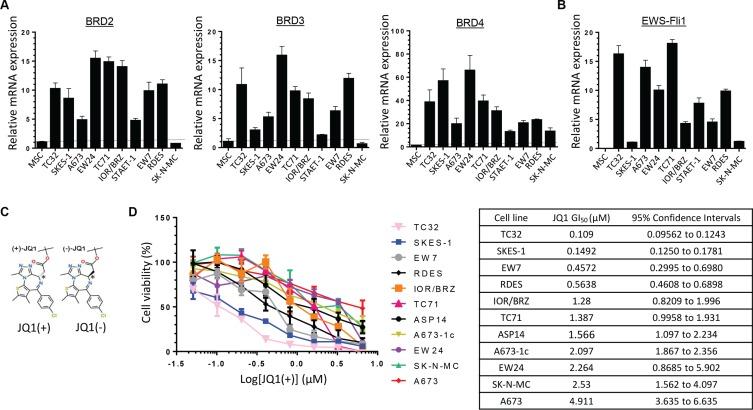
Ewing Sarcoma is a rare bone and soft tissue malignancy affecting children and young adults. Chromosomal translocations in this cancer produce fusion oncogenes as characteristic molecular signatures of the disease. The most common case is the translocation t (11; 22) (q24;q12) which yields the EWS-Fli1 chimeric transcription factor. Finding a way to directly target EWS-Fli1 remains a central therapeutic approach to eradicate this aggressive cancer. Here we demonstrate that treating Ewing Sarcoma cells with JQ1(+), a BET bromodomain inhibitor, represses directly EWS-Fli1 transcription as well as its transcriptional program. Moreover, the Chromatin Immuno Precipitation experiments demonstrate for the first time that these results are a consequence of the depletion of BRD4, one of the BET bromodomains protein from the EWS-Fli1 promoter. In vitro, JQ1(+) treatment reduces the cell viability, impairs the cell clonogenic and the migratory abilities, and induces a G1-phase blockage as well as a time- and a dose-dependent apoptosis. Furthermore, in our in vivo model, we observed a tumor burden delay, an inhibition of the global vascularization and an increase of the mice overall survival. Taken together, our data indicate that inhibiting the BET bromodomains interferes with EWS-FLi1 transcription and could be a promising strategy in the Ewing tumors context.
尤因肉瘤是一种罕见的骨骼和软组织恶性肿瘤,影响儿童和年轻成年人。这种癌症中的染色体易位产生融合致癌基因,作为该疾病的特征性分子标志。最常见的情况是t(11;22)(q24;q12)易位,产生EWS-Fli1嵌合转录因子。找到直接靶向EWS-Fli1的方法仍然是根除这种侵袭性癌症的核心治疗方法。在此,我们证明用BET溴结构域抑制剂JQ1(+)处理尤因肉瘤细胞,可直接抑制EWS-Fli1转录及其转录程序。此外,染色质免疫沉淀实验首次证明,这些结果是由于EWS-Fli1启动子中BET溴结构域蛋白之一BRD4的缺失所致。在体外,JQ1(+)处理降低细胞活力,损害细胞克隆形成和迁移能力,并诱导G1期阻滞以及时间和剂量依赖性凋亡。此外,在我们的体内模型中,我们观察到肿瘤负荷延迟、整体血管生成抑制以及小鼠总体生存期延长。综上所述,我们的数据表明,抑制BET溴结构域会干扰EWS-FLi1转录,在尤因肿瘤背景下可能是一种有前景的策略。



 Zotero 插件