
生存运动神经元基因的拷贝数变异:对脊髓性肌萎缩症和其他神经退行性疾病的影响。
Copy Number Variations in the Survival Motor Neuron Genes: Implications for Spinal Muscular Atrophy and Other Neurodegenerative Diseases.
机构信息
Center for Applied Clinical Genomics, Nemours Biomedical Research, Nemours Alfred I. duPont Hospital for ChildrenWilmington, DE, USA; Center for Pediatric Research, Nemours Biomedical Research, Nemours Alfred I. duPont Hospital for ChildrenWilmington, DE, USA; Department of Biological Sciences, University of DelawareNewark, DE, USA; Department of Pediatrics, Thomas Jefferson UniversityPhiladelphia, PA, USA.
出版信息
Front Mol Biosci. 2016 Mar 10;3:7. doi: 10.3389/fmolb.2016.00007. eCollection 2016.
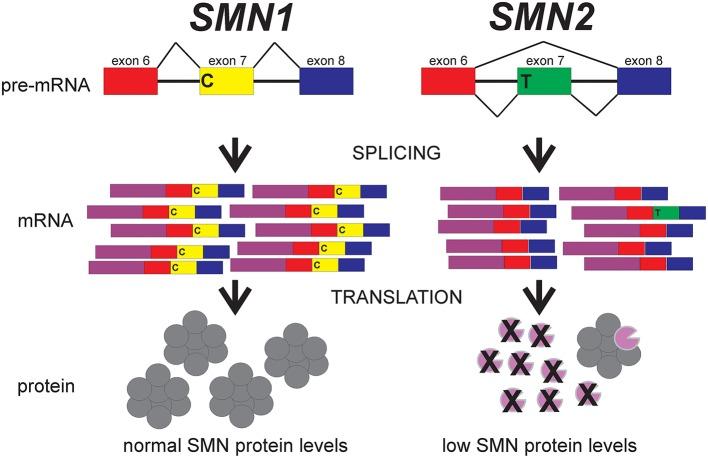
Proximal spinal muscular atrophy (SMA), a leading genetic cause of infant death worldwide, is an early-onset, autosomal recessive neurodegenerative disease characterized by the loss of spinal α-motor neurons. This loss of α-motor neurons is associated with muscle weakness and atrophy. SMA can be classified into five clinical grades based on age of onset and severity of the disease. Regardless of clinical grade, proximal SMA results from the loss or mutation of SMN1 (survival motor neuron 1) on chromosome 5q13. In humans a large tandem chromosomal duplication has lead to a second copy of the SMN gene locus known as SMN2. SMN2 is distinguishable from SMN1 by a single nucleotide difference that disrupts an exonic splice enhancer in exon 7. As a result, most of SMN2 mRNAs lack exon 7 (SMNΔ7) and produce a protein that is both unstable and less than fully functional. Although only 10-20% of the SMN2 gene product is fully functional, increased genomic copies of SMN2 inversely correlates with disease severity among individuals with SMA. Because SMN2 copy number influences disease severity in SMA, there is prognostic value in accurate measurement of SMN2 copy number from patients being evaluated for SMA. This prognostic value is especially important given that SMN2 copy number is now being used as an inclusion criterion for SMA clinical trials. In addition to SMA, copy number variations (CNVs) in the SMN genes can affect the clinical severity of other neurological disorders including amyotrophic lateral sclerosis (ALS) and progressive muscular atrophy (PMA). This review will discuss how SMN1 and SMN2 CNVs are detected and why accurate measurement of SMN1 and SMN2 copy numbers is relevant for SMA and other neurodegenerative diseases.
脊髓性肌萎缩症(SMA)是全球导致婴儿死亡的主要遗传病因,是一种早发性、常染色体隐性神经退行性疾病,其特征是脊髓α运动神经元的丧失。这种α运动神经元的丧失与肌肉无力和萎缩有关。根据发病年龄和疾病严重程度,SMA 可分为五个临床等级。无论临床等级如何,近端 SMA 都是由于 5q13 染色体上 SMN1(运动神经元生存 1)的缺失或突变引起的。在人类中,一个大型串联染色体重复导致了第二个 SMN 基因座的拷贝,称为 SMN2。SMN2 与 SMN1 不同,因为一个核苷酸差异破坏了外显子 7 中的外显子剪接增强子。结果,大多数 SMN2 mRNAs 缺乏外显子 7(SMNΔ7),并产生一种不稳定且功能不足的蛋白质。尽管 SMN2 基因产物只有 10-20%是完全功能性的,但 SMN2 的基因组拷贝数增加与 SMA 患者的疾病严重程度呈反比。由于 SMN2 拷贝数会影响 SMA 的疾病严重程度,因此准确测量 SMA 患者的 SMN2 拷贝数具有预后价值。鉴于 SMN2 拷贝数现在被用作 SMA 临床试验的纳入标准,这种预后价值尤为重要。除了 SMA 之外,SMN 基因的拷贝数变异(CNVs)也会影响其他神经退行性疾病的临床严重程度,包括肌萎缩侧索硬化症(ALS)和进行性肌肉萎缩症(PMA)。这篇综述将讨论如何检测 SMN1 和 SMN2 CNVs,以及为什么准确测量 SMN1 和 SMN2 拷贝数与 SMA 和其他神经退行性疾病相关。

 Zotero 插件